**STAKE BANK ON TRIAL: THE LAW, THE LAND, AND THE LINE BELIZE CANNOT AFFORD TO CROSS**
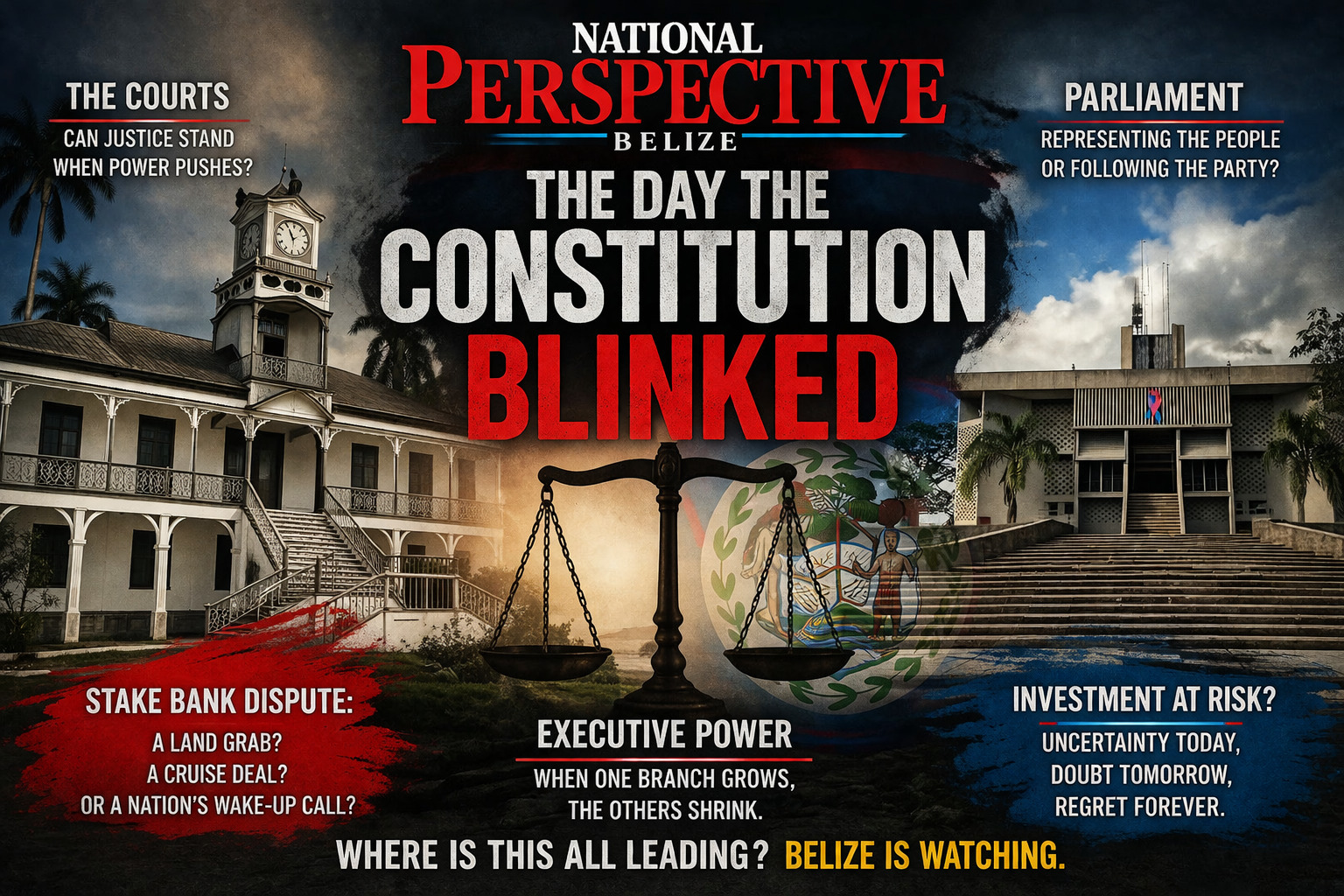
A Nation Confronts the Collision Between Constitutional Protection and State Power
By Omar Silva | Editor/Publisher
National Perspective Belize – Digital 2026
Belize City: Wednesday 29th April 2026
📰 HEADLINE FEATURE
🔎 THE MOMENT THAT DEMANDS CLARITY
Belize now stands at a defining crossroads—not merely over a parcel of land, but over the very integrity of its Constitution, its courts, and its credibility as an investment destination.
The recent ruling by the Court of Appeal, applying the doctrine from Ladd v Marshall, has denied businessman Michael Feinstein the ability to introduce new evidence and compel state disclosure in the ongoing Stake Bank dispute.
But let us be clear from the outset:
👉 This was not the final judgment.
👉 This was not a ruling on constitutionality.
Yet, what it revealed—between the lines—is far more consequential.
Because behind the legal restraint lies a deeper national question:
Is Belize’s legal system equipped—and willing—to fully scrutinize the State when power, politics, and private interests converge?
⚖️ THE LEGAL FRAMEWORK: WHAT THE COURT SAYS VS. WHAT BELIZE NEEDS
At the core of this matter lies Section 17 of the Belize Constitution, which guarantees protection from the arbitrary deprivation of property.
The law is clear:
✔️ Property may only be acquired for a genuine public purpose
✔️ It must follow due process
✔️ It must provide adequate compensation
THE COURT’S POSITION (STRICTLY LEGAL)
The Court of Appeal ruled:
- Feinstein failed to exercise reasonable diligence in obtaining the evidence earlier
- The new report would not have changed the outcome
- The request for Cabinet and internal documents was denied
From a purely legal standpoint, the Court followed established doctrine.
But law, when stripped of context, can become dangerously incomplete.
⚠️ THE FIRST CRACK: WHEN “DILIGENCE” MEETS STATE SECRECY
The Court’s reasoning rests heavily on one assumption:
That the applicant had a fair opportunity to obtain the evidence.
But Belizeans must ask:
👉 How does one obtain documents that are locked within Cabinet?
👉 How does one prove the State’s motive when the State controls the evidence?
This is not a theoretical dilemma.
It is the practical reality of governance in Belize.
THE UNCOMFORTABLE TRUTH
When the State:
- Holds the documents
- Controls access
- Refuses disclosure
And the Court then says:
“You should have obtained it earlier”
👉 The legal system risks creating an impossible standard.
🔐 THE SECOND CRACK: CABINET SECRECY VS. CONSTITUTIONAL SCRUTINY
The Court’s refusal to compel disclosure may be doctrinally sound.
But its implications are profound.
Because the central issue in the Stake Bank case is this:
Was the land acquired for a true public purpose—or for a concealed private objective?
And where would that truth be found?
- Cabinet deliberations
- Ministry reports
- Internal communications
⚖️ THE DANGEROUS IMBALANCE
If:
- The Constitution demands proof of public purpose
But:
- The evidence is shielded behind executive privilege
Then:
The constitutional protection becomes difficult—if not impossible—to enforce.
🧭 THE REAL CASE: STILL TO BE DECIDED
Despite the headlines, the most critical questions remain unanswered:
1. WAS THIS A TRUE PUBLIC PURPOSE?
Or was the acquisition:
- A mechanism to restructure a commercial dispute?
- A pathway to facilitate third-party interests?
- A strategic intervention linked to entities such as OPSA or major cruise investors?
2. WAS THERE POLITICAL INTERFERENCE?
Belizeans must now confront the uncomfortable possibility:
👉 That State power may have been deployed not neutrally—but strategically.
3. WAS DUE PROCESS FULLY OBSERVED?
- Was there full transparency?
- Was valuation independent?
- Were all stakeholders treated fairly?
🌎 THE INTERNATIONAL DIMENSION: A MESSAGE BEYOND BELIZE
This case is no longer domestic.
It is being watched—quietly but closely—by:
- International investors
- Financial institutions
- Regional partners
WHAT THEY SEE
Not just one ruling.
But a pattern:
- Compulsory acquisition of a major private project
- Limited transparency
- Judicial restraint on disclosure
- Procedural barriers to evidence
WHAT THEY MAY CONCLUDE
That Belize presents elevated sovereign risk
Not because of instability—
But because of uncertainty in legal recourse.
⚠️ THE PRECEDENT: SUBTLE, BUT POWERFUL
This ruling does not seize land.
But it does something equally significant:
1. IT NARROWS ACCESS TO EVIDENCE
Future litigants may find:
- Critical documents out of reach
- New evidence barred at appeal
2. IT STRENGTHENS EXECUTIVE INSULATION
Cabinet decisions become:
- Harder to challenge
- Harder to scrutinize
3. IT SHIFTS THE BALANCE OF POWER
From:
- Citizen vs. State
To:
- Citizen against a shielded State
🔥 THE HARD QUESTION BELIZE MUST FACE
This is no longer about Feinstein.
This is about Belize.
WHAT KIND OF COUNTRY ARE WE BUILDING?
One where:
✔️ The Constitution is actively enforced
✔️ The courts interrogate power without fear
✔️ Investors operate with confidence
Or one where:
❗ State action is difficult to challenge
❗ Transparency is limited
❗ Legal processes become barriers rather than safeguards
🧠 THE TRUTH, WITHOUT FILTER
Let us separate fact from rhetoric:
THE COURT DID NOT BREAK THE LAW
It applied:
- Established appellate rules
- Recognized legal doctrine
BUT THE SYSTEM MAY BE FAILING THE SPIRIT OF THE LAW
Because when:
- Rules are rigid
- Information is controlled
- Power is concentrated
👉 Justice can become procedurally correct—but substantively incomplete
🗣️ A CALL FOR NATIONAL AWARENESS
Belizeans must not look away.
This case is a mirror.
TO THE BUSINESS COMMUNITY
Demand clarity. Demand certainty. Demand protection under the law.
TO CIVIL SOCIETY
This is a test of constitutional strength—not a private dispute.
TO THE JUDICIARY
The upcoming substantive ruling must do more than apply law.
It must:
Restore confidence that the Constitution still stands above power.
🧾 FINAL WORD: THE CASE THAT WILL DEFINE THE NEXT DECADE
The final appeal is still pending.
And when it comes, it will answer a question far greater than land ownership:
Can the Belizean State acquire property in the name of the public—without fully proving that the public is truly the beneficiary?
If that question is not answered clearly—
Then this will not just be a case.
It will be a turning point.
- Log in to post comments