“When Delay Becomes Danger: Indian Creek and the Cost of Constitutional Inaction”
By: Omar Silva I Editor/Publisher
National Perspective Belize – Digital 2026
Belize City Wednesday 15th April 2026
📰 NATIONAL PERSPECTIVE BELIZE – SPECIAL FEATURE
I. A DISAPPEARANCE THAT EXPOSES A DEEPER FAILURE
The disappearance of Alcalde Marcus Canti is a human tragedy in motion.
But it is also something more unsettling:
A moment where unresolved law has crossed into lived consequence.
A village divided.
A leader missing.
A community searching in fear.
And beneath it all—a legal framework left incomplete.
⚖️ II. THE LAW THAT SHOULD HAVE PREVENTED THIS
The obligations of the State are not unclear.
They are rooted in the binding authority of the
Caribbean Court of Justice,
and grounded in the Constitution of Belize.
The CCJ did not merely recognize Maya land rights—it imposed clear duties:
- Recognition of communal land tenure
- Protection from interference
- Demarcation of those lands
- A framework for governance and coexistence
🔑 THE CRITICAL LEGAL GAP
That framework remains unfinished.
And in that unfinished space:
- Competing claims persist
- Authority is contested
- Communities are left to interpret rights on their own
👉 This is not conjecture.
👉 This is the direct consequence of incomplete implementation.
🔥 III. CAN INACTION BECOME CAUSE?
Public questioning goes to the heart of constitutional accountability:
Can the failure of the State to act become a contributing cause to conflict?
Legally—yes.
Not in the sense of assigning criminal guilt.
But in the sense of creating conditions that foreseeably lead to conflict.
⚖️ THE DOCTRINE OF STATE RESPONSIBILITY
Where a State:
- Is aware of a legal obligation
- Is aware of ongoing tension
- Fails to implement corrective measures
It may be said to have:
Contributed to an environment of foreseeable harm
🔍 APPLYING THIS TO INDIAN CREEK
The record shows:
- Years of reported conflict
- Repeated notifications to authorities
- Escalating division within the community
- Delays in demarcation and legal clarity
And now—
- A missing Alcalde
- A volatile and divided village
- Threats and fear spreading beyond one community
⚖️ IV. THE LAND ISSUE: WHERE LAW WAS LEFT UNRESOLVED
At the core lies a legally unresolved contradiction:
🟢 Customary Rights (recognized by the CCJ)
vs
🔵 Existing Titles, Transfers, and Conservation Interests
⚠️ THE 2015 CONSENT ORDER ISSUE
If, as alleged:
- Land transfers occurred after the CCJ ruling
- Without full resolution of customary claims
Then serious legal questions arise:
Were those actions consistent with the Court’s directive to “cease and desist” from acts affecting those lands?
👉 That question is not political.
👉 It is judicially testable.
🔥 V. THE BREAKDOWN OF AUTHORITY
What we are now witnessing is not simply dispute—it is authority fragmentation.
In Indian Creek:
- The Alcalde system asserts customary legitimacy
- The Village Council asserts statutory legitimacy
The State asserts administrative control
But no single, harmonized framework governs all three.
🔑 RESULT:
👉 Competing authority becomes competing action
👉 Competing action becomes confrontation
And in this case—possibly something far worse
🧭 VI. THE HUMAN CONSEQUENCE OF LEGAL DELAY
This is where the narrative must remain disciplined—but honest.
No one can yet determine:
- What happened to Marcus Canti
- Who may be responsible
But what can be stated is this:
The environment in which this occurred did not emerge overnight.
It developed over:
- Years of unresolved claims
- Years of legal uncertainty
- Years of delayed implementation
⚖️ VII. THE STATE’S POSITION—AND ITS LIMITS
The Minister has stated:
- That only the Ministry of Natural Resources can issue land titles
- That the Alcalde was asked to cease issuing certificates
This reflects statutory law.
⚠️ BUT THE CONSTITUTIONAL QUESTION REMAINS:
If customary land rights exist—
👉 What legal framework exists for their exercise?
👉 Who governs their allocation in the absence of demarcation?
🔥 THE VOID:
When the State:
- Has not completed the legal framework
- But restricts local exercise of customary practices
It creates:
A vacuum of authority
And in that vacuum—
👉 Individuals act
👉 Communities divide
👉 Conflict escalates
🧠 VIII. THE LARGER NATIONAL WARNING
Indian Creek is not isolated.
It is a signal.
A warning of what happens when:
- Constitutional rulings are delayed in implementation
- Legal systems are allowed to overlap without clarity
- Communities are left to navigate unresolved law
⚖️ IX. FINAL LEGAL POSITION
Let us remain grounded:
- The State has binding obligations under the Constitution
- The CCJ ruling requires active implementation
- Delay does not suspend those obligations
🔥 THE CENTRAL TRUTH
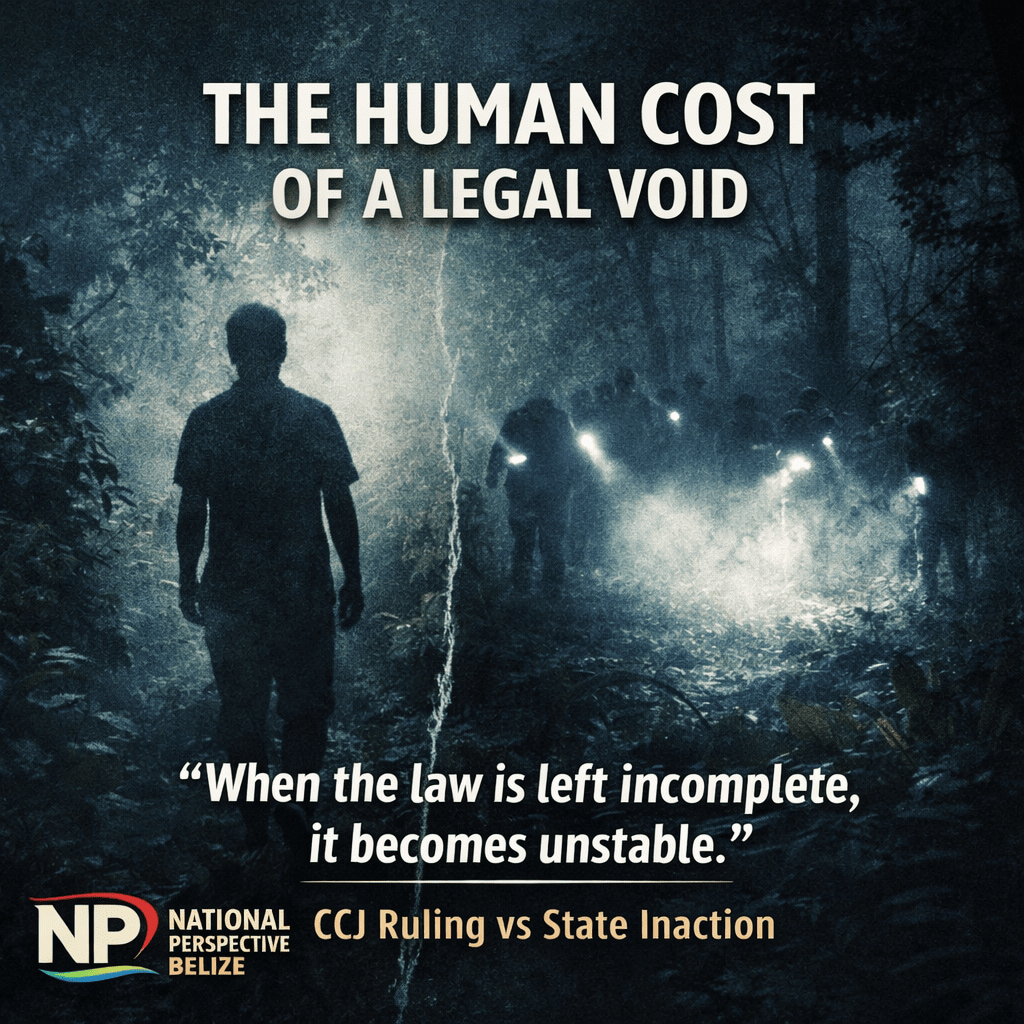
When the law is left incomplete, it does not remain neutral—it becomes unstable.
And instability, left unmanaged, becomes risk.
🕯️ X. CONCLUSION: A MOMENT OF ACCOUNTABILITY
At this hour, a community searches for its leader.
That must remain the priority.
But as the nation watches, it must also confront a broader question:
How long can a constitutional obligation remain unfulfilled before its consequences become unavoidable?
Ed Note: Sketchy information have surfaced that Alcalde Marcus Canti has been found, details to follow.
- Log in to post comments