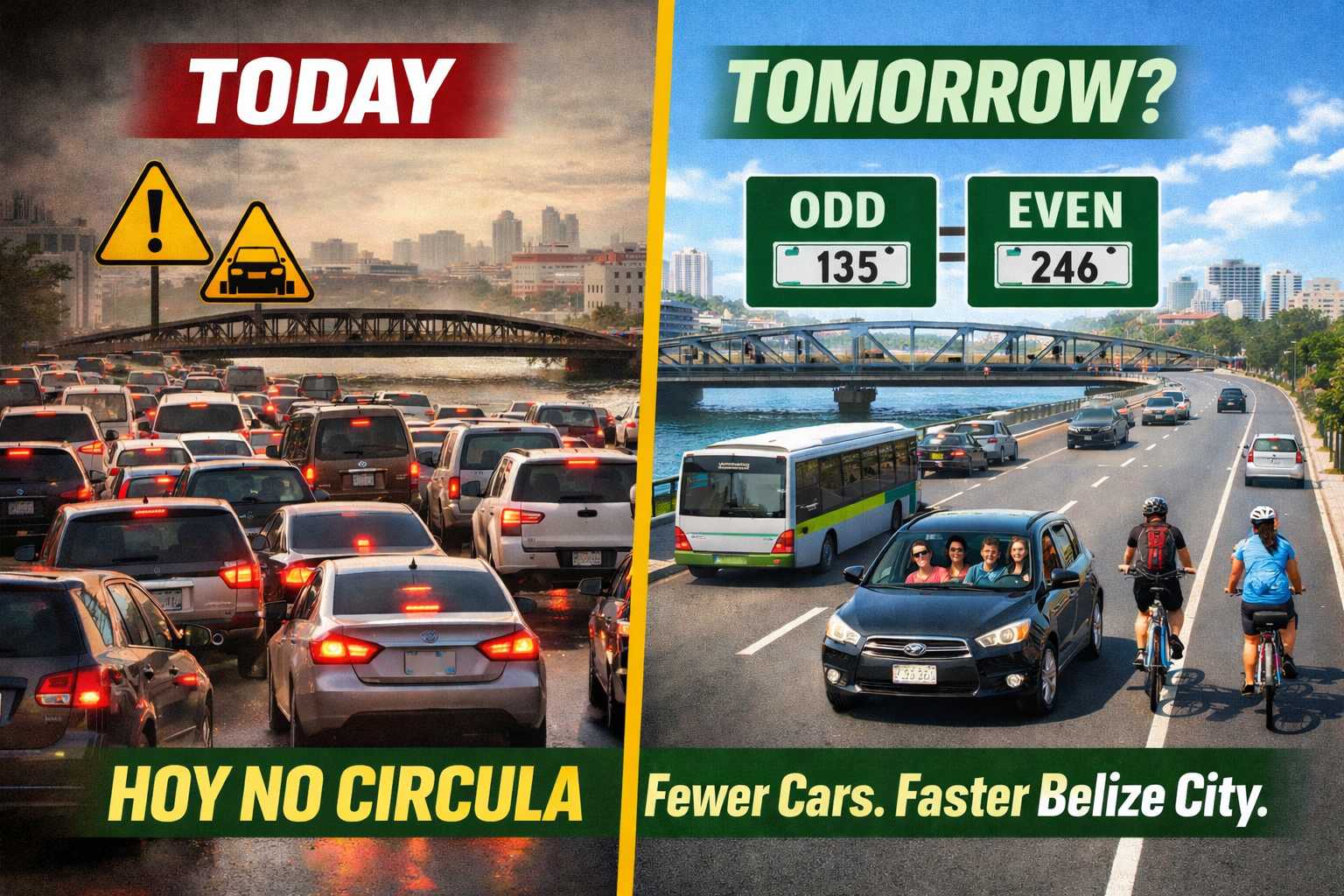
HOY NO CIRCULA!!! Fewer Cars. Faster Belize City.
By: Omar Silva, Editor/Publisher
National Perspective Belize
Belize City Thursday, 5th March 2026
FEATURE ARTICLE
Each working morning thousands of vehicles pour into Belize City from the northern, western, and southern districts. The result is a daily ritual familiar to every commuter: narrow streets choked with vehicles, bridges reduced to bottlenecks, and traffic delays that turn a ten-mile journey into a thirty-minute crawl.
Belize City’s traffic congestion is no longer a temporary inconvenience. It is rapidly becoming a structural crisis for the nation’s economic hub.
The situation is compounded by the city’s limited transport infrastructure. Four principal crossings carry the burden of daily traffic movement across the Haulover Creek:
• the historic Swing Bridge
• the Bel China Bridge
• the Belcan Bridge
• the Chetumal Bridge
Alongside these, the John Smith Road links the Philip Goldson Highway and the George Price Highway, serving as a daily corridor for commuters entering the city.
At the same time, large portions of Belize City’s streets have effectively been converted into exclusive parking zones for businesses, banks, schools, and commercial establishments under policies implemented by the Belize City Council.
The result is predictable: fewer available traffic lanes and an already fragile road network pushed beyond its capacity.
Now, with the government announcing major infrastructure works—including the replacement of the Belcan Bridge and the Swing Bridge—the risk of severe traffic paralysis is becoming very real.
The question therefore becomes unavoidable:
Is Belize prepared with a traffic management strategy capable of handling the coming disruption?
A Proven Solution from Mexico
In the early 2000s, Mexican cities faced a similar crisis of traffic congestion and environmental pollution. The federal government responded with a policy that became widely known as:
Hoy No Circula.
The concept was simple but effective.
Vehicles were allowed to circulate on alternate days depending on whether their license plates ended in an odd or even number. By doing so, nearly half of all vehicles were removed from the road on any given day.
The policy dramatically reduced congestion and forced a more efficient use of road space.
How Such a System Could Work in Belize
Belize could adopt a similar national traffic management measure through a statutory regulation implemented under the authority of the Transport Department and enforced by the Belize Police Department.
The core rule would be straightforward:
EVEN-NUMBERED LICENSE PLATES
Allowed to circulate:
Monday – Wednesday – Friday
ODD-NUMBERED LICENSE PLATES
Allowed to circulate:
Tuesday – Thursday – Saturday
Sunday would remain unrestricted.
Such a system would immediately reduce daily vehicle traffic by nearly half.
Vehicles Exempt from the Regulation
Certain vehicles would remain exempt in order to protect essential public services.
These would include:
• police vehicles
• ambulances
• fire department vehicles
• Belize Defence Force vehicles
• public transportation buses
• licensed taxis
• emergency service vehicles
Government Must Lead by Example
For the measure to gain public trust, government itself must comply.
Non-essential government vehicles should follow the same restrictions and be parked after working hours unless required for official duties.
This would demonstrate that the regulation is designed not to punish the public, but to manage national mobility fairly.
Enforcement
Enforcement would be simple and visible.
Traffic officers could determine compliance instantly by observing the last digit of a vehicle’s license plate.
Violations could carry modest but escalating penalties designed to ensure compliance rather than punishment.
The Reality Belize Must Face
Data presented by Mayor Bernard Wagner revealed that 84 percent of traffic in Belize City consists of private vehicles, many carrying only one person.
In other words, Belize City is currently moving cars rather than people.
Without a comprehensive traffic management strategy, upcoming infrastructure projects could transform an already strained traffic system into prolonged gridlock.
A Conversation Belize Must Now Have
Belize City stands at an important crossroads.
The replacement of major bridges and the upgrading of highways will undoubtedly improve infrastructure in the long term. But without immediate measures to manage traffic flow during this transition, the daily life of commuters and businesses could face years of disruption.
The question therefore is not whether Belize City needs new bridges.
The real question is whether Belize is prepared to manage the vehicles that must cross them.
- Log in to post comments