“Sovereignty in the Shadow: Is Belize Governing Itself—Or Being Quietly Governed?”
By Omar Silva - Editor/Publisher
📰 NATIONAL PERSPECTIVE BELIZE
Belize City: Sunday 26th April 2026
SUNDAY– FRONT PAGE FEATURE
🔎 INTRODUCTION: A SHIFT IN THE WORLD—AND A SILENCE IN BELIZE
Across Latin America, a quiet but unmistakable recalibration is underway.
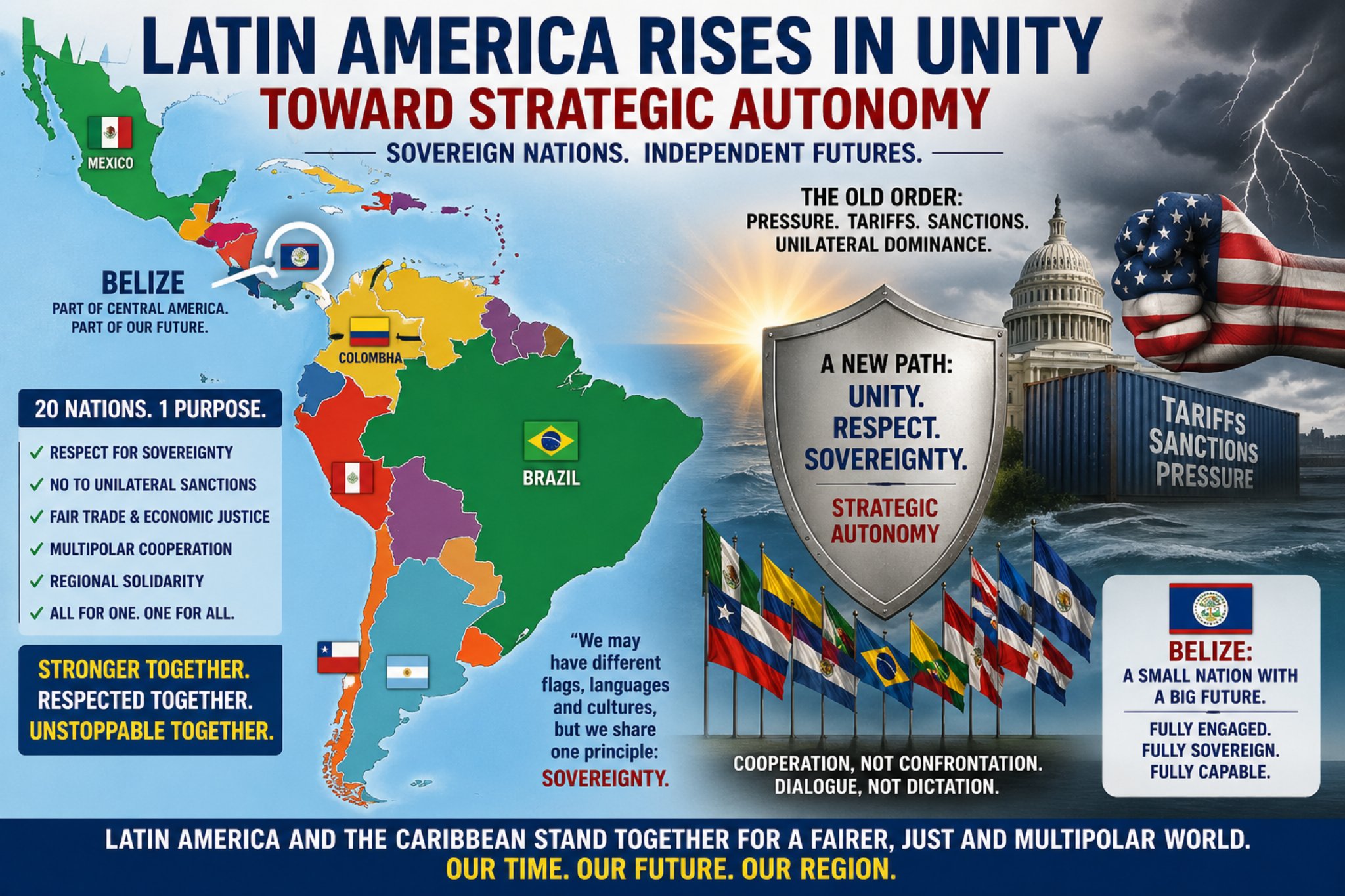
From Mexico under Claudia Sheinbaum, to Brazil under Luiz Inácio Lula da Silva, and Colombia under Gustavo Petro, governments are beginning to coordinate—not in open rebellion—but in strategic resistance to a global order long dominated by the United States.
Through platforms such as CELAC, leaders are:
- Challenging unilateral economic pressure
- Exploring trade outside U.S. influence
- Reasserting sovereign decision-making
This is not a declared alliance.
It is something more subtle—and perhaps more powerful:
A convergence of nations learning how not to stand alone.
And yet—Belize is absent from this conversation.
⚖️ THE CATALYST: PRESSURE, NOT IDEOLOGY
Let us be clear.
This regional shift is not ideological theater—it is reaction.
In recent years, the United States has increasingly relied on:
- Tariffs as economic leverage
- Sanctions as geopolitical enforcement
- Diplomatic pressure to ensure alignment
While these are framed under national interest, many nations now interpret them as:
Instruments of influence within a system that expects compliance, not partnership.
The result?
A growing number of countries are quietly asking:
- Can we trade without dependency?
- Can we govern without external pressure?
- Can sovereignty be practiced—not just declared?
🧭 BELIZE: GEOGRAPHICALLY CENTRAL AMERICAN—STRUCTURALLY DEPENDENT
Belize stands at a crossroads—but behaves as if it does not.
Despite its location in Central America, Belize’s posture remains anchored elsewhere:
- Economically tied to U.S. markets
- Currency pegged to the U.S. dollar
- Diplomatically cautious
- Structurally dependent
Aligned through frameworks like:
- CARICOM
- Commonwealth of Nations
But notably absent from:
- Strategic Latin American economic coordination
- Regional autonomy discussions
🏛️ THE UNCOMFORTABLE QUESTION: WHO SETS BELIZE’S COURSE?
Here lies the issue—not whispered but widely felt.
The proximity is symbolic.
The United States Embassy in Belmopan sits within a stone’s throw of Belize’s administrative centre.
No one is suggesting overt control.
But perception matters—and patterns matter more.
❗ Observed Realities:
- Policy alignment often mirrors U.S. positions
- Silence on regional autonomy initiatives
- No visible doctrine of economic independence
- Limited diversification of strategic partnerships
This raises a legitimate, democratic question:
Are Belize’s policies independently formulated—or cautiously calibrated?
🔍 THE DOCTRINE THAT DOES NOT EXIST
Unlike its regional counterparts, Belize has not articulated a national doctrine on:
- Economic sovereignty
- Trade diversification
- Foreign policy independence
Instead, governance appears:
- Reactive
- Transactional
- Election-cycle driven
Both major political parties operate within:
- The same economic model
- The same external dependencies
- The same absence of ideological direction
The difference is administrative—not transformational.
🌎 WHAT OTHERS ARE DOING—AND BELIZE IS NOT
While Belize remains static, others are moving:
🔹 Mexico
Expanding regional integration
Strengthening state-led development
🔹 Brazil
Advocating multipolar global structures
Deepening ties beyond U.S. influence
🔹 Colombia
Repositioning foreign policy toward autonomy
🔹 Regional Platforms (e.g., CELAC)
Coordinating economic and diplomatic strategies
Creating collective leverage
🧨 THE COST OF NON-POSITIONING
Belize’s absence is not neutral—it is consequential.
⚠️ Risks:
- Continued economic vulnerability
- Limited negotiating power
- Exposure to external shocks (fuel, trade, finance)
- Inability to influence regional direction
🧠 THE DEEPER STRUCTURE: A COLONIAL MODEL IN MODERN FORM
At its core, Belize’s system reflects:
- Import dependency
- External financing reliance
- Limited industrial capacity
- Policy frameworks shaped abroad
This is not accidental.
It is inherited—and maintained.
🔥 THE CRITICAL DISTINCTION
Latin America is not “anti-U.S.”
It is post-dependence information.
Belize, however, remains:
Independent in name—but dependent in structure.
🧭 THREE PATHS BEFORE BELIZE
🟡 1. Continue as Is
- Stability without transformation
- Dependency without resistance
🔵 2. Gradual Diversification
- Engage selectively with regional initiatives
- Maintain balanced diplomacy
🔴 3. Strategic Repositioning
- Develop a national doctrine
- Pursue economic independence
- Align with multipolar opportunities
🗡️ CONCLUSION: SOVEREIGNTY IS NOT PROXIMITY—IT IS POLICY
Belize does not lack independence.
It lacks strategic expression of it.
As nations across the region quietly construct a shield against external economic pressure:
Belize remains exposed—not by force, but by design.
🧨 FINAL LINE
“In a world where nations are redefining sovereignty, Belize risks becoming the last country still asking for permission.”
- Log in to post comments