“Penny Wise, Dollar Foolish: After Years of Waste, Government Hits the Brakes on Public Service Transfers”
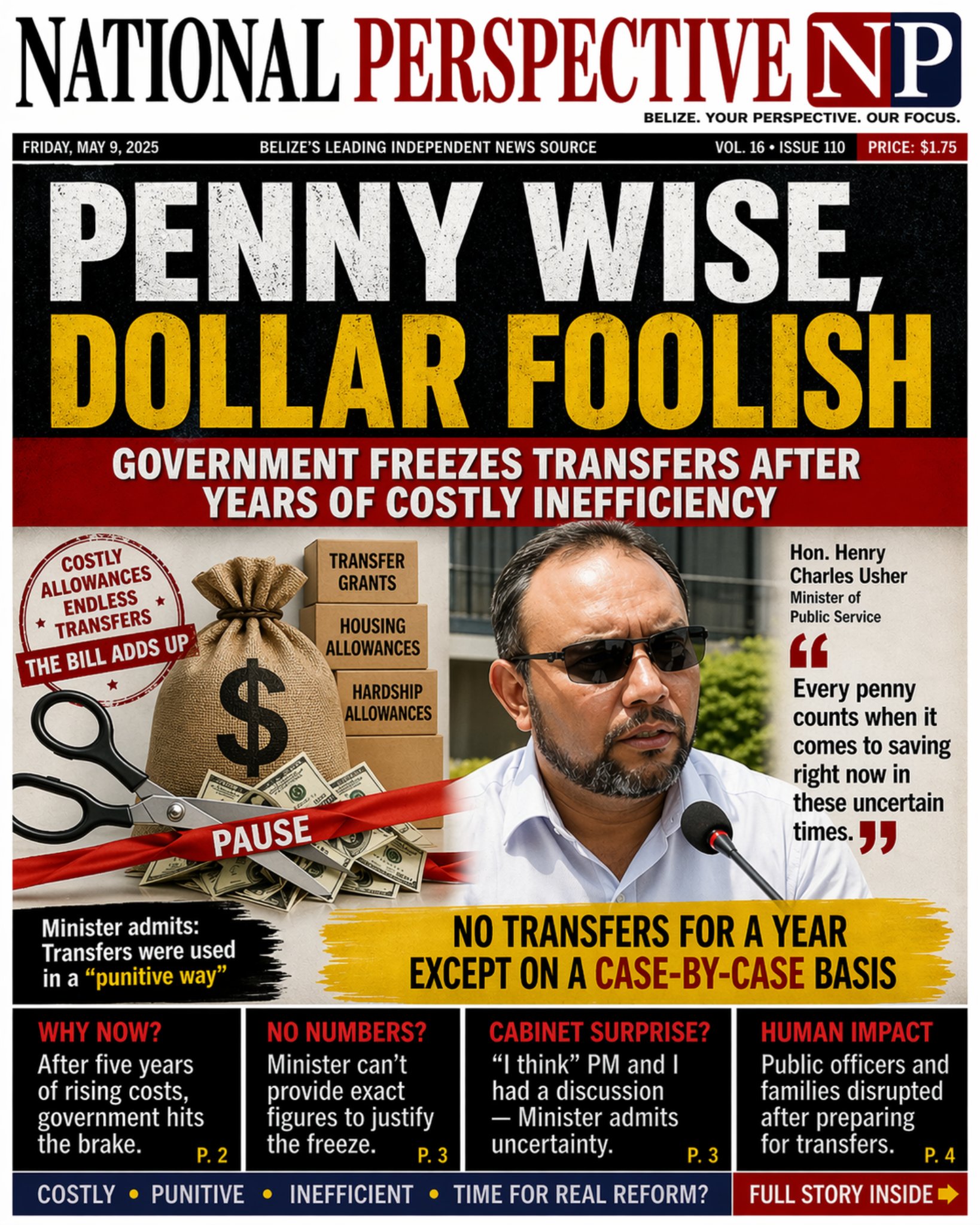
By: Omar Silva – Editor/Publisher
NATIONAL PERSPECTIVE BELIZE
www.nationalperspectivebz.com
Belize City: Wednesday 22nd April 2026
📰 FEATURE ARTICLE
A Sudden Pause… or a Late Realization?
In a move that has sent ripples across Belize’s public sector, Henry Charles Usher announced a sweeping decision:
a one-year pause on government transfers.
Framed as a cost-saving measure in response to global economic uncertainty, the policy is being presented as a prudent adjustment—one that will reduce transfer grants, housing allowances, hardship stipends, and other associated expenses.
But beyond the official explanation lies a more uncomfortable question:
👉 Why is this realization coming now—after nearly five years in government?
The Cost of Transfers: A Known Problem Suddenly Discovered
Transfers within Belize’s public service are not new. They are governed by long-standing regulations, designed to ensure efficiency and proper deployment of personnel.
Yet, in his own words, the Minister acknowledged:
- Transfers have been increasing year after year
- Allowances tied to transfers are a “big pull on the budget”
- Some transfers have been carried out in a punitive and inefficient manner
These are not revelations.
These are long-standing realities within the system.
Which raises a critical issue:
👉 If this was known, why was it allowed to continue unchecked for years?
From Normal Practice to Fiscal Burden
For years, transfers were treated as routine administrative decisions—often executed with little public scrutiny.
But in reality, each transfer carries a financial weight:
- Relocation grants
- Housing allowances
- Hardship stipends
- Travel and logistics costs
Individually, they may appear manageable.
Collectively, they represent millions in recurring expenditure—quietly embedded within the national budget.
Now, faced with tightening fiscal space and mounting economic pressures, the government has chosen to act.
But not proactively.
👉 Reactively.
A Government Adjusting Under Pressure
The justification offered—“uncertain global challenges” and “every penny counts”—suggests a government recalibrating under financial strain.
Yet, this narrative exposes a deeper contradiction:
- When revenues were stable → spending expanded
- When pressures emerge → austerity is introduced
This pattern reflects not strategic governance, but adaptive survival.
A system that responds only when forced to, rather than planning ahead.
The Hidden Admission: Political Abuse of Transfers
Perhaps the most significant element of the Minister’s statement was not about cost—but about conduct.
Transfers, he admitted, have at times been used “in a punitive way.”
This is a profound admission.
It suggests that the transfer system—intended to serve administrative efficiency—has been weaponized within the public service.
If true, then the financial burden is only part of the problem.
The larger issue is structural:
👉 A system vulnerable to political influence, personal conflicts, and misuse
The current pause, therefore, is not just about saving money.
It is an implicit acknowledgment that the system itself has been compromised.
Policy Without Numbers: A Missing Piece
Despite the sweeping nature of the decision, one key element is absent:
📊 Data
The Minister conceded he could not provide exact figures on:
- Total transfer-related expenditure
- Annual cost trends
- Projected savings from the pause
This raises serious concerns.
A nationwide policy shift—impacting hundreds of public officers—is being implemented without transparent financial justification presented to the public.
In governance, intent is not enough.
👉 Credibility requires evidence.
Internal Signals: Coordination or Confusion?
Equally troubling is the suggestion that even within Cabinet, the decision may not have been fully synchronized.
When asked whether the Prime Minister had approved the move, the Minister responded:
“I think the Prime Minister and I had a discussion…”
For a decision of this magnitude, such uncertainty signals:
- Possible gaps in Cabinet coordination
- A lack of clear collective decision-making
- Or a governance structure operating in fragmented silos
At best, it reflects informality.
At worst, institutional weakness.
The Human Impact: Plans Disrupted, Lives Paused
Beyond policy and politics, the real impact falls on public officers:
- Families who had prepared for relocation
- Officers anticipating career movement
- Individuals who adjusted finances and housing arrangements
For them, the pause is not theoretical.
It is immediate and personal.
While the Minister has issued an apology, the broader reality remains:
👉 The burden of adjustment falls on those who did not design the system
Support from the PSU: Reform or Relief?
Interestingly, the Public Service Union (PSU) has expressed support for the measure, citing:
- Reduction in punitive transfers
- Relief from unnecessary disruptions
- Potential for fairer, case-by-case decisions
This endorsement highlights an important truth:
👉 The problem was not just financial—it was systemic.
However, support for the pause should not be mistaken for endorsement of the past.
Rather, it underscores the need for long-overdue reform.
A Pattern of Governance: Reaction Over Strategy
This development fits into a broader pattern emerging in Belize’s governance landscape:
- Policies introduced after pressure mounts
- Corrections made after inefficiencies escalate
- Systems adjusted after public or financial strain becomes visible
From fuel pricing to public sector management, the trend is consistent:
👉 Action follows crisis—not foresight
The Larger Question: Reform or Temporary Fix?
The one-year pause raises a fundamental question:
Is this:
- A temporary cost-cutting measure?
or - The beginning of a comprehensive reform of the public service system?
Without structural changes, the risk is clear:
👉 When the pause ends, the same practices may return
Conclusion: The Cost of Delayed Discipline
The decision to halt transfers may indeed save money.
It may even correct certain inefficiencies.
But it also exposes a deeper truth about governance in Belize:
Problems are often addressed not when they are identified—
but when they become unavoidable.
In that sense, this policy is not just a financial adjustment.
It is a reflection of a broader reality:
👉 A system that tolerated inefficiency—until it could no longer afford to.
Final Word
Belize does not suffer from a lack of awareness.
It suffers from a lack of timely action.
And as this latest decision shows:
Being penny wise today does not erase being dollar foolish yesterday.
- Log in to post comments