“From Public Service to Private Sale: The Quiet Liquidation of Belize’s National Assets”
By: Omar Silva I Editor/Publisher
National Perspective Belize – Digital 2026
www.nationalperspectivebz.com
Belize City: Monday 13th April 2026
📰 SPECIAL FEATURE
There comes a moment in every nation when scattered concerns begin to form a pattern—when what once appeared as isolated decisions begins to reveal a deliberate trajectory.
Belize is now at that moment.
What is unfolding in Caye Caulker is not merely a dispute over land. It is the latest signal in what is becoming a systematic transformation of public assets into disposable real estate, where lands and facilities built, gifted, or designated for public service are quietly repositioned as commodities—sold, transferred, or leveraged under the justification of “national development.”
But development for whom? And at what cost?
THE CAYE CAULKER FLASHPOINT: A COMMUNITY SOUNDS THE ALARM
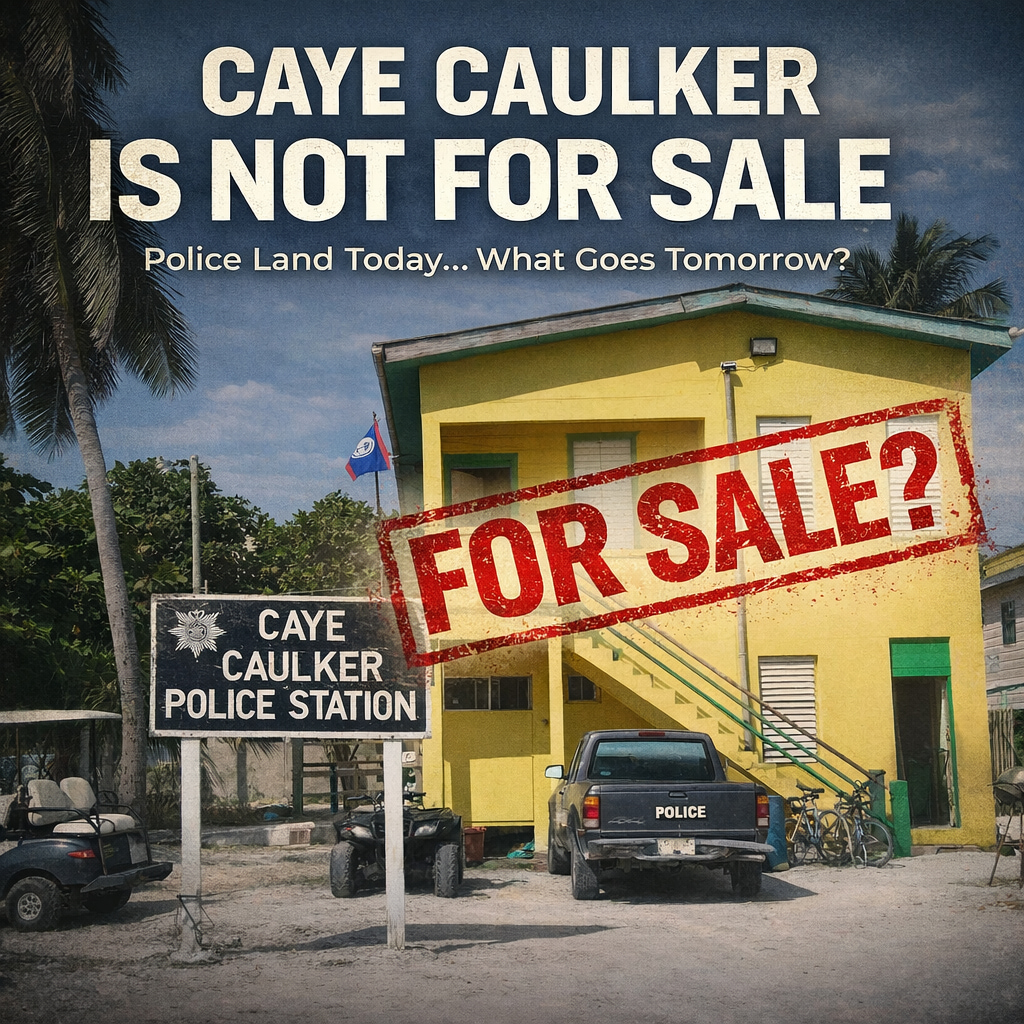
At the center of this emerging storm is Parcel 815 in Caye Caulker—a seafront property designated for policing and community safety.
Earlier in 2026, the Government of Belize publicly announced and signed a contract for the construction of a new police station on that very site. It was presented as progress—modern infrastructure under a national security program.
Yet today, construction has stopped.
The Caye Caulker Village Council has issued an extraordinary and unequivocal rejection of any attempt to sell, lease, or transfer the land. Chairlady Seleny Villanueva-Pott has made it clear:
the community was not consulted, no transparent explanation has been offered, and credible information suggests that the property may be under consideration for divestment.
Her words cut through the silence:
“Parcel 815 is not surplus land… it is critical communal land.”
And therein lies the contradiction.
A government does not sign a contract to build a police station on land it intends to dispose of—unless something changed behind closed doors.
THE FIRE STATION PRECEDENT: BELIZE HAS SEEN THIS BEFORE
If Caye Caulker feels uneasy, it is because Belize has already lived through this exact sequence.
The Swing Bridge & Cleghorn Street Fire Service Story
For decades, Belize City’s fire protection infrastructure was strategically positioned—first near the Swing Bridge, later relocated to Cleghorn Street.
Then came the decision.
The Cleghorn Street property—prime, central, functional—was sold to Atlantic Bank.
The justification?
The proceeds would fund a new, modern fire headquarters.
The reality?
Years later, Belize’s firefighters operate out of the Marion Jones Sporting Complex—a location far removed from the urban core, where response time is critical.
The promise of replacement did not materialize in proportion to the loss.
The public asset was gone.
The public service was weakened.
The accountability disappeared.
A PATTERN EMERGES: THE FOUR-STEP MODEL OF DISPOSSESSION
What connects these cases—and others whispered across the country—is not coincidence. It is method.
1. Reclassification
Public land—once essential—is quietly reimagined as “valuable real estate.”
2. Silence
Communities are excluded. Local authorities are bypassed. Information becomes scarce.
3. Justification
The State promises that selling the asset will fund something “greater” elsewhere.
4. Displacement
The original service is reduced, relocated, delayed, or diminished.
And the public is told to accept less—because something else, somewhere else, will supposedly be better.
WHAT IS REALLY BEING SOLD?
This is not just about land.
When a police station is moved off prime access, security is sold.
When a fire station is relocated out of reach, response time is sold.
When maintenance yards and health facilities disappear, public efficiency is sold.
When officers’ quarters are privatized, institutional stability is sold.
What Belize is witnessing is the gradual erosion of state functionality in favor of asset liquidity.
THE DANGEROUS LOGIC OF “RE-CHANNELING”
At the heart of this issue is a phrase often used to justify these actions:
“We will use the funds for other national priorities.”
But this logic is fundamentally flawed.
Because once accepted, it creates a dangerous precedent:
- Any community asset can be sold to fund projects elsewhere
- Any strategic location can be sacrificed for short-term capital
- Any public service can be displaced in the name of “efficiency”
It transforms governance from planning for people to trading on property.
THE QUESTIONS THAT MUST BE ANSWERED
The Government of Belize must now answer—clearly and publicly:
- Why was a police station contract signed for Parcel 815 if divestment was under consideration?
- Who authorized the halt of construction?
- Has Cabinet approved or discussed any sale, lease, or transfer?
- Has the land been valued? By whom?
- Who are the interested parties?
- Where will policing services be relocated if the land is sold?
- What consultation took place with the community?
- Where will the proceeds go—and under what transparent budget line?
And most importantly:
Why should Belizeans trust another “replacement promise” after the Fire Service precedent?
WHERE ARE WE HEADING?
If Caye Caulker becomes another Cleghorn Street…
If Parcel 815 becomes another lost public asset…
If communities are again told to accept less for the sake of unseen “greater good”…
Then Belize is not developing.
It is liquidating itself—parcel by parcel, service by service.
FINAL WORD: A NATION AT A CROSSROADS
This is the moment Belize must decide:
Will public assets remain tied to public purpose?
Or will they become bargaining chips in a political economy that trades land for influence, service for optics, and community for convenience?
Because once a nation begins to see its schools, stations, yards, and seafronts not as pillars of public life but as items on a balance sheet—
The loss is no longer physical.
It becomes structural. Permanent. Irreversible.
- Log in to post comments