Belize’s $1.9 Billion Budget: Prosperity or Fiscal Illusion?
By: Omar Silva – Editor/Publisher
National Perspective Belize – Digital 2026
Belize City: Wednesday 11th March 2026
SPECIAL BUDGET ANALYSIS
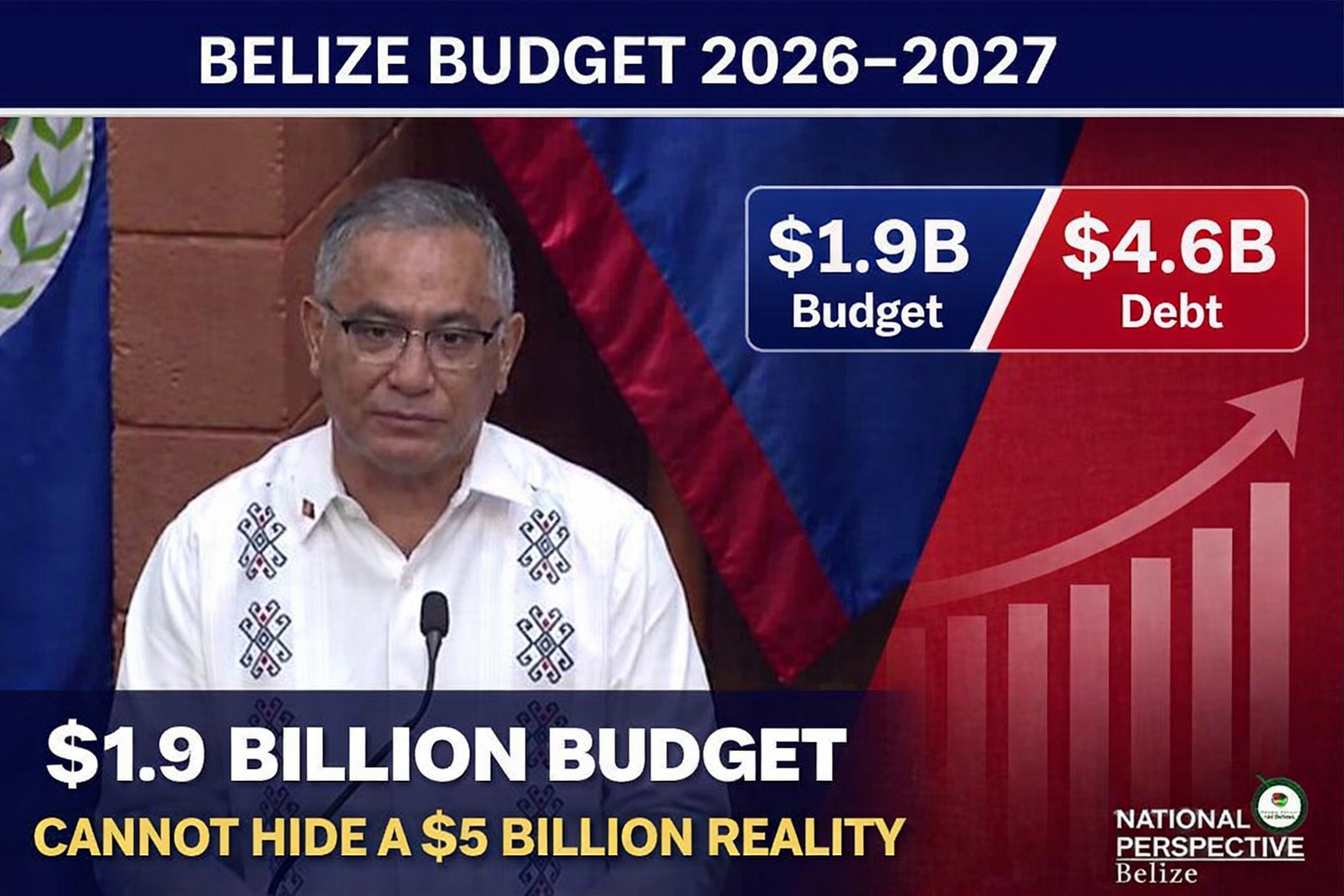
When Prime Minister John Briceño presented the Government of Belize’s $1.902 billion national budget for fiscal year 2026–2027, it was framed as a historic moment of prosperity.
The administration celebrated:
- record low unemployment
- strong economic growth
- improved debt sustainability
- expanding infrastructure investments
Yet beneath the optimistic language lies a budget that raises deeper questions about the sustainability of Belize’s economic structure, the increasing reliance on consumption taxes, and the continued expansion of government spending.
A closer examination reveals that while the government claims fiscal discipline, the structure of the national accounts tells a more complex story.
1. A Budget That Continues to Grow
The proposed 2026–2027 national budget is the largest in Belize’s history.
Category Amount
Total Revenue and Grants $1.79 Billion
Total Government Spending $1.902 Billion
Projected Deficit ≈ $112 Million
This deficit means the government will continue borrowing to finance its operations.
While deficits are not unusual for developing economies, the pattern emerging in Belize is one of continuous budget expansion accompanied by additional borrowing.
2. The Pattern of Supplementary Budgets
Since taking office in November 2020, the administration of John Briceño has repeatedly presented supplementary appropriations mid-year.
For example:
Fiscal Year 2025–2026
Category Amount
Original Budget $1.687 Billion
Supplementary Budget ≈ $106 Million
Effective Spending ≈ $1.79 Billion
This practice raises an important question:
Are initial budgets being intentionally underestimated?
If the trend continues, the 2026–2027 budget could realistically surpass $2 billion once supplementary spending is added.
3. The Structure of Government Spending
One of the most striking revelations in the Prime Minister’s budget speech concerns how government spending is distributed.
Government payroll obligations dominate the recurrent budget.
Category Amount
Public Sector Salaries $598 Million
Pensions $123 Million
Total Payroll Obligations $721 Million
This means:
- 58% of recurrent spending goes to salaries and pensions
- 45 cents of every tax dollar collected pays the government workforce
While public servants are essential to governance, this level of payroll expenditure significantly limits the government’s flexibility to invest in economic transformation.
4. Capital Spending: Investment or Borrowing?
The government has highlighted its $606.8 million capital investment program as proof of its development agenda.
Major projects include:
- a new hospital in San Pedro Town
- replacement of the Belize City Swing Bridge
- national renewable energy expansion
- expansion of National Health Insurance
However, a substantial portion of these projects is externally financed.
Sources include:
- bilateral partners such as Taiwan and Japan
- concessional loans from development banks
- international donor financing
This means many projects being celebrated today will generate future debt obligations.
5. Belize’s Public Debt Remains Significant
According to the Prime Minister, Belize’s public debt currently stands at: $4.676 billion
Breakdown:
Debt Type Amount
External Debt $2.984 Billion
Domestic Debt $1.692 Billion
External debt alone represents 64% of total public debt, leaving Belize heavily exposed to international lenders and global financial conditions.
Debt servicing costs are also rising.
Debt Payment Amount
Interest Payments $189.1 Million
Principal Repayments $140 Million
Total debt service in the coming fiscal year will therefore exceed: $329 million.
6. The Debt Ratio Debate
The government argues that its fiscal strategy has dramatically reduced Belize’s debt burden.
Indeed, the debt-to-GDP ratio has fallen from over 130% in 2020 to roughly 66.6% today.
However, several factors contributed to this change:
- restructuring of the Superbond through the Blue Bond agreement
- post-pandemic economic recovery
- inflation-driven expansion of GDP
In other words, the decline in the ratio reflects multiple structural adjustments, not simply fiscal restraint.
7. The Revenue Question
The government projects $1.79 billion in revenue and grants, with the majority coming from taxation.
Tax revenue totals $1.465 billion, derived mainly from:
- income and profit taxes
- property taxes
- international trade taxes
- goods and services taxes
This revenue model underscores a persistent feature of Belize’s fiscal structure:
The economy relies heavily on consumption taxes.
8. The Role of the New Tax Authority
The government is moving toward transforming the Belize Tax Service Department into a Semi-Autonomous Revenue Authority (SARA).
The reform will introduce:
- electronic invoicing systems
- expanded tax monitoring
- greater enforcement capacity
While the reform is designed to improve tax collection, it also signals a future in which compliance monitoring will become far stricter for businesses and consumers alike.
9. The Economic Model Behind the Budget
Despite the growing size of national budgets, Belize’s economic structure remains largely unchanged.
The country continues to rely heavily on:
- tourism
- imports
- agriculture
- external financing
Belize still lacks significant industrial manufacturing capacity or diversified export industries capable of generating sustained fiscal independence.
This structural limitation means economic growth alone does not necessarily produce long-term economic transformation.
10. The Cost of Government
When payroll obligations, debt servicing, and operational costs are combined, a substantial portion of Belize’s national income is absorbed simply keeping the state running.
This leaves limited fiscal space for:
- national security modernization
- industrial development
- technological innovation
- economic diversification
11. The Budget Debate Begins
Debate on the budget estimates is expected to begin shortly in the National Assembly.
For many Belizeans, however, the core question may not be the size of the budget itself, but rather:
Whether the country’s economic structure is truly changing — or whether government spending is simply expanding faster than the economy’s ability to sustain it.
As Belize enters another fiscal year of ambitious spending and continued borrowing, the national conversation is likely to focus on a central issue:
Can economic growth alone deliver prosperity, or must Belize fundamentally rethink the structure of its economy?
- Log in to post comments