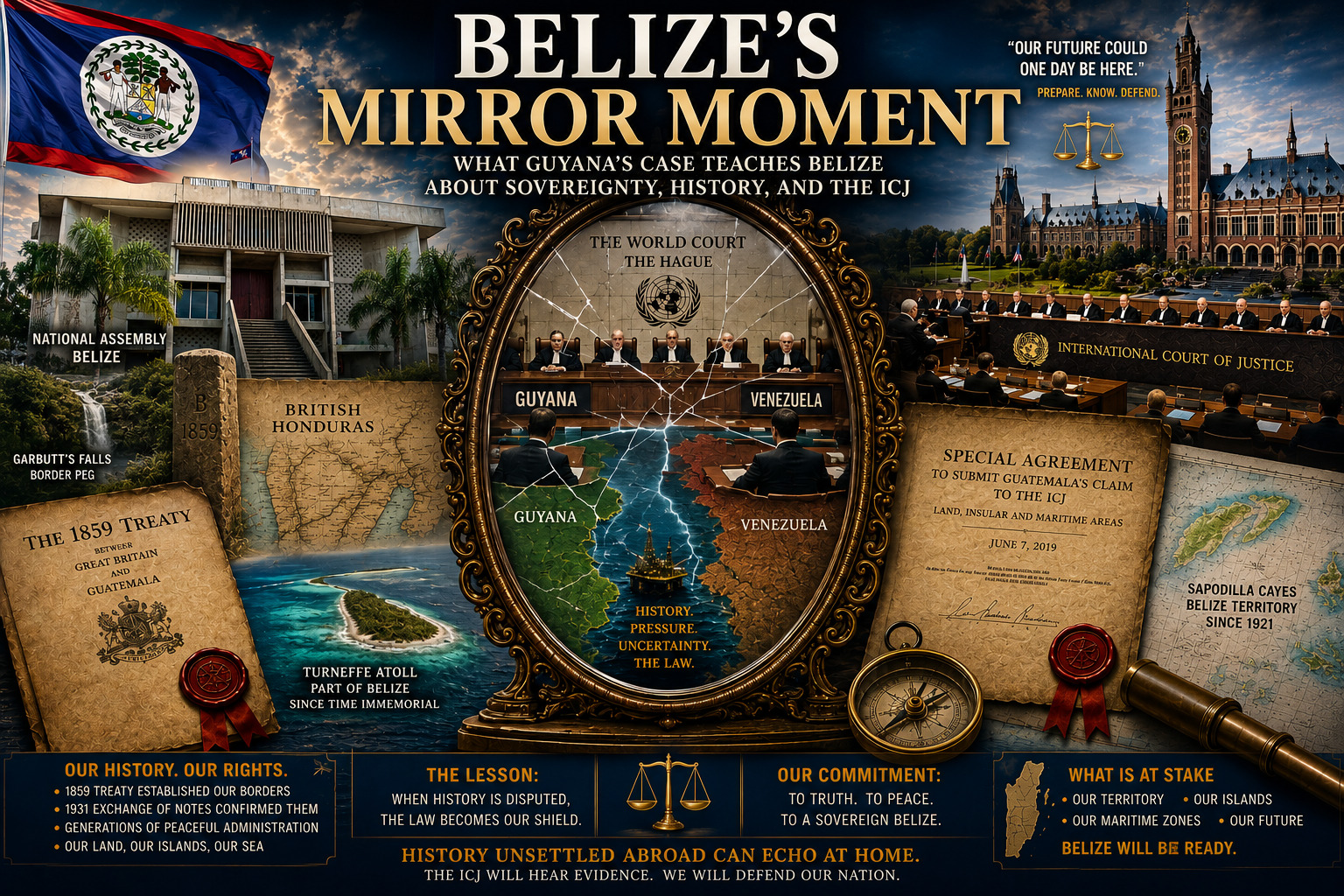
Belize’s Mirror Moment: What the Guyana Case Teaches Us
By: Omar Silva – Editor/Publisher
National Perspective Belize – Digital
Belize City: Thursday 7th May 2026
Belize’s case is not identical to Guyana’s, but the danger is similar: a small state is asking international law to finally quiet a historical claim kept alive by a larger neighbour.
The Belize–Guatemala case before the ICJ is officially titled “Guatemala’s Territorial, Insular and Maritime Claim (Guatemala/Belize)”. Belize’s own Ministry of Foreign Affairs says the Court was seised of the case on 7 June 2019, both sides have submitted two rounds of pleadings, and Belize is awaiting notice from the Court setting oral hearing dates.
The most important wording is in the Special Agreement itself. Belize and Guatemala agreed to submit to the ICJ “any and all legal claims of Guatemala against Belize to land and insular territories and to any maritime areas pertaining to these territories.” That means the case is not only about inland border markers. It expressly includes islands and maritime areas.
That is why your concern about the cayes, Turneffe Atoll, offshore areas, and the Sapodilla Cayes is not misplaced. The 1859 Treaty is often discussed publicly as if it were only about the western and southern land boundary from the Rio Hondo to the Sarstoon, but the ICJ Special Agreement is broader than the popular public explanation. It opens the door for the Court to determine land, insular, and maritime rights.
The 1859 Treaty: Belize’s “Legal Foundation”
The Government of Belize’s public explanation states that in 1859 Britain and Guatemala signed a treaty defining Belize’s western and southern borders, and that Guatemala later argued the treaty was one of “cession” because Article 7 referred to efforts to build a cart road from Guatemala City to the Atlantic Coast. Guatemala later blamed Britain for the road not being built and in 1946 officially tried to declare the treaty null and void.
Belize’s position, in essence, is that the 1859 Treaty was a boundary treaty, not a conditional land sale. That distinction is critical. If it was a boundary treaty, then the border was recognized and settled. If Guatemala persuades the Court that it was a failed cession arrangement, then the argument becomes much more dangerous.
Why the Islands Matter
Your observation about the border pegs is powerful. Markers such as Garbutt’s Falls speak to the inland boundary, but national territory does not end at inland markers. Belize’s sovereignty includes its cayes, reefs, atolls, territorial sea, and maritime zones.
This is why the Sapodilla Cayes matter so much. In March 2026, the ICJ allowed Guatemala to intervene as a non-party in the separate Belize v. Honduras case concerning the Sapodilla Cayes. The Court limited Guatemala’s intervention to sovereignty over the Sapodilla Cayes and related fishing rights, and Belize’s Ministry said this does not decide the substantive issues yet — it only allows the parties’ claims to be aired.
That development quietly confirms something Belizeans must understand: the offshore question is real, alive, and legally consequential.
The Guyana Parallel
Guyana relies heavily on the 1899 Arbitral Award as a final legal settlement. Venezuela argues that later diplomatic instruments and historical grievances reopened the controversy.
Belize relies heavily on the 1859 Treaty and subsequent recognition of its borders. Guatemala argues that the treaty failed because Britain did not fulfill the road obligation.
So, the parallel is this:
Guyana says: the Award settled the boundary.
Venezuela says: the process was defective and the issue remains alive.
Belize says: the Treaty settled the boundary.
Guatemala says: the treaty was conditional and failed.
That is the educational heart of the comparison.
The Belizean Predicament
Belize must now prepare its people for a truth that is uncomfortable but necessary:
The ICJ will not decide based on emotion, patriotic songs, political speeches, or selective textbook history. It will decide based on treaties, maps, diplomatic conduct, recognition, evidence of administration, effective occupation, and rules of international law.
That means Belize’s public education must go beyond slogans. The people must understand:
What did the 1859 Treaty actually say?
What did the 1931 Exchange of Notes confirm?
How did Britain administer British Honduras?
How did Guatemala behave after 1859?
What evidence proves Belize’s continuous sovereignty over its mainland, cayes, atolls, and maritime zones?
What exactly is Guatemala claiming today?
The Warning
Belize’s greatest weakness is not necessarily in law. It is in public understanding.
A nation cannot enter a historic ICJ moment with its citizens only partially informed. If the claim includes land, islands, and maritime areas, then Belizeans deserve a full national explanation — not fragments.
This is where National Perspective Belize can serve the public:
not to frighten the nation, but to educate it before history arrives at our door.
A strong title for this coming feature could be:
BELIZE’S MIRROR AT THE ICJ
What Guyana’s Case Teaches Us About the 1859 Treaty, Guatemala’s Claim, and the Future of Our Sovereignty
.
- Log in to post comments