📰 PRESCRIPTION WITHOUT ACCESS: WHEN “MEDICAL LOGIC” COLLIDES WITH BELIZE’S REALITY
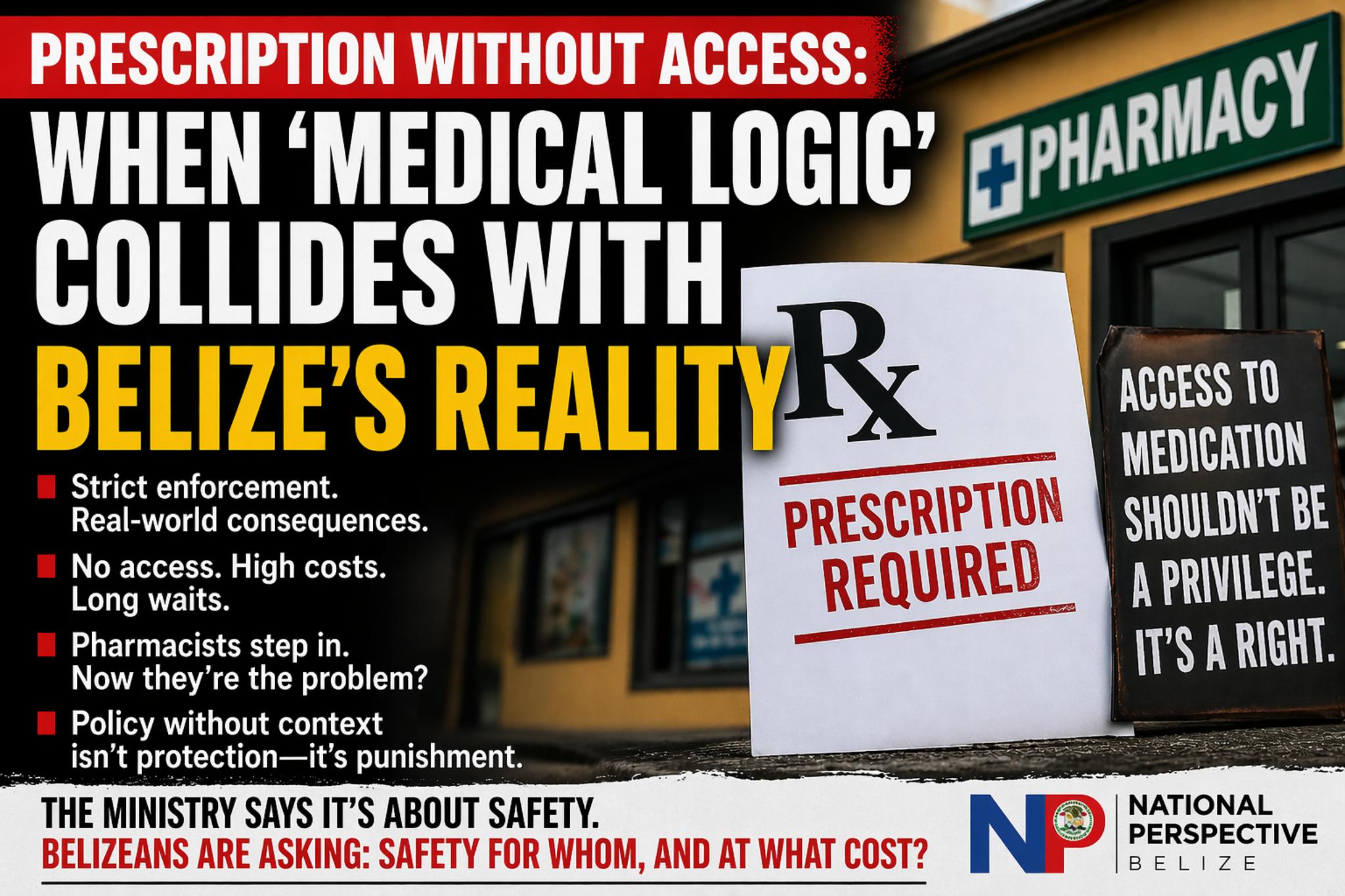
The Ministry says it’s about safety. Belizeans are asking: safety for whom, and at what cost?
By Omar Silva I Editor/Publisher
National Perspective Belize – Digital 2026
Belize City: Friday 24th April 2026
There is a dangerous pattern emerging in Belize’s governance—one that is becoming all too familiar.
Policies are being justified on the basis of “technical correctness”, while completely ignoring the lived reality of the Belizean people.
The latest example comes from the Ministry of Health & Wellness, where CEO, Julio Sabido has defended the enforcement of prescription regulations as nothing new, nothing drastic, and entirely rooted in sound “medical logic.”
But outside the walls of policy briefings and ministry offices, Belizeans are confronting a very different truth:
👉 This is not about logic.
👉 This is about disconnection from reality.
A POLICY BUILT FOR A SYSTEM THAT DOES NOT EXIST
The Ministry’s position assumes a functioning healthcare system where:
- Doctors are readily available
- Clinics are accessible and efficient
- Costs are manageable for the average citizen
- Prescriptions can be obtained without hardship
That system does not exist in Belize.
Across the country—urban and rural alike—patients face:
- Long waiting times at public facilities
- Limited availability of doctors
- High costs in private clinics
- Geographic barriers in remote communities
In this environment, the pharmacy has become something more than a place to fill prescriptions.
👉 It has become the frontline of healthcare.
THE SILENT ROLE OF THE PHARMACIST
For years—quietly and without acknowledgment—pharmacists have stepped into a role the system could not fulfill.
They:
- Offer immediate guidance
- Recommend over-the-counter solutions
- Provide access to relief when doctors are unavailable
In many cases, the pharmacist is the first—and only—point of contact for a sick Belizean.
This is not theoretical.
This is the daily reality of thousands.
Yet today, that reality is being reframed as “non-compliance.”
WHEN SURVIVAL IS LABELED MISUSE
The Ministry argues that Belizeans have been “misusing medication for a long time.”
But let us be clear:
👉 What is being labeled misuse is often necessity.
When a mother cannot afford a doctor’s visit…
When a laborer cannot take a day off to sit in a clinic…
When a villager must travel miles for basic care…
…the pharmacy becomes the only viable option.
This is not recklessness.
This is survival in a constrained system.
THE ECONOMIC BARRIER NO ONE WANTS TO ADDRESS
The enforcement of prescription rules introduces a new and immediate obstacle:
💰 Cost
To access medication legally under strict enforcement, a Belizean must now:
- Pay for a doctor’s consultation
- Obtain a prescription
- Then pay for the medication
For many households, that first step alone is prohibitive.
The result?
👉 Delayed treatment
👉 Untreated conditions
👉 Increased long-term health risks
Ironically, a policy introduced in the name of safety may undermine public health itself.
COPY-PASTE POLICY IN A DIFFERENT WORLD
Strict prescription enforcement is standard in developed countries.
But those systems are supported by:
- Universal or subsidized healthcare
- Insurance coverage
- High doctor-to-patient ratios
- Efficient service delivery
Belize has not yet built that infrastructure.
Applying the same rules here without adjustment is not modernization.
👉 It is policy without context.
THE MINISTRY’S CONTRADICTION
CEO Sabido insists:
- “This is nothing new”
- “90% of pharmacies were compliant”
- “Enforcement was not draconian”
Yet the public reaction tells another story.
If nothing changed—
👉 Why the sudden nationwide concern?
👉 Why the confusion among pharmacies?
👉 Why the shift in patient experience?
Because something did change.
Not necessarily the law—but the enforcement posture.
And it came without:
- Meaningful public consultation
- Clear communication
- Transitional support for citizens
THE REAL PROBLEM: ACCESS, NOT ENFORCEMENT
The Ministry has diagnosed the wrong issue.
The problem is not primarily:
❌ Medication misuse
The problem is:
✅ Limited access to structured healthcare
Until Belize addresses:
- Doctor shortages
- Rural healthcare gaps
- Cost barriers
- System inefficiencies
…any attempt at strict enforcement will remain fundamentally flawed.
FROM PUBLIC HEALTH TO PUBLIC BURDEN
Policies must be judged not by their intention—but by their impact.
And the impact here is clear:
- Increased financial strain on families
- Reduced access to timely care
- Greater dependence on an already strained system
What is presented as “safe access” risks becoming:
👉 Restricted access
A QUESTION OF PRIORITIES
Before enforcing compliance, the State must ask itself:
Have we provided the conditions for compliance to be possible?
Because in Belize today:
👉 You cannot demand first-world medical discipline
👉 In a system that has not yet achieved first-world access
THE NATIONAL PERSPECTIVE
This is not an argument against regulation.
It is an argument against misplaced regulation.
Belize needs:
- Stronger healthcare infrastructure
- Affordable access to doctors
- Public education on medication use
But above all, it needs policy that reflects its own reality—not borrowed standards applied in isolation.
FINAL WORD
If this policy remains unchanged in its current form, it will not correct behavior.
It will deepen inequality.
And it will reinforce a growing perception among Belizeans that governance is becoming increasingly detached from the people it is meant to serve.
“You cannot enforce first-world medical rules on a healthcare system that does not yet provide first-world access—and expect the people not to feel the strain.”
- Log in to post comments