INDEPENDENT BY CONSTITUTION — BUT INDEPENDENT FROM WHOM?
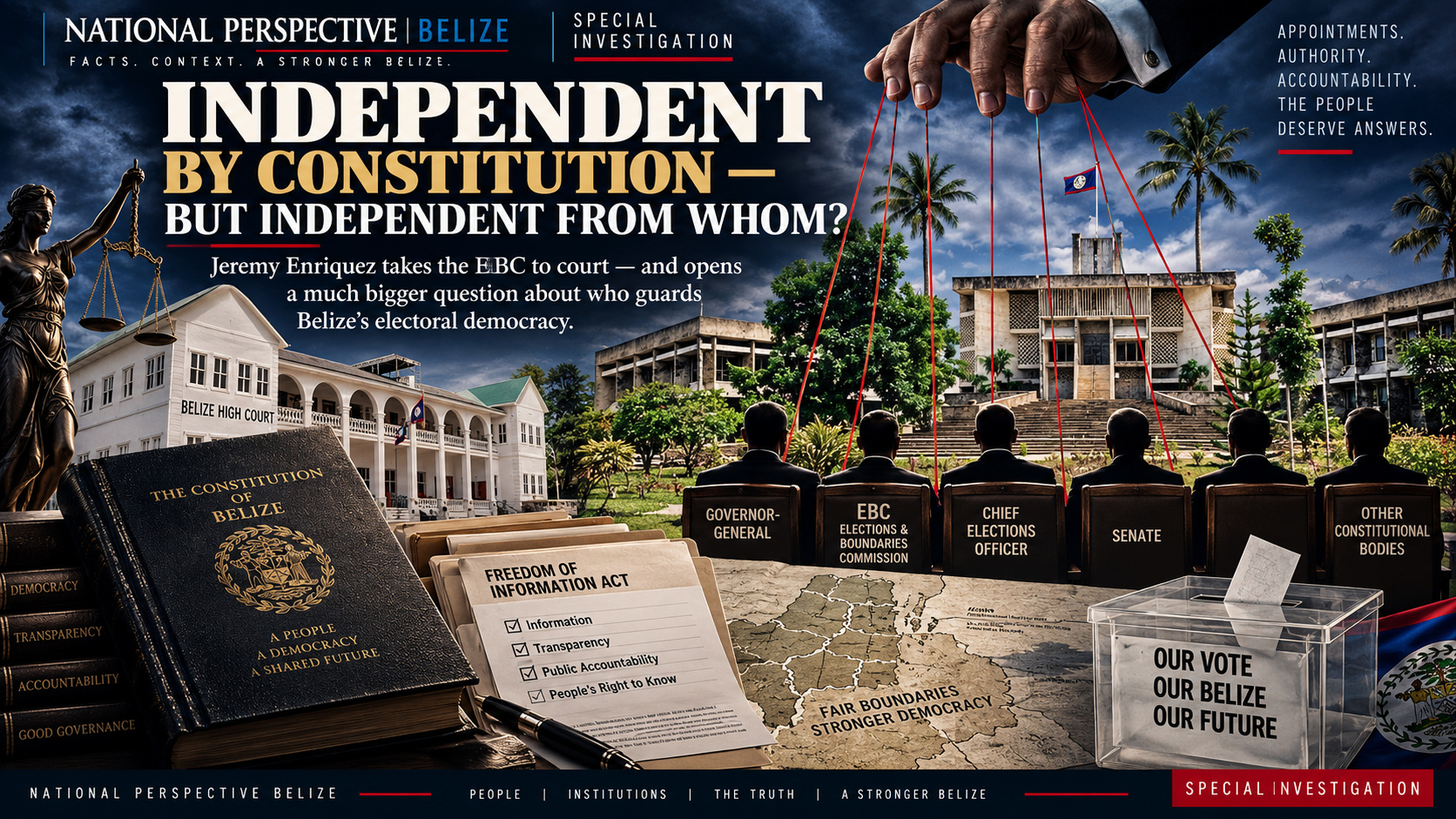
Jeremy Enriquez Takes the EBC to Court — and Opens a Much Bigger Question About Who Guards Belize’s Electoral Democracy
SPECIAL INVESTIGATION | CHAPTER I
- The lawsuit may be about a Freedom of Information request.
- The real issue could become much bigger.
Social activist Jeremy Enriquez has taken Belize’s Elections and Boundaries Commission to the High Court, asking the judiciary to determine whether the very institution entrusted with supervising elections and proposing the boundaries of Belize’s electoral divisions is legally subject to the country’s Freedom of Information Act.
Enriquez filed his claim on Thursday, September 17, 2026, following a dispute that began with a June request for information concerning the unfinished redistricting exercise. He sought information about what had been completed, what remained outstanding, the reasons for delays and when the exercise was expected to be finished. According to Enriquez, the EBC initially responded that the request was too broad and maintained that the Commission was not a public authority subject to the FOIA.
That disagreement has now left the administrative offices and entered the courtroom.
And with it comes a question Belize may have avoided for far too long: Who watches the institution that watches our elections?
THE CASE BEFORE THE COURT
Enriquez is asking the High Court to declare that the Elections and Boundaries Commission is a prescribed public authority under the Freedom of Information Act and to require the Commission to formally consider and determine his information request according to law.
That distinction is important.
Enriquez is not asking the Court simply to hand him every document he requested.
He is challenging the proposition that the EBC can stand outside the statutory access-to-information regime altogether.
- The Freedom of Information Act defines a “prescribed authority” to include a local authority and, significantly, a “public statutory corporation or body.” The Act gives every person a right, subject to its exemptions and procedures, to obtain access to documents held by a Ministry or prescribed authority.
Whether the EBC falls within that definition is now a legal question for the High Court.
National Perspective will not prejudge that determination.
2. But the question deserves examination because the EBC is not an insignificant administrative agency.
It sits at the centre of Belize’s electoral democracy.
WHAT EXACTLY IS THE EBC?
Section 88 of the Belize Constitution establishes an Elections and Boundaries Commission consisting of a Chairman and four other members.
- Its responsibilities are enormous.
- According to the EBC itself, Section 88 gives the Commission responsibility for the direction and supervision of voter registration, elections, referenda and matters connected with them.
- More importantly, Section 88(14) states that in exercising its functions the Commission:
“shall not be subject to the direction or control of any other person or authority.”
That is powerful constitutional language.
The intention is readily understandable.
The institution responsible for administering the machinery through which governments obtain political power should not itself operate under the political direction of the government seeking election.
But there is another part of Section 88 that deserves equally close examination.
- It concerns who appoints the Commission.
FOLLOW THE APPOINTMENTS
- The EBC consists of five people.
According to the Commission’s own explanation of Section 88(2), the Governor-General formally appoints the Chairman and four members.
- But that is only the beginning of the story.
For the Chairman and two members, the Governor-General acts in accordance with the advice of the Prime Minister given after consultation with the Leader of the Opposition.
- For the remaining two members, the Governor-General acts in accordance with the Prime Minister’s advice given with the concurrence of the Leader of the Opposition.
Those constitutional words must not be treated as interchangeable.
- Consultation is not concurrence.
- Concurrence requires agreement.
- Consultation requires that another party be consulted, but it does not give that party the same power of agreement required by concurrence.
- The practical architecture therefore deserves public attention:
THREE POSITIONS
- Chairman + two commissioners
Prime Minister advises
Opposition Leader is consulted.
TWO POSITIONS
2. Prime Minister advises
Opposition Leader must concur.
The EBC currently identifies its five members as Chairman Oscar Sabido Puga and commissioners Conrad Lewis, Orlando Espat, Juliet Thimbriel and Aldo Salazar.
- Nothing about that appointment structure, standing alone, proves that any commissioner is politically controlled.
- Nor does it prove that commissioners vote according to party instructions.
- There would need to be evidence before such conclusions could responsibly be made.
- But the architecture raises a legitimate institutional question:
Can an electoral commission be constitutionally independent in its functions while its appointment mechanism still gives the political executive such an important role in determining its composition?
- That is not an accusation.
- It is a question arising directly from the Constitution.
THE CHIEF ELECTIONS OFFICER IS NOT THE COMMISSION
- Another distinction is necessary.
The Elections and Boundaries Commission and Elections and Boundaries Department are not the same entity.
The EBC's own institutional description says Belize has two electoral management bodies and describes them as separate legal entities.
- The Chief Elections Officer is not one of the five commissioners.
- According to the EBC, the Commission confers administrative powers and duties upon the Chief Elections Officer, who heads the Elections and Boundaries Department and is responsible for administration.
That means criticism of a decision must distinguish between:
- what the Commission decided,
- what the Department administered,
- and what the Chief Elections Officer communicated.
- This distinction could become extremely important as the Enriquez litigation proceeds.
If a decision was made that the EBC is outside the Freedom of Information Act, Belizeans deserve to know the legal and institutional basis upon which that position was reached.
- Was it an administrative interpretation?
- Was it legal advice?
- Was it a decision of the Commission?
- Was there a Commission vote?
- Were commissioners unanimous?
- Were there dissenting views?
- Was the Attorney General’s Ministry consulted?
Those are questions.
- They should not be answered by speculation.
- They should be answered by records.
- And therein lies the extraordinary irony of the dispute:
The controversy over obtaining information may itself create the need for considerably more information.
THEN COMES REDISTRICTING
- This case cannot be separated from what Enriquez originally wanted information about.
Belize’s electoral map.
Section 90 of the Constitution requires the EBC, after considering population distribution, to make proposals from time to time for dividing Belize into electoral divisions so that each division has, as nearly as may be, an equal number of persons eligible to vote.
- The Constitution also permits consideration of physical features, transportation and other facilities when fixing boundaries.
But here comes another important piece of the architecture.
The EBC does not have the final word.
Its proposals must be laid before the National Assembly.
Section 90 provides that the proposed electoral divisions do not become the electoral divisions of Belize until they are enacted into law by the National Assembly. The EBC itself explains the arrangement more simply: the Commission makes the proposals; the National Assembly makes the final decision and may accept all or part of what is submitted.
That creates an institutional chain Belizeans need to understand: THE ELECTORAL POWER CHAIN :
Prime Minister ↓
plays the constitutionally prescribed advisory role in appointments to the EBC
Governor-General ↓
formally appoints the commissioners according to the Section 88 formula
Elections & Boundaries Commission ↓
supervises elections and prepares redistricting proposals
Chairman of the EBC ↓
lays those proposals before the National Assembly
National Assembly ↓
must enact the boundaries into law before they take effect.
That architecture does not establish political interference.
But neither should the word “independent” prevent Belizeans from examining how the system actually works.
INDEPENDENCE FROM GOVERNMENT IS NOT THE SAME QUESTION AS ACCOUNTABILITY TO THE PUBLIC
- This may become the defining issue emerging from the Enriquez litigation.
- Constitutional independence exists for an important reason.
An Elections and Boundaries Commission should not receive instructions from a Prime Minister telling it how to register voters, administer an election, count votes or design constituency proposals.
- Section 88(14) expressly protects the Commission from direction or control.
But Enriquez's lawsuit raises a different proposition:
Does independence from political direction also mean independence from a generally applicable transparency law?
That is now for the High Court to determine.
- And Belize should pay very close attention to the answer.
Because there is an enormous democratic difference between: independence from political interference
and : immunity from public scrutiny.
One protects democracy.
- The other, if carried too far, could weaken public accountability.
- AND THEN THERE IS THE GOVERNOR-GENERAL
This investigation does not stop at the doors of the EBC.
- The Constitution says the Governor-General formally appoints the commissioners.
So the next logical question becomes: Who determines who becomes Governor-General?
Section 30 of the Constitution establishes the Governor-General as the Belizean representative of the monarch.
The present Governor-General, Dame Froyla Tzalam, came to office in 2021 after Prime Minister John Briceño announced that his government had submitted her nomination through the appropriate channel to Buckingham Palace. Contemporary reporting recorded Briceño publicly announcing the nomination; Buckingham Palace subsequently approved the appointment.
Does this demonstrates that the Governor-General is a political subordinate of the Prime Minister?
- That conclusion cannot responsibly be made merely from an appointment mechanism.
- Indeed, the Constitution expressly provides circumstances in which the Governor-General exercises personal constitutional judgment.
- But it exposes another question that Chapter II of this investigation must examine:
How much of Belize’s supposedly independent constitutional machinery ultimately traces its appointment pathway back toward the political executive?
- That question reaches far beyond the EBC.
- It reaches into the architecture of the Belizean state itself.
THE HIGH COURT CASE MAY THEREFORE BE ABOUT MUCH MORE THAN ONE FOIA REQUEST
- Jeremy Enriquez has opened one door.
- Behind it may be an entire constitutional corridor.
The immediate question is whether the Elections and Boundaries Commission is legally subject to the Freedom of Information Act.
But behind that stand other questions: Who appoints the people who supervise elections?
- Who supervises those appointees?
- Who decides whether their records are public?
- Who determines electoral boundaries?
- Who converts those recommendations into law?
- What information must the public receive while this process is underway?
- And what happens when an institution established to protect democracy invokes its constitutional independence in a dispute over transparency?
These questions belong neither to the PUP nor the UDP.
- They belong to Belize.
- Because governments change.
- Prime Ministers change.
- Commissioners change.
- Opposition parties eventually become governments, and governments eventually become oppositions.
The constitutional machinery remains.
That is why this investigation must not become an argument about whether today's personalities are good people or bad people.
The much more consequential question is whether the system itself contains sufficient checks when good people are replaced by bad ones—or when political interests collide with constitutional responsibility.
THE NATIONAL PERSPECTIVE TEST
National Perspective Belize proposes a simple test for every institution we examine in this series:
- WHO APPOINTS YOU?
- WHO CAN REMOVE YOU?
- WHO PAYS YOU?
- WHO CAN DIRECT YOU?
- WHO CAN OVERRULE YOU?
- WHO CAN DEMAND YOUR RECORDS?
- WHO HOLDS YOU ACCOUNTABLE?
Answer those seven questions and the true architecture of institutional independence begins to emerge.
- We therefore will not begin by declaring anyone a puppet.
- We will do something considerably more useful.
- We will identify every constitutional string.
- We will establish who legally holds each one.
We will determine which strings are ceremonial, which carry actual power, which require consultation, which require concurrence, which provide discretion and which impose binding constitutional advice.
- And then Belizeans can decide for themselves whether institutions described as independent possess enough independence in reality as well as in law.
Jeremy Enriquez may have gone to court asking whether the EBC must answer a Freedom of Information request.
He may inadvertently have opened a much bigger national conversation:
WHO GUARDS THE GUARDIANS OF BELIZE’S DEMOCRACY?
NEXT — CHAPTER II:
THE CONSTITUTIONAL STRINGS: FROM THE PRIME MINISTER TO THE GOVERNOR-GENERAL, THE EBC, THE SENATE AND BEYOND
We follow the appointments—not the rhetoric—to determine where constitutional authority really begins, where it ends, and where Belize’s safeguards actually stand.
By: Omar Silva – Editorial Director @ www.nationalperspectivebz.com
NATIONAL PERSPECTIVE BELIZE —
- Log in to post comments