FOLLOW THE GALLON: THE GOVERNMENT $ TAKE
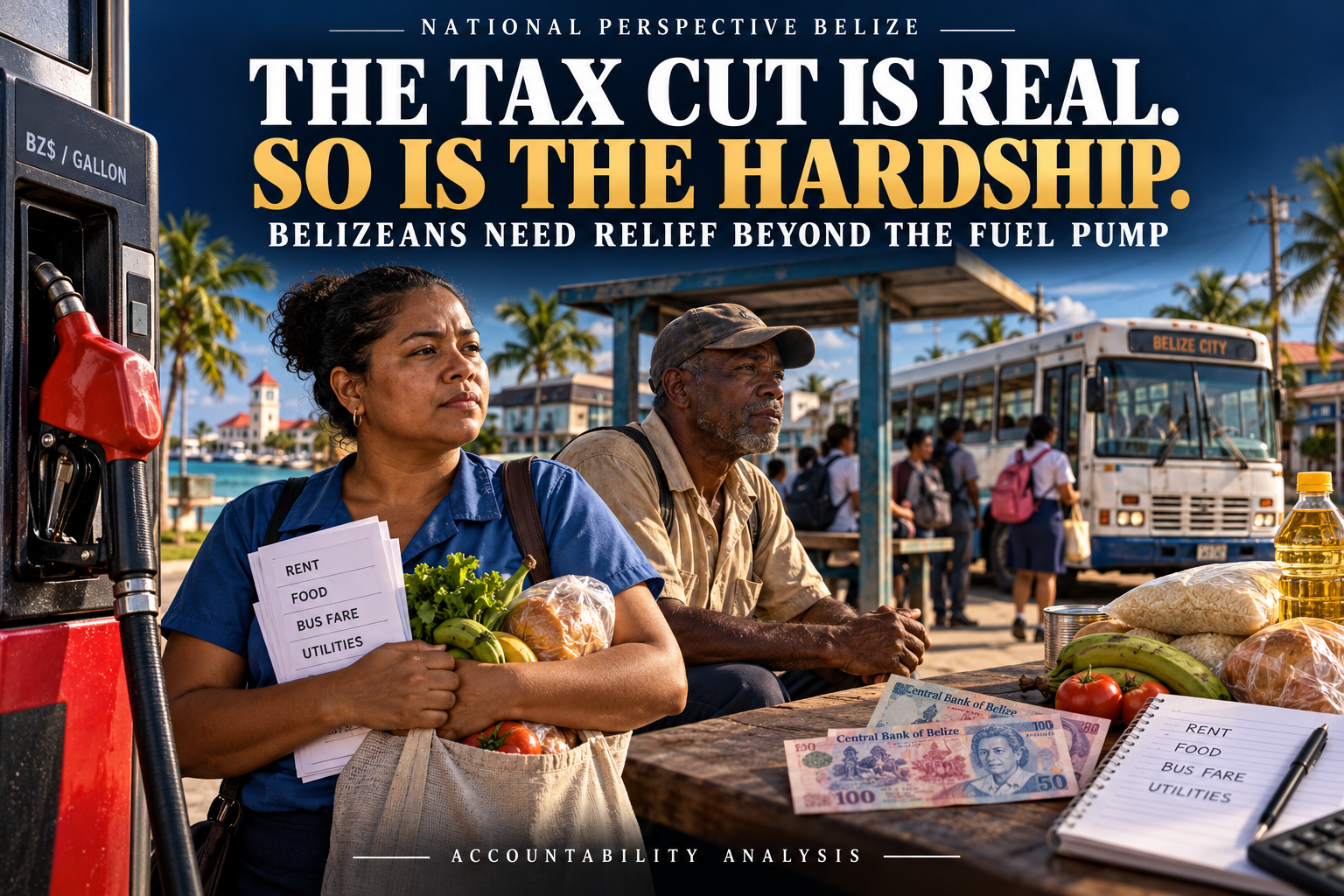

What Belizeans Pay at the Pump, What Government Collects—and What Relief Would Actually Cost
Accountability Analysis
Belize City 15th October 2026 | Every time a Belizean purchases fuel, part of the payment buys the product, part supports the commercial chain, and part represents Government taxes.
That third share deserves a clear public accounting. A gallon powers a vehicle, a delivery route or a fishing trip. It also contributes to the revenue available to the administration governing Belize.
- The question is how much—and what choices Government has when the same gallon becomes increasingly difficult for households and businesses to afford.
National Perspective Belize’s “Follow the Gallon” series now turns to the Government take: the tax component, the public accounts and the evidence needed to judge competing claims about relief.
- The figures we can establish
The Ministry of Finance’s published worksheet provides the following historical snapshot for Belize City on March 27, 2026. These are dated figures, not a statement of October prices.
Component, BZ$ per gallon Premium Regular Diesel
Landed cost 6.7483 6.4833 9.1412
Commercial margins 1.6869 1.6310 1.7296
Government taxes 5.3206 4.9058 3.6766
Published pump price 13.76 13.02 14.55
Tax share of published pump price, calculated
38.7% 37.7% 25.3%
Source: Ministry of Finance, Fuel Pump Price for 2026 worksheet. Percentages calculated by dividing Government taxes by the published pump price. Small differences between component sums and pump prices reflect published rounding.
- The tax line therefore represented approximately 39 cents of each dollar spent on premium, 38 cents on regular and 25 cents on diesel in that snapshot.
- Commercial margins should not automatically be described as net profit: they can cover operating costs as well as returns. Nor does the aggregate Government-tax line identify how much belongs to each individual levy. That requires the underlying tax schedule.
Government has reduced its take—and still collected taxes
- The same worksheet shows that by April 5, the premium tax component had fallen to BZ$4.7332 per gallon and regular to BZ$4.3450. Those were reductions of approximately 59 cents and 56 cents respectively from March 27.
- That matters. The evidence supports the existence of tax relief during that interval. It also illustrates why relief does not necessarily produce a lower pump price: increases elsewhere in the composition can outweigh a tax reduction.
- A fair assessment must establish both the relief granted and the tax that remains.
What “consolidated revenue” means
- Section 114(1) of Belize’s Constitution establishes the general rule that revenues received by Belize form the Consolidated Revenue Fund, except money legally payable into another specific public fund. Section 114(2) governs authorized withdrawals.
- The Fund contains public money administered by the Government of the day. Describing it as revenue available to the Briceño administration is reasonable; describing it as the administration’s private money would be wrong.
- It is also misleading to assign a particular gallon’s tax payment directly to a hospital, a ministerial allowance or a road without supporting accounting evidence. General revenues finance the overall budget. Any legally earmarked portion must be identified separately.
The accountability task is to reconcile fuel-related collections with the appropriate revenue headings and then examine the expenditure choices made through the budget.
- A tax per gallon is not yet an annual revenue total
- A price worksheet cannot establish total Government receipts by itself.
- An estimate must combine the applicable tax component with the corresponding taxable volume for each fuel and period. Actual collections must then be reconciled with administrative records, including exemptions, adjustments and timing differences.
Imports, releases into domestic consumption and retail sales cannot simply be treated as interchangeable. The taxable event matters.
- Government should publish fuel-specific volumes, effective tax rates and collections under each revenue heading. That would let the public distinguish calculated liabilities from cash actually received—and see how significant fuel taxation is within total revenue.
- The reported BZ$40 million needs reconciliation
- A local media reported on September 16 that Prime Minister John Briceño estimated Government had forgone more than BZ$40 million in fuel revenue. The report explicitly characterized his figure as an estimate. It also reported on his argument that further relief must be weighed against financing public programs.
Forgone revenue is the difference between what Government collected and what it would have collected under a specified alternative tax policy. It is not automatically a cash payment to consumers.
- To assess the estimate, Belizeans need the start and end dates, the baseline tax rates, the actual reduced rates, the taxable volumes and the calculation for each fuel.
The distinction matters: revenue forgone against an earlier tax schedule may differ from revenue below a budget forecast. A defensible account must state which comparison is being made.
- The figure deserves verification. Its repetition does not provide that verification.
What modest relief would cost
- Government can make the alternatives understandable without first committing to a blanket tax suspension.
The following calculations show the direct reduction in tax revenue for every one million eligible gallons, assuming the stated tax reduction applies to each gallon:
Tax reduction per gallon Direct revenue reduction per million gallons Consumer saving on 20 gall ons, with full pass-through
BZ$0.25 BZ$250,000 BZ$5
BZ$0.50 BZ$500,000 BZ$10
BZ$1.00 BZ$1,000,000 BZ$20
These are illustrations, not estimates of Belize’s consumption or predictions of total fiscal effects. Changes in demand, other taxes and programme administration could affect the final result.
- The missing national calculation is straightforward in principle: apply each scenario to verified eligible volumes over a defined period and explain the funding consequences.
- Protect services—and disclose the alternatives
- Public services require dependable financing. A permanent tax cut without a credible financing plan can create a fiscal gap.
- But that concern should begin the public explanation. Government should disclose the cost of temporary relief, targeted assistance and different eligibility rules; identify financing or spending adjustments; and explain which options it rejects and why.
- A universal fuel-tax cut also distributes larger direct savings to those buying more fuel. Targeted assistance may reach vulnerable groups more precisely, but require administration and safeguards. Neither approach should be declared superior without the relevant costs and evidence.
The public deserves a comparison of actual choices.
- Guatemala provides a test
- Guatemala’s Ministry of Energy and Mines confirms that temporary IVA and IDP exemptions under Decree 22-2026 apply from October 1 through December 31. It also describes mandatory daily price reporting and the requirement to transfer the benefit to consumers.
- That establishes a policy intervention, not proof of its final success. A credible comparison must examine actual prices, equivalent fuels, units, exchange rates and the fiscal cost.
The useful question for Belize is what relief can be delivered, to whom, for how long—and how authorities will verify that the benefit reaches the intended consumer.
Follow the gallon beyond the pump
- A household without a vehicle can still face fuel costs through transportation, deliveries and production. However, fuel is only one influence on the food basket; exchange rates, weather, competition and other costs also matter.
- A fuel-tax reduction does not guarantee an equivalent reduction in fares or grocery prices. That is why the next stage must examine transmission: whether changes at the pump produce measurable changes in what families pay.
- For now, the public accounting begins with five disclosures: the current price composition; fuel-specific taxable volumes and receipts; the reconciliation of the reported BZ$40 million; costed relief scenarios; and a method for monitoring consumer benefits.
The Ministry lists a September composition worksheet. Its contents could not be retrieved for this analysis, and an October composition was not located. The historical figures above must therefore not be substituted for a current breakdown.
- Belizeans can reasonably accept that Government needs revenue while demanding evidence that its fuel-tax choices are proportionate, transparent and responsive to household pressure.
- Of every gallon Belizeans purchase, how much strengthens Government’s revenue—and what room exists to ease the burden on the people supplying it?
That question deserves an answer in figures.
By Omar Silva | Editorial Director @ www.nationalperspectivebz.com
National Perspective Belize
Editorial scope: This is an accountability analysis using dated, verifiable examples. It does not establish October’s tax composition, total fuel-tax receipts or an independently reconciled BZ$40 million figure.
- Log in to post comments