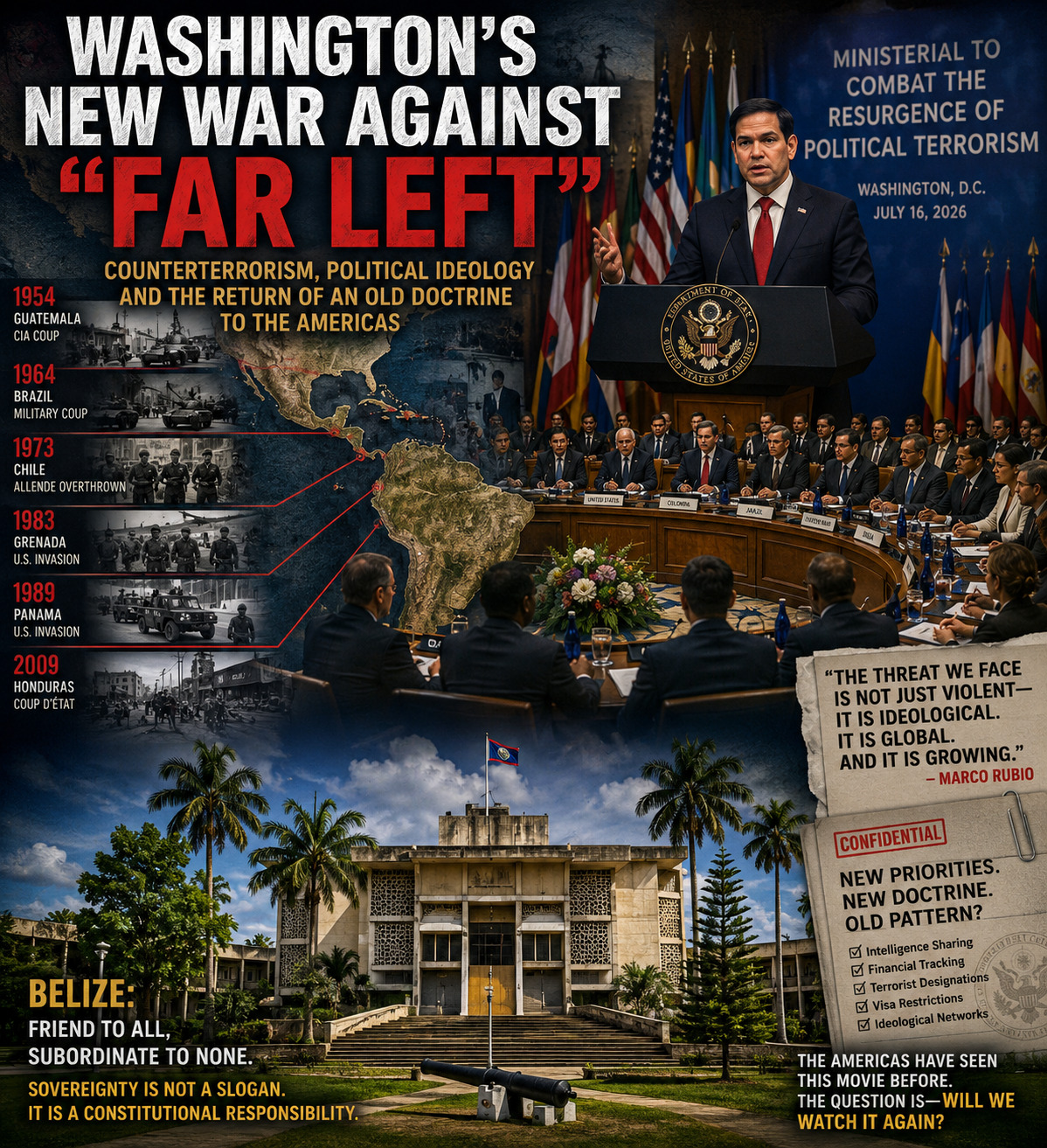
WASHINGTON’S NEW WAR AGAINST THE “FAR LEFT”: Counterterrorism, Political Ideology and the Return of an Old Doctrine to the Americas
Special Feature - Must Read:
Belize City: Tuesday 20th July 2026: The United States has opened a new international front in what it describes as the fight against terrorism.
This time, however, the principal target presented to dozens of foreign governments was not al-Qaeda, the Islamic State or another established international terrorist organization. It was what the Trump Administration calls the resurgence of transnational far-left political terrorism.
On July 16, 2026, United States Secretary of State Marco Rubio convened representatives from more than sixty countries at the State Department in Washington. Rubio called upon the participating governments to help identify, map, finance-track and dismantle what he portrayed as an expanding international network of anarchists, Marxists, communists, anti-capitalists and anti-fascist militants.
The event was not merely a discussion about occasional acts of political violence.
- It was an attempt to construct an international counterterrorism architecture around a particular ideological category.
That distinction is important.
Political violence, regardless of who commits it, must never be excused merely because its perpetrators claim to represent justice, liberation, religion, patriotism or national security. A bomb does not become morally acceptable because the bomber quotes Marx rather than Hitler. Murder does not become legitimate because it is carried out in the name of capitalism, socialism, religion or the defence of Western civilization.
- But counterterrorism becomes politically dangerous when governments cease concentrating on demonstrable criminal conduct and begin constructing broad ideological categories into which lawful dissent, protest, solidarity, opposition and social movements may eventually be placed.
That is the concern raised by Washington’s new initiative.
WHAT WAS THE SUMMIT ACTUALLY ABOUT?
The stated objective was straightforward.
- Rubio argued that far-left political violence has been ignored, minimized or romanticized by the media, universities, governments and established counterterrorism institutions. He described it as a longstanding transnational threat now undergoing a resurgence.
- He claimed that contemporary militant networks attack pipelines, railways, electrical systems, laboratories, political figures and other physical symbols of government, capitalism and Western technological power.
- He further alleged that militants travel internationally to participate in joint actions, exchange propaganda and targeting information through encrypted channels, obtain transnational financing, use clandestine safe houses and cooperate with hostile foreign governments.
Rubio therefore called for the rebuilding of international counterterrorism machinery to identify and defeat this alleged network.
The summit included senior figures from the American national-security and financial establishment. Treasury Secretary Scott Bessent spoke about using the financial tools developed against international terrorist organizations to disrupt left-wing networks. White House Deputy Chief of Staff Stephen Miller presented the issue as a civilizational struggle requiring governments to defend their societies as though an intruder had entered the family home.
Rubio also announced a visa-restriction policy broad enough to affect persons accused of supporting, financing, recruiting for or providing logistical assistance to organizations associated with political violence. The Administration has already designated four European anti-fascist or anarchist groups as foreign terrorist organizations.
The summit’s practical purpose was therefore much larger than exchanging information.
It sought to secure international cooperation for:
- mapping organizations and personal relationships;
- tracing financial transactions;
- expanding intelligence sharing;
- coordinating investigations;
- applying sanctions and visa restrictions;
- making additional terrorist designations;
- disrupting recruitment and communications;
- and redirecting existing counterterrorism institutions toward left-wing political networks.
It was, in effect, an effort to persuade foreign governments to accept Washington’s definition of the emerging threat—and then participate in the enforcement system built around that definition.
THE STRATEGIC LOGIC
The summit must be understood within the United States’ broader 2026 Counterterrorism Strategy.
- That strategy identifies three major categories of concern: narcotics cartels and transnational gangs, global jihadist organizations, and violent left-wing extremists, including anarchists and anti-fascists. It represents a major shift toward the Western Hemisphere and away from the post-September 11 concentration on Islamist militancy.
The logic appears to contain several interlocking parts.
- First, the Administration argues that traditional counterterrorism policy developed a blind spot. While governments became highly sophisticated at tracking jihadist organizations, it says comparable systems were not developed to confront violent revolutionary groups of the left.
- Second, Washington considers many modern militant movements to be transnational rather than purely domestic. Their members communicate internationally, follow similar ideological literature, participate in demonstrations across borders and sometimes raise money through overlapping solidarity networks.
- Third, the Administration believes that foreign connections provide the legal and political opening for applying counterterrorism powers that may be more difficult to employ against purely domestic political movements.
- Fourth, the strategy aligns counterterrorism policy with the Trump Administration’s wider political argument that Marxism, communism, radical gender politics, uncontrolled migration, anti-capitalism and militant anti-fascism are connected threats to Western civilization.
- Fifth, by obtaining the cooperation of dozens of governments, Washington can transform an American ideological and security priority into an international one.
The summit was therefore not an isolated diplomatic meeting. It was part of an effort to internationalize the Administration’s domestic and geopolitical worldview.
WHY THE LANGUAGE MATTERS
Rubio did not confine his criticism to named organizations proven to have committed specific terrorist offences.
He placed several ideological descriptions beside one another: anti-capitalist, anti-imperialist, communist, anarchist and Marxist. He argued that beneath their different names lay the same fundamental character—a destructive resentment disguised in the language of equality, justice and liberation.
That language moves beyond counterterrorism.
It becomes an ideological judgment.
Anti-capitalism is a political and economic position. Anti-imperialism is a historical and geopolitical position. Marxism is an ideological tradition. None of these, by itself, constitutes terrorism.
- A person may oppose capitalism without planting a bomb.
- A country may oppose foreign intervention without sponsoring terrorism.
- A trade union may advocate public ownership without becoming a security threat.
- An indigenous movement may resist land dispossession without being part of a transnational revolutionary conspiracy.
- A political movement may demand constitutional reconstruction, national industrialization, stronger public institutions or economic sovereignty without seeking the violent overthrow of the state.
The difference between belief and criminal conduct must therefore remain unmistakable.
- When governments begin with criminal acts and follow the evidence toward responsible individuals, they are enforcing the law.
- When governments begin with ideology and search outward for possible criminal associations, they risk policing political thought.
THE EVIDENCE DOES NOT JUSTIFY SELECTIVE BLINDNESS
Rubio’s underlying proposition—that violence committed in the name of the left should not be dismissed—is reasonable.
- The difficulty is the selective construction of the threat.
The available data cited in reports about the summit does indicate that left-wing incidents increased from an extremely low level and briefly exceeded far-right incidents during part of 2025. But the same data shows a much larger historical prevalence of far-right violence.
- According to figures discussed by the Associated Press, the annual average from 2016 through 2024 was approximately four left-wing incidents compared with 22.7 right-wing incidents. The apparent reversal in 2025 resulted from five incidents attributed to the left and a sharp decline to one on the right—not from left-wing violence suddenly reaching the historical scale of right-wing extremism.
- That does not mean five incidents should be ignored.
- It means the statistical context should not be manipulated.
An honest counterterrorism doctrine would examine violence across the ideological spectrum. It would pursue the anarchist who burns infrastructure, the white supremacist who attacks a minority community, the religious extremist who bombs civilians and the state official who knowingly organizes unlawful political violence.
Washington’s strategy, however, prominently elevates left-wing extremism while omitting racially and ethnically motivated violent extremism as a comparable central category. Counterterrorism specialists have criticized that omission, especially because the United States’ own reporting has documented plots involving neo-Nazis, white supremacists and other actors of the violent far right.
The problem is therefore not that the United States has identified a form of violence that should never be tolerated.
- The problem is that it is building a doctrine around one ideological direction while minimizing or excluding another with a more substantial modern record.
CUBA AT THE CENTRE—AGAIN
Cuba occupied a central place in Rubio’s presentation.
He alleged that the Cuban Government helped build far-left ideological and intelligence networks throughout the United States and the wider hemisphere. His personal and political history as the son of Cuban immigrants has long influenced his understanding of communism, the Cuban state and Latin American affairs.
Cuba unquestionably maintains political relationships, solidarity organizations and international networks. Its domestic political system, treatment of opposition, restrictions on expression and concentration of state power remain legitimate subjects for scrutiny.
But Cuba has also served for decades as Washington’s ideological centrepiece whenever the United States seeks to mobilize the hemisphere against left-wing governments or movements.
- During the Cold War, reformist governments, trade unions, peasant movements, student organizations, liberation theologians and nationalists seeking control of natural resources were frequently placed within a broad narrative of Cuban or Soviet subversion.
That history makes the present rhetoric impossible to evaluate in isolation.
- When Cuba is again described as the coordinating centre behind a transnational ideological threat, Latin America and the Caribbean are entitled to ask whether Washington has discovered a genuinely new security structure—or revived a familiar political framework under updated terminology.
THE HISTORY THE SUMMIT DID NOT DISCUSS
No serious discussion of political terrorism in the Americas can begin in 2026.
The hemisphere has an extensive history of left-wing guerrilla violence, kidnappings, assassinations and bombings. Those acts should be acknowledged without romanticism.
But the hemisphere also has a larger history of military coups, state terror, disappearances, torture centres, paramilitary organizations, death squads, assassinations and cross-border repression carried out by governments that described themselves as protectors of civilization against communism.
- Guatemala’s elected government was overthrown in 1954 through a covert operation supported by the United States.
- Brazil entered military dictatorship following the 1964 rupture.
- Chile’s elected socialist government was destabilized before the 1973 military coup that installed Augusto Pinochet.
Southern Cone dictatorships developed Operation Condor, a transnational system through which political opponents were monitored, abducted, tortured, disappeared and assassinated across national borders.
Central America became a theatre of proxy conflict, covert operations, military assistance and counterinsurgency.
- Nicaragua endured the Contra war and the mining of its harbours—actions for which the International Court of Justice found the United States responsible for violating international law.
- Grenada was invaded in 1983.
- Panama was invaded in 1989.
- Honduras became a strategic platform for American regional policy and later suffered the overthrow of President Manuel Zelaya in 2009, followed by international accommodation with the political order that emerged.
This history does not establish that every American policy was identical, that every local actor lacked agency or that every government opposed by Washington was democratic and innocent.
It establishes something more important:
The United States has never been a politically neutral observer of ideological conflict in the Americas.
- It has repeatedly defined threats, selected allies, supported preferred political orders and used economic, diplomatic, intelligence or military power to shape outcomes.
That history does not disappear merely because Washington now speaks in the language of counterterrorism.
THE MONROE DOCTRINE IN MODERN FORM
The Monroe Doctrine was announced in 1823 as opposition to renewed European colonial intervention in the Americas.
Over time, however, the United States increasingly treated the hemisphere as a strategic sphere in which Washington possessed a special authority to determine which foreign relationships, governments and political developments were acceptable.
Modern American influence rarely requires the formal language of colonialism.
It operates through:
- financial pressure;
- sanctions;
- diplomatic recognition;
- military and police assistance;
- intelligence cooperation;
- development financing;
- access to the American market;
- visa authority;
- international banking compliance;
- migration agreements;
- security classifications;
- and control over participation in major international systems.
The new counterterrorism initiative potentially adds another layer.
A government or movement that challenges American strategic preferences may no longer be described merely as socialist, anti-American or destabilizing. Through relationships—real, exaggerated or alleged—with designated foreign organizations, it may enter the much more consequential world of counterterrorism enforcement.
- That can bring surveillance, frozen assets, travel restrictions, financial exclusion, intelligence sharing and international criminal investigations.
- This is why the summit matters to small states.
BELIZE MUST LISTEN CAREFULLY
Belize was not created to become hostile toward the United States.
The United States is a major economic, diplomatic, security and human connection for Belize. Thousands of Belizean families have relatives there. Belize benefits from cooperation in education, disaster response, law enforcement, migration management, trade and development.
- Friendship and cooperation should continue.
- But friendship between sovereign states cannot mean automatic policy obedience.
- Belize must examine any future invitation to participate in this expanding counterterrorism architecture with several questions.
- What precise conduct will define a terrorist organization?
- Will ideological sympathy be treated as evidence of operational membership?
- What evidentiary standard will be required before information is shared?
Could lawful political advocacy, labour activism, anti-war protest, indigenous resistance, environmental action or constitutional reform be placed under suspicion because of foreign associations?
- Will Belizean citizens be entered into databases or financial watch systems without judicial oversight?
- Could an American designation automatically affect a person or organization in Belize?
- What appeal mechanism would exist?
- Would Parliament debate such commitments?
- Would the public ever see the agreement?
- Who would protect constitutional rights?
These are not questions asked in defence of violence.
- They are questions asked in defence of democracy.
WHY THIS MATTERS TO ANY MOVEMENT SEEKING CHANGE
Belize suffers from political stagnation, institutional dependency, limited productive capacity and an unfinished transition from colonial administration to fully developed sovereign governance.
Any movement seriously proposing to alter that condition will challenge established interests.
A programme calling for constitutional transformation, campaign-finance regulation, stronger public institutions, national industrialization, economic sovereignty, procurement reform, control of strategic resources and reduced dependency could easily be labelled radical by those who benefit from the existing arrangement.
- That does not make such a movement far left.
- It does not make it far right.
- It makes it transformational.
A democratic movement becomes dangerous only when it abandons peaceful constitutional methods, embraces political violence or attempts to extinguish the rights of others.
Belize must therefore defend a crucial line:
Radical reform is not terrorism. Opposition is not subversion. Sovereignty is not hostility. And disagreement with a foreign power is not evidence of allegiance to its enemies.
THE FAILURE OF THE PUP–UDP ERA
- Belize’s vulnerability cannot be blamed entirely on Washington or any other foreign capital.
- Large states will always pursue their interests.
The deeper responsibility lies with successive Belizean governments that have often failed to define, institutionalize and defend a coherent national interest.
Before Independence, colonial policy was developed elsewhere.
After Independence, Belize gained its flag, anthem, government and international legal personality. Yet political independence did not automatically create strategic independence.
Under both the People’s United Party and the United Democratic Party, Belize has remained dependent on foreign financing, imported energy, external expertise, international security assistance, development agencies and policy frameworks frequently designed outside the country.
Some external cooperation has been necessary and beneficial.
- But dependence becomes dangerous when governments accept externally shaped policies without sufficient parliamentary scrutiny, public consultation, constitutional safeguards or long-term national planning.
- Biometric identification programmes, migration arrangements, security agreements, information sharing and so-called safe-third-country policies cannot be treated as minor administrative matters.
They touch citizenship, privacy, mobility, sovereignty and the relationship between the individual and the state.
- A dependent government asks what a powerful partner requires.
- A sovereign government first asks what its people need, what its Constitution permits, what evidence supports the proposal and what protections must be secured.
NOT ANTI-AMERICAN—PRO-BELIZE
The most convenient response to this analysis will be to call it anti-American.
That would avoid the argument.
Belize should neither demonize the United States nor surrender its judgment to it.
- The United States is entitled to defend itself against genuine terrorism.
- It is entitled to prosecute persons who burn infrastructure, assassinate public officials or finance criminal violence.
It is entitled to ask friendly governments for lawful cooperation.
But it is not entitled to demand that the rest of the hemisphere forget history, accept ideological generalizations or surrender national decision-making to Washington’s political classifications.
Belize must be capable of saying yes where cooperation serves the national interest—and no where it does not.
That is not enmity.
That is sovereignty.
THE VERDICT ON THE SUMMIT
The Washington summit had a clear objective.
It sought to persuade more than sixty governments that transnational far-left terrorism is a growing and insufficiently recognized threat. It sought to redirect intelligence, financial, diplomatic and law-enforcement resources toward that threat. It sought to establish American leadership over the categories, organizations and networks that participating states may be expected to monitor.
Its logic is not entirely without foundation.
Violent organizations can operate across borders. Political violence from the left exists. Governments should exchange information about genuine criminal conspiracies. No ideology should grant immunity for terrorism.
But the summit’s credibility is weakened by four fundamental defects.
- First, it broadens the language of threat from identifiable violent conduct toward expansive ideological categories.
- Second, it gives insufficient attention to the historically greater danger presented by violent far-right extremism.
- Third, it places Cuba and revolutionary ideology at the centre of a narrative that closely resembles past American doctrines used to discipline the hemisphere.
- Fourth, it asks Latin America and the Caribbean to accept Washington’s moral leadership without confronting the documented history of coups, state terror, intervention and political violence supported in the name of anti-communism.
The media does not need to praise this initiative.
Neither does it need to manufacture a demon.
The Administration has publicly stated its objectives, selected its enemies and displayed the political worldview underlying its strategy.
- Our responsibility is to place those declarations beside the evidence and the history.
- The conclusion belongs to the people.
THE QUESTION BELIZE MUST ANSWER
The greatest danger to Belize may not be that Washington will suddenly classify every reform movement as terrorist.
The greater danger is that Belize could enter another international security framework without first defining its own constitutional boundaries, national interest and sovereign position.
- Political Independence was achieved on September 21, 1981.
- Strategic sovereignty remains unfinished.
Belize must remain a friend to the United States, a partner within CARICOM, a neighbour to Mexico and Central America, and a responsible member of the international community.
But friendship must never become subordination.
- Cooperation must never eliminate scrutiny.
- Security must never become an excuse for ideological policing.
- And no foreign capital—Washington or otherwise—should determine the limits of democratic thought in Belize.
The United States has every right to pursue its national interests.
Belize has every right to pursue its national interests with sovereignty and dignity.
The question that remains, after forty-five years of Independence, is whether Belize is finally prepared to pursue its own.
NATIONAL PERSPECTIVE BELIZE
Our position is neither pro-left nor pro-right. It is pro-truth, pro-democracy, pro - nationalist and unapologetically pro-Belize.
- Log in to post comments