WHEN THE RIVER CROSSES THE BORDER: A Belizean Architecture for Water Security, Environmental Sovereignty and Transformational Governance
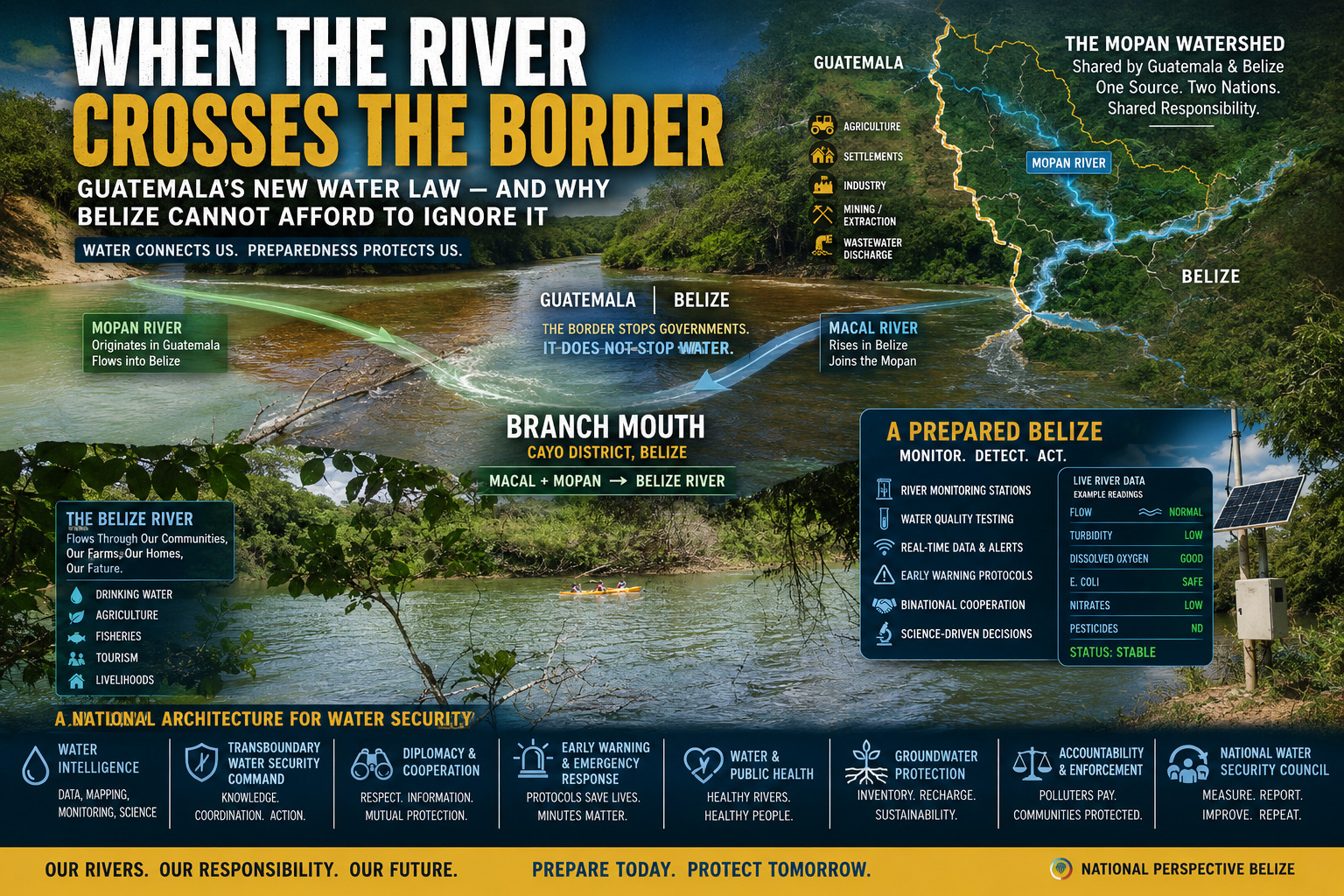
A Belizean Architecture for Water Security, Environmental Sovereignty and Transformational Governance
Belize City: Sunday 30th August 2026: Belize must begin treating water not merely as an environmental issue, but as a matter of national security, public health, economic survival and sovereign responsibility.
- The Mopan River does not ask permission before crossing an international frontier.
- Rain falling over Guatemala can eventually enter Belize.
- Agricultural runoff produced upstream can travel downstream.
- Industrial discharge can travel downstream.
- Sewage can travel downstream.
- Sediment can travel downstream.
- A chemical spill can travel downstream.
And decisions made by one country about abstraction, diversion, pollution control or watershed development can eventually become consequences for another.
This is the reality Belize must awaken to.
Guatemala is now attempting to establish a comprehensive national water law after decades without the integrated legal framework contemplated by its Constitution. That development should not be interpreted as an act against Belize. In fact, stronger water governance in Guatemala could benefit the entire region.
But Belize would be negligent if it failed to examine what that emerging system means for the rivers, aquifers and watersheds we share.
- The question before us therefore is larger than Guatemala's proposed Water Law.
The question is:
2.Does Belize possess the institutional architecture required to protect its water future?
WATER MUST BECOME A NATIONAL STRATEGIC RESOURCE
For too long, countries have treated water as something that simply exists.
- A river flows.
- A well produces.
- Rain falls.
- The tap opens.
- Until one day it does not.
Climate change, drought, population growth, agricultural expansion, urbanization, contamination and industrial demand are changing that assumption throughout the world.
Belize cannot wait for a national water crisis before constructing a national water strategy.
Water must therefore be recognized within national planning alongside energy, food, defence, infrastructure and economic security.
A modern Belizean state should know, continuously:
- where our water comes from;
- how much exists;
- how much is being extracted;
- who is extracting it;
- what its chemical and biological quality is;
- where contamination originates;
- how climate variability is changing supply;
- and what developments upstream could affect communities downstream.
If government cannot answer those questions, then government does not truly know the condition of one of the country's most valuable natural resources.
PILLAR ONE: BUILD THE NATIONAL WATER INTELLIGENCE SYSTEM
Belize needs a permanent National Water Intelligence System.
- Not another occasional study.
- Not another consultant report deposited on a government shelf.
- A functioning continuously updated national system.
Every major watershed should eventually contain monitoring stations measuring river level, flow, rainfall, temperature, turbidity, dissolved oxygen and other appropriate water-quality indicators.
- Strategic locations should additionally undergo laboratory analysis for bacteria, nutrients, pesticides, heavy metals and other contaminants according to identified risks.
- The information should feed into one national digital platform.
- That platform should allow government, scientists and eventually the public to understand what is happening to Belize's water systems almost in real time.
Imagine a national water map where policymakers could see:
GREEN: normal conditions.
AMBER: deteriorating water quality.
RED: contamination or dangerous flow conditions.
That is modern environmental governance.
We should stop governing rivers from filing cabinets.
PILLAR TWO: CREATE A TRANSBOUNDARY WATER SECURITY COMMAND
Belize's transboundary waters require special treatment.
- The Río Hondo.
- The Mopan.
- The Moho.
- The Temash.
- The Sarstoon.
These cannot be governed exclusively as domestic waterways because significant portions of their hydrological systems exist beyond Belizean territory.
Belize should therefore establish a specialized Transboundary Water Security Unit bringing together expertise from:
- the Hydrology Unit;
- Department of the Environment;
- Ministry responsible for Natural Resources;
- Ministry of Health;
- Belize Agricultural Health Authority where appropriate;
- Meteorological Service;
- Foreign Affairs;
- universities and scientific institutions;
- and national emergency-management authorities.
- Its job would not be political confrontation.
- Its job would be knowledge.
- Know what is happening upstream.
- Know what infrastructure is being proposed.
- Know where contamination risks exist.
- Know when river flow changes.
- Know what chemicals are being detected.
- Know which communities may be vulnerable.
The first obligation of competent government is to know.
PILLAR THREE: THE MOPAN–BELIZE RIVER OBSERVATORY
The Mopan should become the pilot project.
Belize should establish a permanent Mopan–Belize River Observatory.
The river corridor should be scientifically mapped from its Guatemalan catchment through the Belize border, through Benque Viejo del Carmen and western Belize, through its confluence with the Macal and onward into the Belize River.
We should identify:
- population centres;
- sewage discharge points;
- farms;
- livestock operations;
- agricultural chemical use;
- mining or quarrying activities where relevant;
- industrial facilities;
- water abstraction points;
- solid-waste sites;
- tributaries;
- erosion zones;
- and known environmental hazards.
Once those risks are mapped, monitoring becomes targeted rather than accidental.
Belize could then begin answering the question we presently cannot afford to leave unanswered:
What exactly is entering Belize through the Mopan River?
PILLAR FOUR: WATER DIPLOMACY WITH GUATEMALA
National sovereignty does not require silence between neighbours.
It requires intelligent diplomacy.
Belize should seek a formal mechanism for cooperation with Guatemala concerning shared water systems, without prejudice to either country's positions concerning territorial or maritime matters.
That distinction must be explicit.
Water cooperation should never become territorial concession.
Instead, both countries should be able to agree that families living downstream deserve warning if something dangerous happens upstream.
A future Belize–Guatemala Transboundary Waters Commission could establish protocols for:
- joint monitoring;
- exchange of hydrological information;
- notification of major upstream projects;
- emergency warnings following chemical or industrial accidents;
- pollution investigations;
- minimum scientific standards;
- drought management;
- watershed restoration;
- and dispute resolution.
Good neighbours do not have to agree about everything.
But responsible neighbours should tell each other when something entering a shared river could harm people downstream.
PILLAR FIVE: ENVIRONMENTAL EARLY WARNING
Belize should build a Water Emergency Warning Protocol.
If contamination is detected upstream, government should not begin searching for telephone numbers after the event occurs.
Protocols must already exist.
Authorities should know:
- who contacts Guatemala;
- who contacts BWS;
- who contacts hospitals;
- who contacts municipalities;
- who closes abstraction points;
- who conducts laboratory confirmation;
- who warns communities;
- and who communicates verified information publicly.
Hours matter during contamination emergencies.
Government improvisation is not preparedness.
PILLAR SIX: WATER AND PUBLIC HEALTH MUST BECOME ONE SYSTEM
Environmental monitoring and public-health monitoring cannot continue functioning as separate worlds.
If communities depend upon rivers, wells or groundwater, water security becomes health security.
The country should establish a unified surveillance regime for potable-water risks.
Where unusual gastrointestinal illness, chemical exposure or other potentially water-related health patterns appear, public-health authorities should be able to compare those cases against environmental monitoring data.
- Likewise, where a river experiences contamination, health facilities in potentially affected communities should immediately be alerted.
Information must move faster than contamination.
PILLAR SEVEN: KNOW BELIZE'S GROUNDWATER BEFORE WE LOSE IT
Our discussion cannot stop at rivers.
Groundwater represents another strategic national asset.
Belize needs a complete national groundwater inventory incorporating aquifers, recharge zones, wells, extraction volumes, saline intrusion risks and contamination vulnerabilities.
Major commercial abstractions should be measured.
- Critical recharge areas should be protected.
- Groundwater quality should be monitored.
And development planning should recognize that concrete, roads, deforestation and uncontrolled construction can interfere with groundwater recharge.
A country cannot protect an aquifer it has never properly mapped.
PILLAR EIGHT: WATER MUST ENTER ECONOMIC PLANNING
There is another dimension Belize rarely discusses.
- Water is productive capital.
- Agriculture requires it.
- Food processing requires it.
- Tourism requires it.
- Manufacturing requires it.
- Housing requires it.
- Energy production can require it.
Future industrialization therefore depends upon knowing where sustainable water supply exists.
Before Belize establishes new industrial zones, agro-processing centres or major settlements, national Development planners should calculate the available water balance.
This allows development to occur where infrastructure and natural resources can support it rather than allowing growth to overwhelm the environment afterward.
That is the difference between planning a country and reacting to one.
PILLAR NINE: ACCOUNTABILITY MUST FOLLOW POLLUTION
Environmental law means little without enforcement.
- Every significant discharge permit should be traceable.
- Every major licensed abstraction should be identifiable.
- Repeat polluters should face escalating consequences.
- Environmental fines should not simply disappear into general revenue.
- A portion should finance restoration, monitoring and scientific investigation of the affected watershed.
The principle should become simple: Those who profit from using Belize's environmental resources carry a corresponding responsibility not to destroy them.
PILLAR TEN: CREATE THE NATIONAL WATER SECURITY COUNCIL
Water policy presently touches multiple ministries and agencies.
That fragmentation can create institutional paralysis.
Belize should establish a high-level National Water Security Council responsible for coordinating national strategy.
Its membership should include government institutions, scientists, municipalities, agricultural stakeholders, utilities and appropriate civil-society expertise.
But it must not become another ceremonial committee.
It should publish measurable national objectives.
Every year Belize should know whether:
- river quality improved or deteriorated;
- groundwater monitoring expanded;
- pollution incidents increased;
- water losses decreased;
- new treatment capacity was created;
- transboundary cooperation advanced;
- and drought resilience strengthened.
Transformation requires measurement.
THE GOVERNANCE PRINCIPLE BEHIND ALL OF THIS
The deeper lesson extends beyond water.
- Belize must move from government by reaction to government by anticipation.
- Leadership cannot simply respond when something breaks.
- Transformational governance identifies vulnerabilities before they become emergencies.
- It gathers intelligence.
- It plans.
- It builds institutional capacity.
- It invests in science.
- It measures performance.
- It anticipates consequences.
- It collaborates where cooperation serves the national interest.
- And it acts before crisis makes action unavoidable.
That is what an efficient state looks like.
CONSCIENCE-DRIVEN LEADERSHIP
- Conscience-driven leadership must mean more than good intentions.
- It must translate conscience into competence.
- Compassion without institutional capacity cannot protect a river.
- Patriotism without scientific knowledge cannot protect an aquifer.
- Political speeches cannot detect pesticides.
- Partisan loyalty cannot measure river flow.
- And nationalism without preparedness cannot protect national sovereignty.
The leaders Belize requires for the coming generation must therefore bring something different to public life:
- initiative;
- professional competence;
- scientific curiosity;
- institutional discipline;
- technological literacy;
- courage to plan beyond an electoral cycle;
- respect for evidence;
- and the humility to recruit people who know more than they do.
- The transformational leader does not need to personally know everything.
- The transformational leader must know how to build a state capable of finding the answer.
THIS IS THE FUTURE TEST
Suppose tomorrow contamination is detected in the Mopan.
- A traditional government may issue a press release.
- A prepared government already knows the contaminant.
- It knows where it appeared.
- It knows where the river will carry it.
- It knows which communities are threatened.
- It knows which water intakes must close.
- It knows whom to contact across the border.
- It knows which laboratories will confirm the results.
- It knows what alternative water supply will be activated.
- And the public receives accurate information before rumours begin.
- That difference is not ideology.
- That difference is governance.
BELIZE MUST THINK A GENERATION AHEAD
The discussion surrounding Guatemala's proposed Water Law should therefore become a wake-up call rather than a source of fear.
Guatemala is examining the future management of its water resources.
- Belize should simultaneously examine ours.
- And because nature has physically connected both countries through shared watersheds, eventually both countries must construct mechanisms capable of managing what geography has already joined.
- The river gives us no alternative.
- This is bigger than one government.
- Bigger than one political party.
- Bigger than one election.
Water security belongs to the Belizean child who will be born twenty years from now and will inherit whatever condition we leave these rivers in.
Our generation therefore carries a simple obligation:
- Do not merely inherit Belize. Prepare Belize.
And perhaps that should become one of the governing principles of national transformation:
A sovereign nation does not wait for its vulnerabilities to become crises. It identifies them, understands them and prepares the institutions capable of overcoming them.
The river is already moving.
The question is whether Belizean leadership will move with equal purpose.
By Omar Silva: Editorial Director @ www.nationalperspectivebz.com
- Log in to post comments