MARANCO AND CARA ENERGY: FIFTEEN YEARS LATER, WHY NOW — AND ON WHAT TERMS?
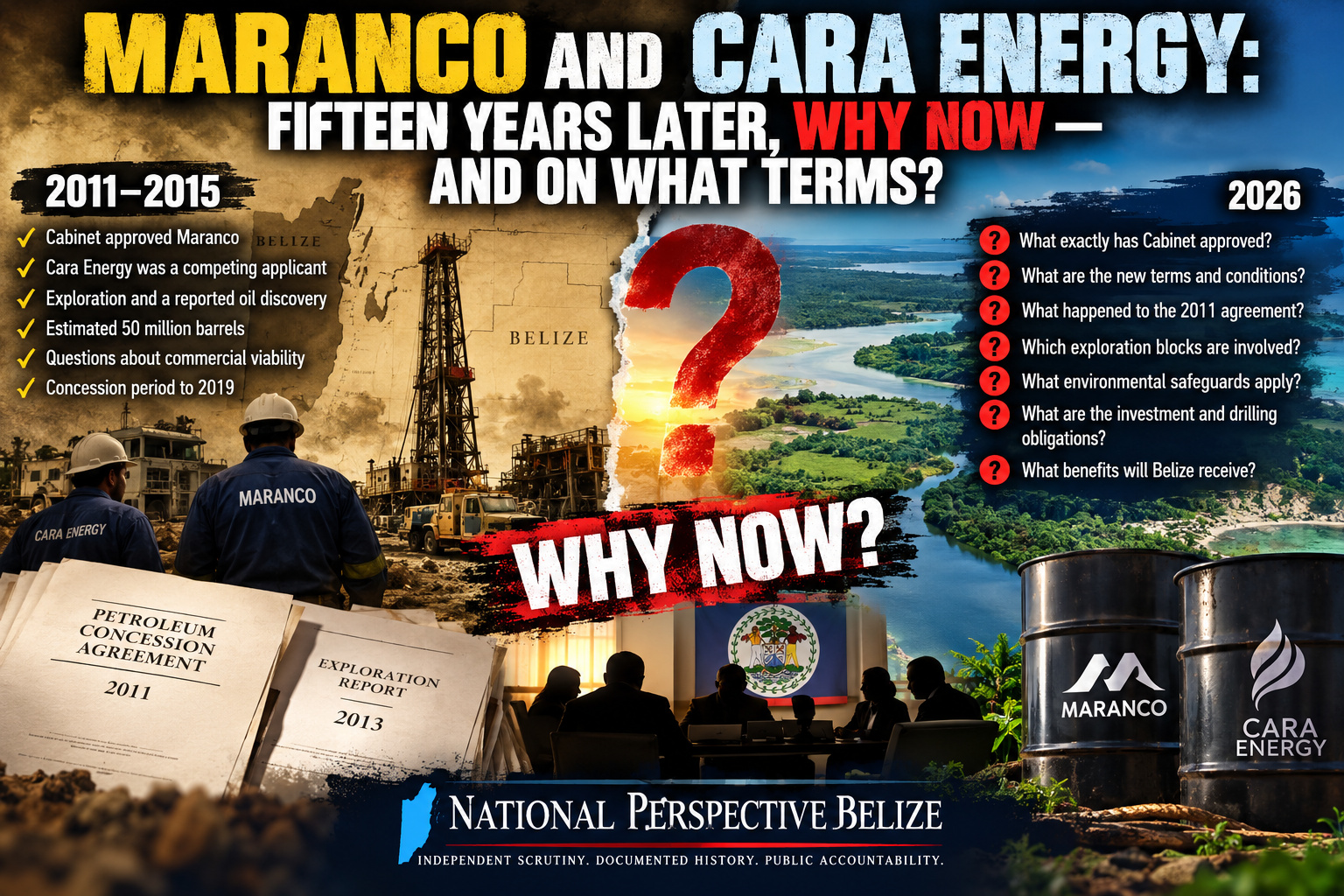
Cabinet announces new petroleum arrangements, but Belizeans deserve to know what became of earlier exploration, what has changed, and what the nation stands to gain.
SPECIAL INVESTIGATIVE FEATURE | OCTOBER 2026
Belize City: Friday 9th October 2026: The Government of Belize has reportedly approved new oil and gas arrangements involving Maranco and Cara Energy.
- At first glance, this might appear to signal renewed confidence in Belize's petroleum potential. For a country struggling with the high cost of imported fuel and searching for greater energy security, new petroleum investment deserves serious consideration.
But there is another side to this announcement.
These names are not strangers to Belize's petroleum history.
- Fifteen years ago, both companies appeared in the contest for petroleum exploration rights in northwestern Belize. One secured a production-sharing agreement. The other objected to the decision.
What followed included exploration, an oil discovery, considerable public expectations and difficult questions about commercial viability.
- Now, in 2026, the names have resurfaced.
And the Belizean public is entitled to ask one fundamental question: WHAT HAS CHANGED?
THE STORY DID NOT BEGIN YESTERDAY
- On March 9, 2011, under the administration of Prime Minister Dean Barrow, the government announced its intention to award a production-sharing agreement to Maranco Limited for petroleum exploration blocks in northwestern Orange Walk District.
Five companies had applied, including Belize Natural Energy, Cara Energy Belize Limited, New Hope Natural Resources and Providence Energy Belize.
- Maranco emerged as the government's preferred applicant.
By March 29, Cabinet had confirmed its decision.
- The proposed concession was controversial because portions of the exploration area included the Rio Bravo Conservation and Management Area.
- Environmental organizations raised concerns about the potential consequences for protected ecosystems.
Cara Energy and Belize Natural Energy also objected to the award.
- This history matters because it establishes that the petroleum interests now being discussed were already part of Belize's commercial and governmental considerations fifteen years ago.
WHAT WERE THE ORIGINAL TERMS?
Contemporary reporting by Amandala indicated that Maranco's 2011 agreement provided for a 10 percent royalty on crude oil and natural gas, together with production-sharing revenues ranging from 15 to 40 percent, depending on production volumes.
- The company subsequently reported that its agreement covered approximately 378,565 acres, with an initial exploration period and provisions for renewals.
These are not insignificant details.
They provide a historical benchmark against which the terms of any new petroleum agreement should be examined.
- If the government has negotiated improved conditions, Belizeans should be told what those improvements are.
- If the terms are substantially similar, the government should explain why.
- And if the arrangements involve different exploration areas, financing structures or obligations, those differences deserve public disclosure.
THE OIL DISCOVERY THAT RAISED EXPECTATIONS
- In March 2013, Maranco announced an encouraging oil discovery at its South Canal Bank #1 exploration well in Orange Walk.
Further appraisal followed.
- By March 2014, public reports referred to a possible petroleum resource of approximately 50 million barrels at South Canal Bank #3.
For a country of Belize's size, the figure naturally attracted attention.
But there was an important qualification.
- The petroleum was difficult to extract.
Contemporary reports described heavy crude oil trapped in formations with limited permeability. Extracting it economically presented serious technical and financial challenges.
- Indeed, Prime Minister Dean Barrow publicly discussed seeking technical assistance from Trinidad and Tobago to better understand the extraction difficulties.
- The estimated resource was therefore not equivalent to 50 million barrels of proven, commercially recoverable oil.
That distinction remains essential today.
- Oil discovered beneath Belizean soil does not automatically become oil produced, sold or converted into national revenue.
WHAT HAPPENED BETWEEN THEN AND NOW?
A World Bank document subsequently recorded Maranco's production-sharing agreement as running from May 3, 2011, to May 2, 2019.
- It also identified extended production testing under an appraisal programme in 2015.
These records demonstrate that exploration activities did take place.
- But they do not, by themselves, establish the final commercial outcome of the concession.
- Did the discovery ultimately prove commercially viable?
- Were the original exploration and appraisal commitments fulfilled?
- Was commercial production authorized or undertaken?
- What petroleum royalties, taxes or other payments resulted?
- Did the concession expire in 2019, or was its legal status subsequently altered?
These questions cannot be answered simply by revisiting the original announcements.
- They require the government's petroleum records and the companies' documented performance.
CARA ENERGY: A DIFFERENT QUESTION
Cara Energy's historical involvement must also be examined accurately.
- In 2011, Cara Energy Belize Limited was a competing applicant for the Orange Walk concession awarded to Maranco.
- It was not the recipient of that particular agreement.
Consequently, the public should not assume that Cara Energy's commercial history or obligations are identical to Maranco's.
- The government should identify precisely which legal entities are involved in the 2026 approvals, their ownership, the petroleum blocks concerned and their respective exploration obligations.
The fact that both names appeared in the 2011 proceedings does not establish that the new arrangements are renewals of the same agreement.
- That is precisely why disclosure is necessary.
CABINET APPROVAL IS NOT THE END OF THE STORY
The latest announcement raises an immediate transparency question.
- What, specifically, has Cabinet approved?
- Has the government executed legally binding production-sharing agreements?
- Has it approved applications subject to further conditions?
- Are environmental assessments still required?
- Have the companies demonstrated sufficient technical and financial capacity to undertake the proposed exploration?
- What are the investment commitments, timelines and consequences for non-performance?
A Cabinet announcement may establish that a governmental decision has been taken.
- It does not necessarily tell the public whether a petroleum project is financially secured, technically viable or ready for implementation.
Those distinctions matter.
THE NATIONAL INTEREST MUST BE MEASURABLE
- Belize has every reason to examine opportunities for responsible development of its petroleum resources.
- Petroleum exploration can attract investment, create employment, generate public revenues and improve knowledge of the country's geological potential.
But these benefits must be measured against commercial risk, environmental obligations and the actual terms negotiated.
- The existence of domestic petroleum resources also does not automatically translate into lower fuel prices.
- Belize's retail fuel prices depend on refined-product supply, transportation, taxation, distribution and other costs.
Any suggestion that new exploration agreements will reduce the cost of gasoline or diesel must therefore be supported by a credible commercial explanation.
- A petroleum agreement should be judged by what it obligates the parties to deliver, not merely by the expectations surrounding its announcement.
SEVEN QUESTIONS CABINET SHOULD ANSWER
National Perspective Belize places the following questions in the public domain:
- What are the exact legal and commercial arrangements approved for Maranco and Cara Energy in 2026?
- What became of Maranco's original 2011 production-sharing agreement, including its exploration results and financial obligations?
- What is the current ownership, technical capacity and financial standing of the companies receiving approval?
- What royalty rates, production-sharing provisions, taxes, exemptions and guarantees are included in the new arrangements?
- Which petroleum blocks are involved, and what environmental assessments and safeguards apply?
- What minimum exploration expenditures, drilling commitments and implementation deadlines have been established?
- What measurable benefits does the government anticipate for Belize, and how will the public be able to verify them?
These are not accusations.
- They are questions arising from documented history and a new government announcement.
FIFTEEN YEARS LATER, BELIZE DESERVES AN EXPLANATION
- The Barrow administration made its petroleum decision in 2011.
- The Briceño administration is now announcing new arrangements in 2026.
Different governments. Different economic circumstances. Different opportunities, perhaps.
- But the same fundamental obligation remains.
Belize's natural resources belong to the nation, and decisions concerning their commercial development must be accountable to the people.
- There may be sound geological, financial and commercial reasons for renewed interest in Maranco and Cara Energy.
- There may be improved technology, new financing or revised exploration opportunities that distinguish today's proposals from those of fifteen years ago.
If so, the government has an opportunity to explain them.
National Perspective Belize welcomes a substantive response from the Ministry responsible for petroleum, the Geology and Petroleum Department, Cabinet and the companies themselves.
- The public should not be expected to draw conclusions from an announcement whose material conditions remain undisclosed.
- The question is not simply why Maranco and Cara Energy have returned to the headlines.
- The question is what Belize has learned from fifteen years of petroleum exploration — and whether those lessons are reflected in the agreements now being approved.
FIFTEEN YEARS LATER, WHY NOW — AND ON WHAT TERMS?
National Perspective Belize — Independent scrutiny. Documented history. Public accountability.
By: Omar Silva – Editorial Director @ www.nationalpersprctivebz.com
- Log in to post comments