BELIZE’S MIRROR MOMENT: THE HANDSHAKE THAT BELIZE CANNOT IGNORE
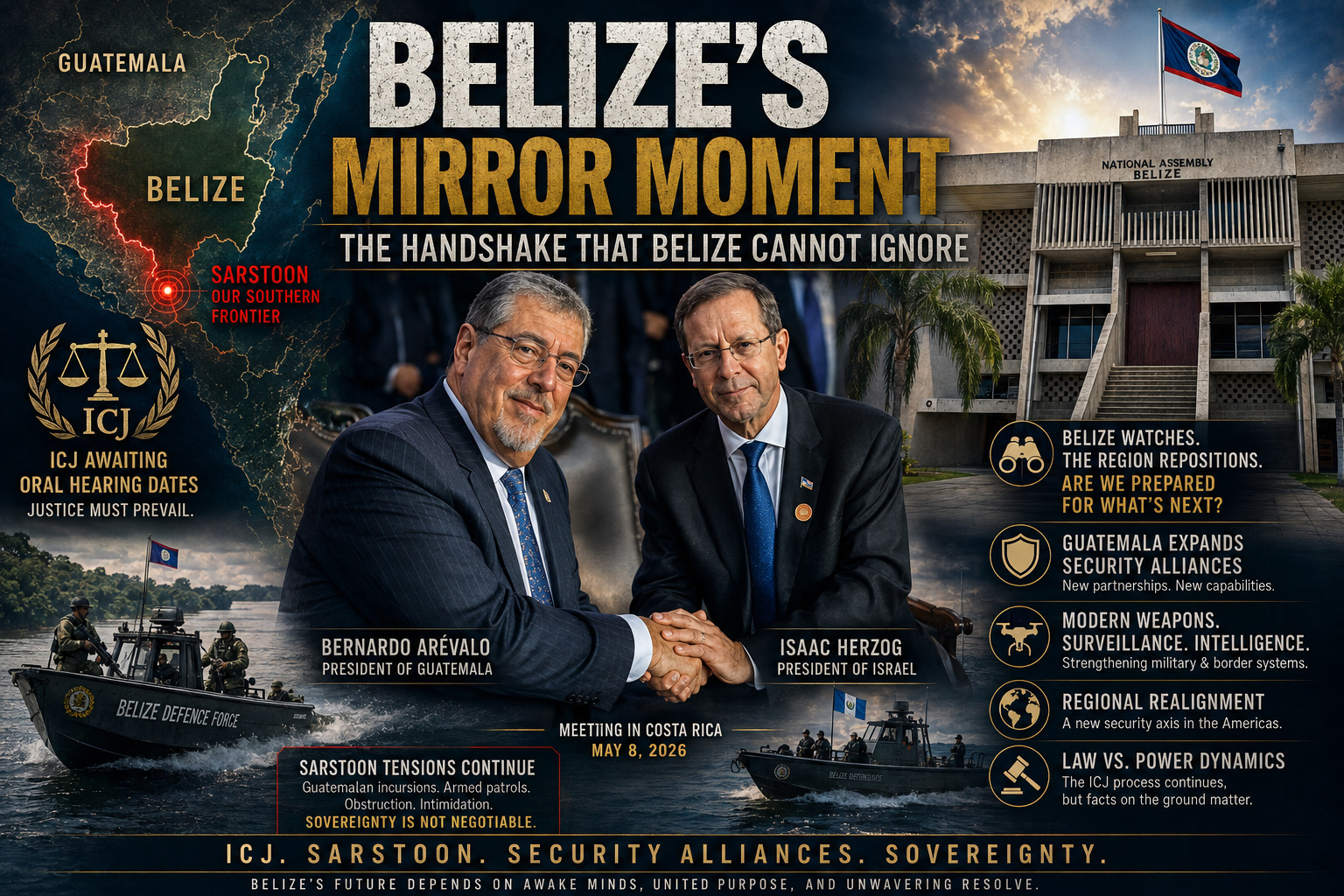
While Belize Waits at the ICJ, Guatemala Builds Alliances, Expands Security Ties, and Tests the Sarstoon
By: Omar Silva |Editor/Publisher
National Perspective Belize -Digital
Belize City: Saturday 9th May 2026
A National Perspective Investigative Feature
There are moments in history that arrive quietly.
No declaration of war.
No emergency broadcast.
No marching armies crossing borders.
Just handshakes.
Photographs.
Diplomatic smiles.
Security meetings.
Strategic alliances.
And then one day, a nation suddenly realizes the geopolitical chessboard was moving around it while it remained distracted by internal politics, partisan theatrics, and daily survival.
The recent meeting held on Friday ,8th May in Costa Rica between Guatemalan President Bernardo Arévalo and Israeli President Isaac Herzog — alongside the presence of regional leaders including Panama’s President José Raúl Mulino — may appear harmless to the ordinary eye.
But for Belize, awaiting a fixed oral hearing date at the International Court of Justice (ICJ) regarding Guatemala’s long-standing territorial claim, this meeting deserves far deeper scrutiny.
Because timing in geopolitics is rarely accidental.
THE HANDSHAKE THAT SHOULD NOT BE IGNORED
The official narrative surrounding the meeting spoke of:
- “historic friendship,”
- bilateral cooperation,
- diplomacy,
- technology,
- economic collaboration,
- and security cooperation.
Simple words.
But beneath those words lies a wider hemispheric reality now taking shape across Latin America and the Caribbean.
A new security axis is quietly emerging.
An axis centered around:
- intelligence sharing,
- border security,
- military modernization,
- surveillance technology,
- anti-crime cooperation,
- migration control,
- cybersecurity,
- and geopolitical alignment with Western strategic interests.
And Guatemala is positioning itself directly inside that architecture.
Belize must ask itself:
Where do we fit into this changing regional order?
BELIZE WAITS… WHILE GUATEMALA MOVES
Belize remains before the ICJ awaiting the Court’s formal scheduling of oral hearings regarding Guatemala’s claim over:
- Belizean territory,
- maritime space,
- and sovereignty.
The Belizean people are repeatedly told:
“Trust the process.”
Yet while Belize waits in legal silence, Guatemala continues:
- strengthening military capability,
- deepening strategic alliances,
- modernizing security structures,
- and asserting itself aggressively at the Sarstoon.
This is not paranoia.
These are observable realities.
THE SARSTOON IS NOT “NORMAL”
Belizeans must stop treating Sarstoon incidents as isolated episodes.
They are not.
They are strategic signals.
Repeated Guatemalan incursions and aggressive manoeuvres near Belize’s southern waters reveal something deeper:
- pressure,
- testing,
- normalization of presence,
- and psychological conditioning.
Every time Guatemalan armed patrols:
- obstruct Belizean navigation,
- challenge Belizean vessels,
- plant symbolic markers,
- or create confrontational encounters,
they are not merely “patrolling.”
They are reinforcing a narrative of disputed authority.
And in geopolitical conflicts, perception matters almost as much as law.
THE DANGEROUS CONTRADICTION
Here lies the contradiction Belizeans must understand clearly:
Guatemala speaks peace in The Hague…
while projecting pressure at the Sarstoon.
One hand presents diplomacy.
The other hand quietly reinforces strategic leverage.
This dual-track strategy is not uncommon in international disputes.
History is full of nations negotiating formally while simultaneously:
- strengthening military posture,
- building alliances,
- shaping international perception,
- and testing territorial reaction thresholds.
WHY ISRAEL’S ROLE MATTERS
Israel is not simply another diplomatic friend to Guatemala.
Israel is:
- a major security and intelligence power,
- a leader in surveillance systems,
- drone technology,
- border monitoring,
- cybersecurity,
- and military modernization.
For decades, Guatemala and Israel have maintained exceptionally close relations.
This latest meeting signals continuity.
Belize must therefore recognize an uncomfortable reality:
Guatemala’s growing international security relationships may indirectly strengthen its long-term strategic posture surrounding Belize.
Not necessarily through direct aggression —
but through:
- enhanced intelligence capability,
- improved maritime surveillance,
- stronger border systems,
- military training,
- and geopolitical backing.
BELIZE’S STRATEGIC WEAKNESS
The greatest danger to Belize may not be military inferiority.
It may be national complacency.
Belize remains internally consumed by:
- partisan politics,
- tribal political loyalty,
- corruption scandals,
- economic hardship,
- and political distraction.
Meanwhile the larger geopolitical environment surrounding Belize is evolving rapidly.
The Belizean public is rarely engaged in serious national discussions regarding:
- sovereignty doctrine,
- maritime security,
- territorial defense,
- geopolitical alliances,
- or long-term national strategy.
Instead, these issues remain confined to small diplomatic circles while the population remains psychologically detached from the magnitude of what is unfolding.
THE ICJ IS NOT THE END OF THE STORY
Many Belizeans mistakenly believe:
“Once the ICJ rules, the matter ends.”
History says otherwise.
Even after court rulings:
- implementation,
- interpretation,
- political acceptance,
- enforcement,
- and future tensions
can continue for decades.
International law is powerful —
but geopolitics often determines how that law is lived in reality.
BELIZE MUST WAKE UP
This is not a call for panic.
Nor hostility.
Nor reckless nationalism.
It is a call for awareness.
Belize must:
- strengthen maritime presence,
- modernize national security capacity,
- deepen regional diplomacy,
- improve intelligence coordination,
- educate the population on sovereignty matters,
- and build a unified national posture beyond party politics.
Because sovereignty is not defended only in courtrooms.
It is defended through:
- preparedness,
- national unity,
- diplomatic agility,
- strategic clarity,
- and constant vigilance.
THE REAL QUESTION
The Costa Rica meeting may eventually fade from headlines.
But Belizeans should ask themselves one critical question:
While Guatemala prepares strategically for the future…
is Belize preparing at all?
Or are we merely hoping history will protect us?
Because history protects no nation that refuses to understand the moment standing before it.
- Log in to post comments