BELIZE’S LOST HUMAN CAPITAL, What If the Problem Isn’t Just Our Schools?
WORLD BANK'S NEW HUMAN-CAPITAL LENS PUTS BELIZE UNDER A DIFFERENT MICROSCOPE
Special Feature
Belize City: Tuesday 8th September 2026: For decades, when Belize has discussed human development, much of the national conversation has revolved around schools.
Build more classrooms. Provide scholarships. Train teachers. Expand access to tertiary education. Introduce technology. Improve examination results.
All are important.
- But what if the development of a Belizean child begins to diverge from that of another Belizean child long before either enters the classroom?
- What if the community in which that child grows up helps determine how much opportunity he or she will eventually have?
- And what if, after years of education, the economy into which that young Belizean emerges does not provide the kind of workplace where skills continue to develop, productivity increases and wages rise?
That is the larger question emerging from the World Bank Group's Human Capital Report 2026.
Its central argument should command Belize's attention:
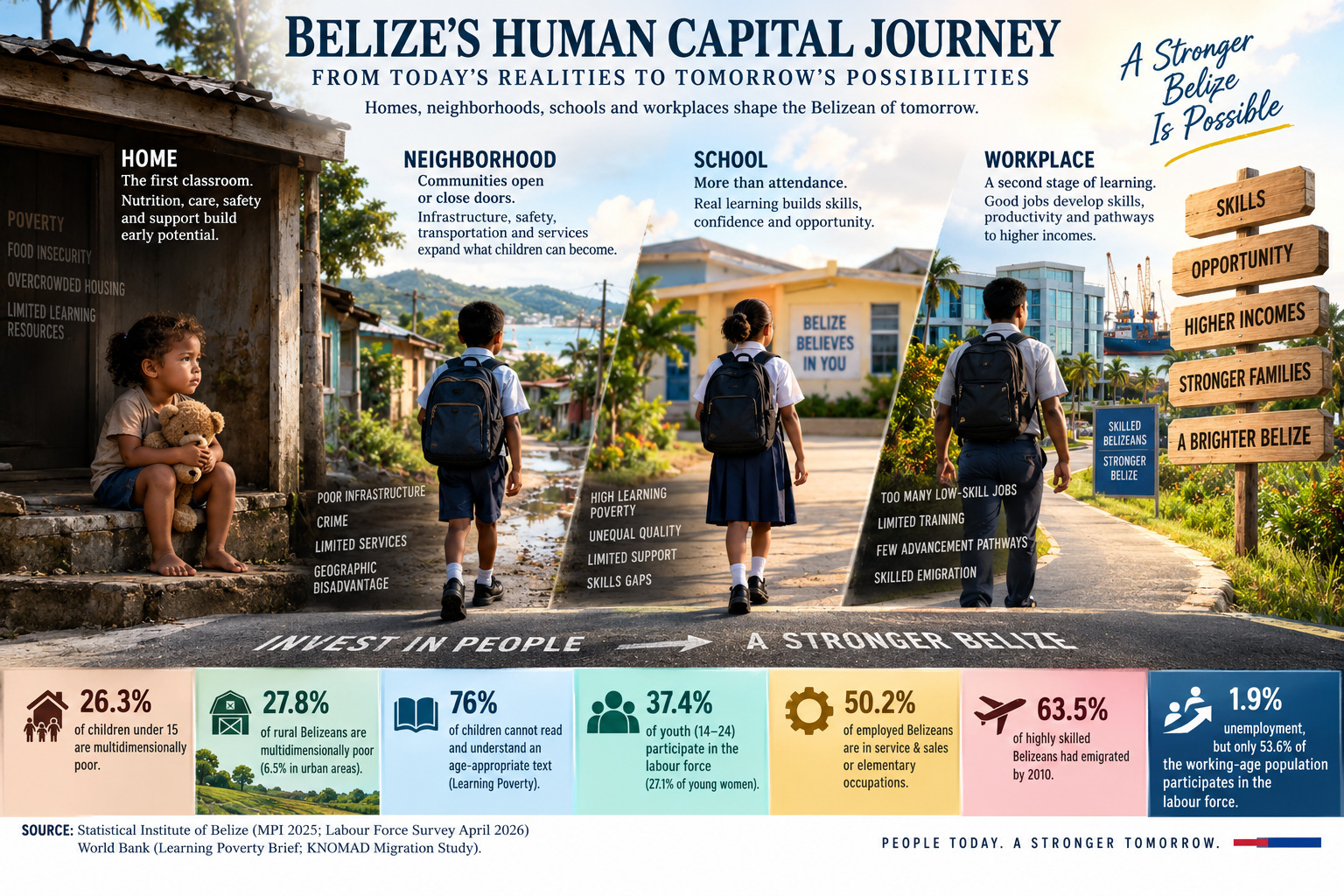
Human capital is not produced by schools alone. It is formed continuously—in homes, neighborhoods and workplaces.
That seemingly simple observation fundamentally changes how a country such as Belize should diagnose poverty, education, employment and economic development.
- It means that a struggling child cannot be understood only by examining the school.
- It means that unemployment statistics cannot tell us whether workers are progressing.
- And it means that economic growth cannot automatically be interpreted as human development.
For Belize, this provides an opportunity to look at ourselves differently.
HUMAN CAPITAL IS THE WEALTH INSIDE PEOPLE
Human capital is essentially the accumulated health, knowledge, skills, experience and capabilities that allow people to participate productively in society and the economy.
- Roads are capital.
- Electricity infrastructure is capital.
- Factories are capital.
- Ports are capital.
But so is a healthy five-year-old child capable of learning.
- So is a trained electrician.
- So is an experienced nurse.
- So is an agricultural technician.
- So is a teacher.
- So is an engineer capable of designing the infrastructure that Belize otherwise pays foreign specialists to design.
A country's people are therefore not merely beneficiaries of development.
They are themselves one of its greatest productive assets.
The World Bank's new framework consequently asks governments to examine where that asset is actually being created—or diminished.
And it identifies three environments that extend far beyond conventional education policy:
- THE HOME.
- THE NEIGHBORHOOD.
- THE WORKPLACE.
When we place Belize beneath those three lenses, an uncomfortable national picture begins to emerge.
THE FIRST CLASSROOM: THE BELIZEAN HOME
Before a teacher ever encounters a child, years of human-capital formation have already taken place.
- Nutrition matters.
- Language exposure matters.
- Books matter.
- Parental education matters.
- Safety matters.
- Housing conditions matter.
- Internet access increasingly matters.
Even whether a child has somewhere quiet to sleep and study matters.
The World Bank reports that disparities associated with family circumstances can emerge before age five and persist through adolescence.
Now place Belize inside that observation.
- The World Bank's Belize country assessment reports multidimensional poverty affecting approximately 22.1 percent of the population.
- Among children aged 0–14, however, the figure rises to approximately 30.5 percent.
That should stop us in our tracks.
- Nearly one in three Belizean children in that age category is experiencing multidimensional poverty.
- These children may eventually enter what is technically the same national education system as children from more prosperous households.
But they are not necessarily arriving at the same starting line.
- One child may have reliable electricity, broadband internet, a computer, nutritious meals, books, transportation, educated parents and perhaps private tutoring.
- Another may share a crowded home, depend upon irregular connectivity, struggle with transportation, experience food insecurity or have parents working multiple jobs simply to maintain the household.
- Both children may wear uniforms.
- Both may appear on an enrolment statistic.
- Both may sit examinations.
But equality of enrolment is not necessarily equality of opportunity.
The classroom inherits inequalities that the classroom did not create.
That distinction should fundamentally influence Belize's social policy.
THE SECOND CLASSROOM: THE NEIGHBORHOOD
Now move outside the house.
The World Bank's framework argues that neighborhoods themselves influence human-capital development.
Where people live affects their access to schools, healthcare, transportation, infrastructure, safety, employment and social networks.
That observation carries enormous significance for Belize because geography remains one of the country's great determinants of opportunity.
There is not one uniform Belizean childhood.
- A child growing up in metropolitan Belize City experiences a different environment from a child in rural Toledo.
- A young person living in Belmopan does not necessarily confront the transportation difficulties of someone in a remote village.
- Someone growing up in San Pedro may live inside one of Belize's most economically productive tourism zones while simultaneously confronting extraordinarily high housing and living costs.
The northern agricultural communities face yet another economic environment.
Infrastructure therefore becomes human-capital policy.
- A road is not simply asphalt.
- It determines whether someone can reach school, employment, healthcare and markets.
Reliable electricity is not simply an energy statistic.
- It determines whether children can study, businesses can operate and technology can be deployed.
Internet connectivity is no longer a luxury.
- It determines access to education, information, commerce and increasingly employment itself.
Public safety also belongs inside this equation.
- When crime restricts mobility, discourages investment and consumes young lives, it destroys human capital.
The World Bank's Belize assessment identifies infrastructure deficiencies, skills shortages and crime among constraints affecting private-sector development.
Multidimensional poverty also remains substantially more pronounced in rural Belize.
The question therefore cannot merely be:
Did government build a school?
It must become: What environment surrounds that school, and what opportunities surround the child who leaves it every afternoon?
THE THIRD CLASSROOM: SCHOOL
None of this diminishes the importance of education.
- It actually makes education more important.
But it also explains why schools cannot carry the entire burden of correcting inequality.
- Teachers receive children carrying the accumulated consequences of their homes and communities.
- Schools are then expected to compensate.
- Some succeed remarkably.
- Others struggle.
Belize consequently needs to examine not merely school attendance, but actual learning.
- Can children read and comprehend at the appropriate level?
- Can they perform mathematics?
- Can they use technology?
- Can they solve problems rather than merely reproduce information?
- Do graduates possess the technical and interpersonal skills demanded by a changing economy?
And perhaps the most important question: What economy are we educating them for?
Because education without an economic destination creates another problem.
- It can produce qualifications without opportunity.
THE FOURTH CLASSROOM: THE WORKPLACE
This may be the most overlooked component of Belize's human-capital debate.
Education does not end at graduation.
The World Bank estimates that workplace learning accounts for at least one-quarter of the human capital workers accumulate during their careers.
That means the quality of jobs matters enormously.
- A job is therefore more than a pay check.
- A good job should also increase the worker's productive value.
Consider two young Belizeans who begin working at age twenty.
- One enters an organization offering structured training, technology, certification, mentorship and opportunities for promotion.
- The other performs essentially the same low-skill function for fifteen years without formal training or meaningful advancement.
- At age thirty-five, both have fifteen years of employment.
- But they have not accumulated fifteen equivalent years of human capital.
- One has been climbing.
- The other has largely been standing still.
That distinction should transform the way Belize talks about employment.
LOW UNEMPLOYMENT DOES NOT AUTOMATICALLY MEAN HIGH DEVELOPMENT
Belize has recently recorded historically low unemployment.
That is positive.
But another question must follow:
What kinds of jobs are being created?
Employment quantity and employment quality are not identical.
- A tourism job can provide valuable skills—but does the worker progress into management, hospitality technology, finance, marketing and ownership?
- An agricultural worker can accumulate tremendous practical knowledge—but does the economic system provide pathways into agronomy, mechanization, food science, processing and export logistics?
- A construction worker may spend decades building Belize—but can that experience lead to recognized certification, higher productivity and substantially higher wages?
- Can a mechanic become a mechatronics specialist?
- Can an electrician become a renewable-energy technician?
- Can a farm worker become a food-processing technician?
- Can a hotel employee become an owner?
These transitions determine whether an economy simply uses labour or continuously develops people.
BELIZE DOES NOT ONLY NEED MORE JOBS — IT NEEDS BETTER LEARNING JOBS
This is where human-capital policy collides with industrial policy.
If Belize predominantly produces low-productivity jobs, the workplace cannot sufficiently perform its role as the fourth classroom.
The country therefore needs enterprises capable of absorbing increasingly sophisticated skills.
- Agro-processing.
- Renewable energy.
- Engineering.
- Digital services.
- Logistics.
- Marine industries.
- Advanced tourism services.
- Construction technology.
- Food manufacturing.
- Creative industries.
- Specialized healthcare.
- Information technology.
These sectors do more than generate employment.
- Properly developed, they create skill ladders.
- And skill ladders create wage ladders.
This is why Belize's persistent dependence on imported finished products deserves examination from another perspective.
- When Belize exports raw or minimally processed products and imports higher-value finished goods, it does not merely export economic value.
- In many instances, it also exports the opportunity for somebody else to acquire the manufacturing, engineering, logistics, scientific and managerial skills associated with transforming those products.
- The factory located somewhere else becomes someone else's classroom.
THE HUMAN-CAPITAL CHAIN
The World Bank framework allows Belize's development problem to be visualized as one interconnected chain:
HOME → NEIGHBORHOOD → SCHOOL → WORKPLACE → PRODUCTIVITY → WAGES → NEXT GENERATION
Now consider what happens when several links become weak.
- A child begins life inside poverty.
- The neighborhood provides limited services and opportunity.
- The school struggles to compensate for accumulated disadvantage.
- The young person leaves education with inadequate skills—or adequate skills but insufficient opportunity.
- The economy offers employment with little workplace training or advancement.
- Productivity remains low.
- Wages remain constrained.
- That worker establishes a household.
- And the next child begins the cycle again.
- Poverty consequently becomes more than insufficient income.
It becomes an intergenerational transmission mechanism.
WHY GOVERNMENT MINISTRIES CANNOT OPERATE AS ISLANDS
This analysis produces another important conclusion for Belize.
- Human-capital development cannot belong exclusively to the Ministry of Education.
- The Ministry of Health influences it through maternal health, childhood nutrition and healthcare.
- Infrastructure influences it through roads, transportation and connectivity.
- Energy policy influences it through reliable and affordable electricity.
- Housing policy influences it through living conditions.
- Public-safety policy influences it through the environment in which children and businesses operate.
- Agriculture influences it through rural livelihoods and opportunities.
- Economic-development policy determines what industries exist to absorb increasingly skilled workers.
- The private sector determines how much learning occurs inside workplaces.
Human-capital development therefore requires institutional interdependence.
Government cannot repair one link while allowing the remaining chain to deteriorate.
THE WORLD BANK'S BELIZE STRATEGY NOW MAKES MORE SENSE
This is also why the World Bank's new Country Partnership Framework for Belize deserves closer examination.
Approved in 2026, it places significant emphasis on economic opportunity, private-sector development, skills, better employment and energy.
- Viewed separately, those can appear to be unrelated development projects.
- Viewed through the human-capital framework, however, they are interconnected.
- Reliable energy enables productive businesses.
- Productive businesses create better employment.
- Better workplaces create skills.
- Greater skills improve productivity.
- Greater productivity can support higher incomes.
- Higher household incomes can improve childhood development.
- And stronger childhood development improves the next generation's productive potential.
That is the development circle Belize should be attempting to create.
BUT THERE IS ANOTHER BELIZEAN PROBLEM: THE HUMAN-CAPITAL LEAK
Suppose Belize successfully educates a nurse, engineer, teacher, technician, accountant or computer specialist.
What happens when that person concludes that the best opportunity lies abroad?
- Migration can produce remittances and valuable international experience.
- But persistent skilled emigration can also represent a transfer of human capital.
- The Belizean household invests.
- The Belizean education system invests.
- The state may subsidize training.
- The individual sacrifices years acquiring expertise.
- Then another economy captures much of that worker's productive contribution.
This is not an argument against Belizeans exercising their freedom to migrate.
- It is an argument for creating a country competitive enough that remaining—or returning—becomes attractive.
- Human-capital policy must therefore include retention.
FROM SCHOLARSHIPS TO A NATIONAL HUMAN-CAPITAL STRATEGY
Belize has invested in scholarships and professional training.
Those initiatives are valuable.
But scholarships should form part of something much larger.
Belize needs to know:
- What skills will the country require in five, ten and twenty years?
- What industries are capable of employing those skills?
- Where are the geographical concentrations of childhood deprivation?
- Which communities are producing persistent educational disadvantages?
- Which employers are investing in worker training?
- Which sectors provide genuine upward mobility?
- Which qualifications are being produced faster than the economy can absorb them?
- Which critical skills are Belize importing because we have failed to develop sufficient domestic capacity?
- And which Belizean professionals are leaving—and why?
Only when these questions are connected can education planning become national-development planning.
THE MEASURE OF DEVELOPMENT MUST CHANGE
Perhaps this is the most important lesson.
Belize frequently measures development through inputs.
- How much was spent?
- How many scholarships were awarded?
- How many classrooms were constructed?
- How many people were employed?
- How much did GDP grow?
Those indicators matter.
But human-capital development demands another set of questions.
What changed in people's capabilities?
- Did children become healthier?
- Did students actually learn more?
- Did workers become more skilled?
- Did productivity increase?
- Did wages rise with productivity?
- Did disadvantaged communities begin catching up?
- Did young Belizeans acquire credible pathways toward ownership and professional advancement?
- Did the country become less dependent upon imported expertise?
Those are outcome questions.
And ultimately development must be measured by outcomes.
BELIZE'S GREATEST NATURAL RESOURCE MAY NOT BE BENEATH THE GROUND
Belize frequently speaks about its natural wealth.
- Our forests.
- Our agricultural lands.
- Our reef.
- Our marine resources.
- Our petroleum history.
- Our tourism assets.
- Our geographic position between Central America and the Caribbean.
But there is another national resource that cannot be mined, harvested or imported.
The productive potential of the Belizean people.
- Every child whose abilities are diminished by preventable deprivation represents productive potential never fully realized.
- Every young person leaving school without adequate learning represents capacity lost.
- Every trained Belizean unable to find an appropriate opportunity represents underutilized investment.
- Every worker trapped for decades in employment that provides neither training nor advancement represents productivity that could have been developed.
And every skilled Belizean who concludes that opportunity exists everywhere except home should force the country to ask why.
The World Bank's Human Capital Report therefore provides Belize with something more useful than another international ranking.
It provides a mirror.
And what that mirror suggests is that the country's human-capital challenge does not begin at the schoolhouse door and does not end at graduation.
- It begins in the home.
- It is shaped by the neighborhood.
- It is strengthened—or weakened—by school.
- It continues inside the workplace.
And ultimately it determines the productivity, income and possibilities inherited by the next generation.
The national question should therefore no longer be merely:
How much are we spending on education?
It should be:
WHAT KIND OF BELIZEAN ARE OUR HOMES, COMMUNITIES, SCHOOLS, WORKPLACES AND ECONOMY GIVING PEOPLE THE OPPORTUNITY TO BECOME?
Because a country that fails to develop the capabilities of its people eventually pays for that failure everywhere else—in poverty, productivity, inequality, crime, migration, dependency and lost economic opportunity.
Belize cannot industrialize without human capital.
- It cannot achieve energy sovereignty without human capital.
- It cannot modernize agriculture without human capital.
- It cannot strengthen healthcare without human capital.
- It cannot build stronger institutions without human capital.
- And it cannot transform its economy while leaving large numbers of its people trapped at the bottom of the development ladder.
Belize's greatest development project is therefore not a building, highway, loan or foreign-funded programme.
It is the Belizean people themselves.
By: Omar Silva – Editorial Director @ www.nationalperspectivebz.com©
NATIONAL PERSPECTIVE BELIZE ©
- Log in to post comments