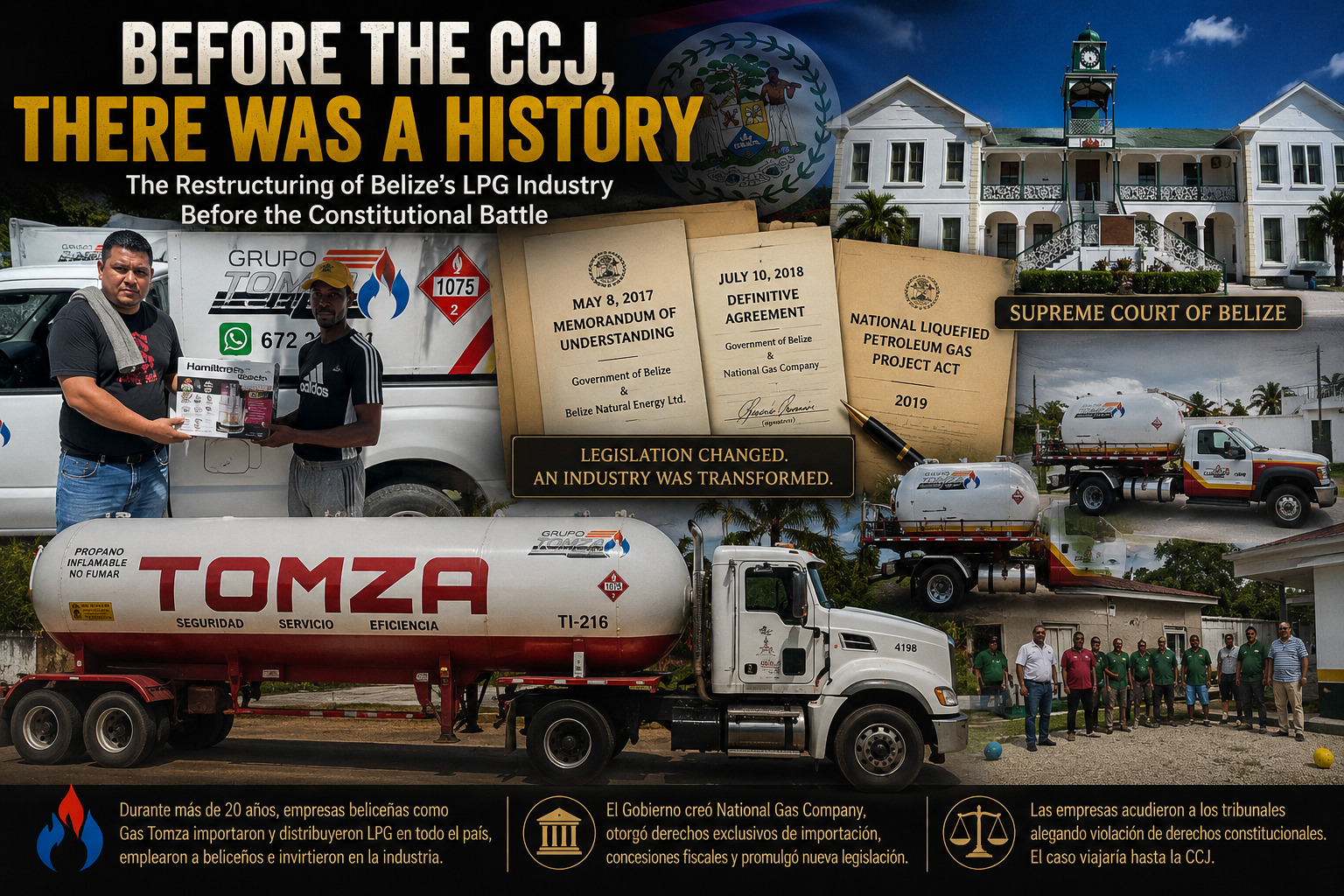
BEFORE THE CCJ, THERE WAS A HISTORY The Gas Tomza Case Did Not Begin in a Courtroom — It Began With the Restructuring of an Entire Belizean Industry

CHAPTER I
Belize City: Tuesday 11th August 2026: Before Belizeans attempt to understand why the Caribbean Court of Justice eventually reversed crucial constitutional findings in the Gas Tomza litigation, we must first return to the beginning.
- Not to Port of Spain.
- Not to the CCJ.
- Not even initially to the courtroom.
We must return to the Belizean LPG industry that existed before Government fundamentally changed it.
- Because unless that history is understood, the constitutional dispute can easily be reduced to something it never really was: a simple quarrel between Government and a handful of butane companies.
It was much more than that.
This was a confrontation between established private enterprises and the regulatory power of the Belizean State.
- It involved businesses that had operated for decades.
- It involved Government's declared responsibility to protect consumers, improve the quality and security of Belize's LPG supply, combat smuggling and modernise the industry.
- It involved the creation of a new National Gas Company.
- It involved exclusive statutory importation rights.
- It involved significant fiscal concessions.
- It involved legislation that fundamentally changed who could import one of the most essential household commodities used by Belizean families.
And ultimately it raised one of the most important questions any constitutional democracy must confront:
How far can Government restructure a lawful private industry in the name of the public interest before regulation becomes unconstitutional interference with private rights?
That was the question travelling quietly beneath the surface of the Gas Tomza litigation from its earliest days.
And it is the question Belizeans must understand before examining what ultimately happened at the Caribbean Court of Justice.
BEFORE NATIONAL GAS COMPANY
Liquefied petroleum gas—LPG, commonly referred to throughout Belize as butane—is not a luxury commodity.
It is an essential household product.
- The CCJ itself recorded that LPG is used for cooking in approximately 83 percent of Belizean homes.
- Historically, Belize did not possess a direct marine terminal capable of receiving LPG shipments.
- The product originated principally from the United States Gulf Coast but entered Belize indirectly.
- It would first be shipped to terminals in neighbouring Central American countries—particularly Guatemala, Honduras and El Salvador—and subsequently transported by road into Belize.
For more than two decades, that importation market was operated principally by several private companies.
They included:
- Gas Tomza Ltd.
- Western Gas Company Ltd.
- Southern Choice Butane Ltd, commonly known as Zeta Gas.
- And Belize Western Energy Ltd.
Together, according to the CCJ's own description of the record, these companies controlled LPG importation into Belize for more than twenty years.
- They had established supply relationships.
- They maintained storage and distribution infrastructure.
- They developed customers.
- They built commercial goodwill.
- They employed Belizeans.
- And they operated within a market regulated by the State.
This was therefore not a situation in which private companies suddenly attempted to claim ownership over an industry Government had created.
- The businesses existed first.
- The restructuring came later.
- That sequence is important.
GOVERNMENT IDENTIFIES A PROBLEM
Government, however, maintained that the existing LPG system had serious deficiencies.
Its concerns were not insignificant.
According to the case ultimately presented before the courts, Government wanted greater stability in Belize's LPG supply.
- It wanted greater consistency in product quality.
- It wanted stronger safeguards for health and public safety.
- It wanted to address concerns surrounding smuggling.
- It raised questions about transfer pricing.
- It wanted more resilient LPG infrastructure.
- And it argued that Belize required a more reliable mechanism for importing a commodity upon which the vast majority of households depended.
These are legitimate governmental objectives.
National Perspective Belize does not dismiss them.
Every government possesses regulatory responsibilities.
Essential commodities cannot simply be abandoned entirely to private commercial interests where national supply, consumer protection and public safety are concerned.
- The State has the authority to regulate.
- Indeed, sometimes it has the obligation to regulate.
- But constitutional government contains an additional principle.
The legitimacy of Government's objective does not automatically make every method used to achieve that objective constitutional.
That distinction eventually became the centre of this dispute.
MAY 8, 2017
THE FIRST IMPORTANT AGREEMENT
The documentary chronology identified by the courts takes us to May 8, 2017.
On that date, the Government of Belize entered into a Memorandum of Understanding involving Belize Natural Energy Ltd, which became connected to the development of what would ultimately emerge as the National Gas Company project.
This marked an important moment.
- Government was no longer merely discussing regulation of the existing LPG industry.
A different structural model was beginning to take shape.
- The concept contemplated new infrastructure and a new mechanism through which Belize would receive LPG.
But the arrangement would soon become far more significant.
JULY 10, 2018
THE DEFINITIVE AGREEMENT
Approximately fourteen months later came what the Belize Court of Appeal and ultimately the CCJ identified as the Definitive Agreement.
The Government of Belize and National Gas Company entered into that agreement on July 10, 2018.
Its importance cannot be overstated.
The agreement contemplated LPG being imported into Belize entirely by sea.
It contemplated the development of infrastructure necessary for receiving the commodity.
- It contemplated storage.
- Distribution.
- Supply.
- And the establishment of an entirely different architecture for the LPG industry.
This was no longer simply regulatory adjustment.
Belize was preparing for structural transformation.
NATIONAL GAS COMPANY
The National Gas Company emerged as the principal vehicle through which the National Liquefied Petroleum Gas Project would operate.
NGC today describes itself as a public-private partnership with the Government of Belize.
- Under its stated arrangement, Government holds a 25 percent interest during the first fifteen years, after which ownership of the project facilities is intended eventually to transfer entirely to Government.
- Its stated purpose included designing, financing, building and operating an LPG marine terminal together with regional wholesale depots.
From a national-development perspective, such infrastructure could readily be defended.
- Belize has long confronted vulnerabilities created by dependence upon imported energy products and foreign transportation chains.
- Direct marine importation could therefore offer logistical advantages.
- Greater storage capacity could strengthen national resilience.
- Quality control could potentially improve.
The country could reduce dependence upon trucking LPG through neighbouring countries.
Those policy arguments deserve recognition.
- But infrastructure was only one side of the transformation.
- The other involved market power.
SEPTEMBER 2019
PARLIAMENT CHANGES THE RULES
The National Liquefied Petroleum Gas Project Act was enacted.
And with it, Government fundamentally altered the LPG industry.
- National Gas Company was granted the exclusive right to import LPG into Belize.
- The significance of that provision cannot be understated.
- Companies that had historically imported LPG could no longer continue doing so under the new statutory arrangement.
- They could remain involved in other areas of the LPG business.
- They could distribute.
- They could retail.
- But the importation component of their established operations was transferred into an exclusive statutory structure centred upon NGC.
- Government had effectively changed the rules of an industry in which those companies had operated for decades.
- And National Gas Company received more than importation exclusivity.
The statutory framework also provided substantial fiscal concessions.
According to the judicial record, these included exemptions involving:
- income and business taxes;
- sales taxes;
- customs and excise duties;
- stamp duties;
- environmental taxes;
- and other fiscal obligations.
For Government, these concessions formed part of the financing and development architecture required to establish the National LPG Project.
For the established importers, however, the picture looked very different.
- A new competitor had not simply entered their market.
- A new entity had entered under legislation that gave it exclusive access to the very activity upon which a substantial part of their businesses had historically depended.
That distinction would eventually become constitutionally explosive.
REGULATION OR DISPLACEMENT?
Imagine the issue outside the technical language of constitutional law.
Suppose several companies lawfully operate within an industry for twenty years.
- They build facilities.
- Develop customers.
- Employ workers.
- Establish supply chains.
- Invest capital.
- Create commercial relationships.
- Government then determines that the industry requires reform.
- Government is entitled to reform it.
- But Government subsequently creates a new structure under which one entity receives the exclusive statutory right to perform one of the industry's most important commercial activities.
- The existing companies are prohibited from performing that activity.
- They remain legally permitted to conduct other aspects of their businesses.
The Government then argues:
- You have not been deprived of your businesses because you can still operate.
The companies respond:
- But you have taken away the essential activity around which significant portions of those businesses were built.
There lies the constitutional conflict.
And that is why the Gas Tomza litigation cannot intelligently be understood merely as an argument over butane.
It concerned the boundary separating regulation from deprivation.
THE CONSTITUTION ENTERS THE ROOM
Belize's Constitution protects property.
- It protects individuals and businesses against certain forms of governmental deprivation.
- It protects the right to work.
- It protects freedom of association.
- And it guarantees protection of the law and equality of treatment.
But constitutional rights are rarely absolute.
- Governments must govern.
- Economic systems must sometimes be regulated.
Markets change.
- Industries require reform.
- Public safety can require intervention.
- National emergencies can require extraordinary measures.
The courts therefore frequently face difficult balancing exercises.
- They must decide when Government has acted legitimately in the public interest and when Government has crossed the constitutional boundary protecting the individual or private enterprise.
- Gas Tomza would eventually force Belize's judiciary to confront precisely that problem.
THE COMPANIES GO TO COURT
Following enactment of the National LPG legislation, the affected companies initiated constitutional proceedings.
- Gas Tomza Ltd.
- Western Gas Company Ltd.
- Southern Choice Butane Ltd.
- Belize Western Energy Ltd.
- Their claim went beyond commercial dissatisfaction.
- They alleged that Government's legislative restructuring violated constitutionally protected rights.
Among them:
- the protection of property;
- the right to work;
- freedom of association;
- protection of the law;
- and equality of treatment.
One particularly important argument concerned goodwill.
Goodwill in commercial law does not necessarily mean a physical object.
- It can represent the accumulated value of a business's reputation, customer relationships and continuing commercial expectations.
You cannot put goodwill into a warehouse.
- But businesses can spend decades creating it.
This became enormously significant.
- Because the companies contended that by removing their ability to continue importing LPG and transferring exclusive importation to NGC, Government had effectively taken part of the commercial value their businesses had accumulated.
Government disagreed.
- It maintained that the companies had not been prohibited from conducting business altogether.
- They could continue participating in the LPG industry.
- The State had merely regulated how LPG would enter Belize.
Again:
regulation versus deprivation.
That was becoming the constitutional fault line.
THEN THE LAW CHANGED AGAIN
Before the entire litigation had completed its journey, Government amended the original legislation.
- The CCJ later recorded that the amendment made importation by companies other than NGC legally possible.
That might appear, at first glance, to have resolved the controversy.
- But constitutional cases do not necessarily disappear simply because Government later changes the law.
The companies maintained that damage had already occurred.
- Business had already been lost.
- Customers had already moved.
- Goodwill, they argued, had already been affected.
- And even following amendment, they contended that the commercial environment had fundamentally changed.
The question therefore remained:
What constitutional consequences followed from what Government had already done?
THIS IS WHERE THE HISTORY BECOMES CRITICAL
It is tempting, particularly years later, to begin the story with the final CCJ judgment.
That would be a serious mistake.
The litigation did not originate with abstract constitutional theory.
It originated with an economic reality.
- For decades, private companies imported LPG into Belize.
- Government decided that the system required transformation.
- Government negotiated agreements.
- Government created a public-private partnership.
- Government enacted legislation.
- Government granted exclusive importation authority.
- Government provided significant exemptions.
Established companies lost the statutory ability to continue importing LPG.
Those companies went to court.
Everything that followed—from the High Court to the Court of Appeal and finally to the Caribbean Court of Justice—arose from that sequence.
And the distinction matters profoundly.
Because before Belizeans decide whether the CCJ majority ultimately got the constitutional issue right, they must first understand what Government actually did.
THE QUESTION BELIZE MUST CARRY INTO CHAPTER II
Government said:
We regulated an essential industry in the public interest.
The companies effectively said:
You did more than regulate us—you removed a valuable part of our businesses and gave exclusive statutory control over that activity to another entity.
Both propositions cannot simply be accepted without constitutional examination.
- Someone had to determine where regulation ended and deprivation began.
That someone was the judiciary.
- And what happened next is precisely why the Gas Tomza case has returned to national relevance.
Because when Belize's courts began answering that question, the story did not travel in a straight line.
- The first major judicial findings would favour the companies on critical constitutional issues.
Belize's Court of Appeal would subsequently affirm that constitutional rights had been infringed.
- Then the case travelled to the Caribbean Court of Justice.
And there— the constitutional direction changed.
NEXT:
CHAPTER II
WHEN REGULATION BECAME DEPRIVATION
How Belize's Courts Examined the Government's LPG Monopoly — and Why the Companies Initially Won the Constitutional Argument
By: Omar Silva - Editor/Publisher @ www.nationalperspectivebz.com
- Log in to post comments