AMERICA WANTS TO CONTAIN CHINA — BUT THE BATTLE FOR MEXICO IS EXPOSING THE GOOD, THE BAD AND THE UGLY OF THE NEW INDUSTRIAL WAR
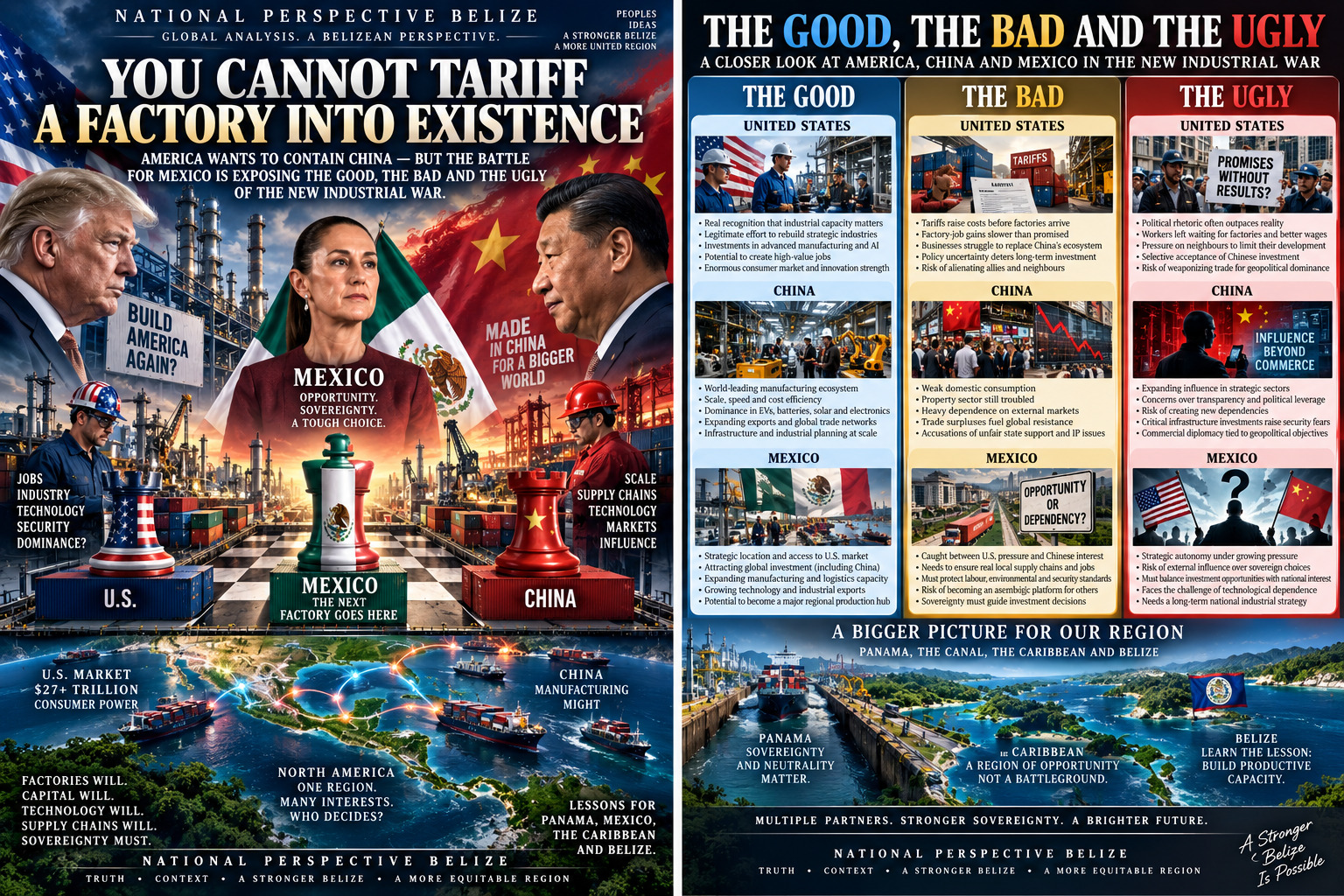

YOU CANNOT TARIFF A FACTORY INTO EXISTENCE
GLOBAL ECONOMIC & GEOPOLITICAL FEATURE
Belize City: Monday 14th September 2026: Something important is happening beneath the tariff war between the United States and China.
It is no longer simply about who sells more products to whom.
It is about who possesses the factories, technology, skilled workers, energy, ports, logistics systems, supplier networks and industrial ecosystems capable of manufacturing the twenty-first century.
- And increasingly, Mexico sits directly in the middle.
- Washington wants to rebuild American manufacturing.
- Beijing wants to preserve and expand China's enormous industrial position.
Mexico wants investment from the world while retaining privileged access to the world's largest consumer economy immediately across its northern border.
- All three objectives are understandable.
- But they cannot all coexist indefinitely without collision.
- That collision is beginning.
And it is revealing an uncomfortable economic truth:
- A TARIFF CAN CHANGE THE PRICE OF A PRODUCT.
- IT CANNOT BUILD THE INDUSTRIAL ECOSYSTEM THAT PRODUCES IT.
THE GOOD: AMERICA HAS IDENTIFIED A REAL PROBLEM
There is an intellectually lazy way to examine Donald Trump's industrial strategy:
- Dismiss everything as protectionism.
- That would miss an important part of the story.
- America does have an industrial problem.
For decades, significant portions of manufacturing migrated toward countries offering cheaper labour, larger supplier ecosystems and increasingly sophisticated industrial capabilities.
China became the greatest beneficiary.
- What began as the world's low-cost factory evolved into something considerably more formidable.
- China built ports.
- Railways.
- Power generation.
- Industrial parks.
- Technical universities.
- Engineering capacity.
- Supplier networks.
- Battery industries.
- Solar industries.
- Electronics ecosystems.
- Automobile manufacturing.
- Critical-mineral processing.
- Machine-tool capacity.
And increasingly advanced technology.
America eventually discovered that globalization had created extraordinary consumer efficiencies while simultaneously allowing strategic industrial dependencies to accumulate.
Washington therefore has legitimate reasons to ask:
- Should America manufacture more of what America consumes?
- Should strategic industries remain overwhelmingly dependent upon a geopolitical competitor?
- Should American workers recover more industrial employment?
Those are serious questions.
And Trump is not wrong simply because he asks them.
THE SECOND GOOD: REINDUSTRIALIZATION IS A LEGITIMATE NATIONAL OBJECTIVE
There is nothing inherently objectionable about an American president wanting factories built in America.
Countries throughout history have attempted to develop productive capacity.
- China certainly did.
- Mexico is doing it.
- India is doing it.
European governments increasingly speak about strategic industrial autonomy.
- The United States is entitled to do the same.
- Indeed, Trump's latest statement makes his objective unusually clear.
He says he would be prepared to accept Chinese automobile manufacturers establishing factories inside the United States, provided those factories employ American workers.
But he does not want Chinese companies manufacturing those same vehicles in Mexico and exporting them northward.
That distinction tells us something enormously important.
The issue is no longer simply: CHINA.
It is: WHERE DOES PRODUCTION OCCUR?
- Who receives the factory?
- Who receives the investment?
- Who receives the jobs?
- Who acquires the technology?
- Who develops the supplier ecosystem?
And ultimately: Who controls the productive architecture of North America?
That is a considerably more sophisticated question than tariffs alone.
NOW COMES THE BAD
Washington appears to have discovered that punishing imports is much easier than rebuilding industrial ecosystems.
A tariff can be signed by a president.
- An industrial ecosystem cannot.
- Factories require capital.
- Factories require electricity.
- Factories require engineers.
- Factories require skilled technicians.
- Factories require ports and railways.
- Factories require suppliers.
Suppliers require their own suppliers.
- Companies require predictable regulations.
- Investors require confidence that rules governing billion-dollar facilities will survive longer than one election.
And all of this requires time.
That is where America's containment strategy begins colliding with industrial reality.
- SOME COMPANIES LEFT CHINA.
- SOME ARE NOW GOING BACK.
On September 14, Reuters documented something Washington should study very carefully.
After companies moved production or sourcing away from China to escape higher American tariffs, some discovered that reproducing China's manufacturing ecosystem elsewhere was considerably harder than expected.
- Some buyers have restored Chinese suppliers.
- Some manufacturers that experimented with moving production elsewhere have returned operations to China.
The reasons are remarkably instructive:
- skilled labour.
- supplier networks.
- reliable electricity.
- equipment availability.
- industrial efficiency.
And overall production costs that, once everything was calculated, were not necessarily dramatically better elsewhere.
- There is not yet sufficient aggregate evidence to say manufacturing is flooding back into China.
- That would overstate the facts.
- India, Vietnam, Indonesia and other manufacturing centres continue attracting enormous investment.
- But something much more important has already been demonstrated:
CHINA'S INDUSTRIAL ECOSYSTEM CANNOT SIMPLY BE REPLICATED BY PRESIDENTIAL DECREE.
That should fundamentally change the conversation.
- CHINA DIDN'T JUST BUILD FACTORIES
- China built the ecosystem surrounding the factory.
That distinction is critical.
Imagine manufacturing a relatively ordinary product.
- The factory needs screws.
- Packaging.
- Moulds.
- Electronic components.
- Machine maintenance.
- Warehouses.
- Truck transportation.
- Port access.
- Power.
- Engineers.
- Financing.
- Raw materials.
- Quality-control laboratories.
- Customs systems.
- Software.
- And dozens—sometimes hundreds—of suppliers.
When those suppliers exist within a few hours of each other, manufacturing becomes extraordinarily efficient.
- When they are scattered across continents, costs rise.
- China spent decades creating industrial clusters in which entire production ecosystems exist within relatively concentrated geographical areas.
That is one reason tariffs have not automatically destroyed Chinese manufacturing dominance.
AND CHINA IS STILL EXPORTING
- China's industrial position is not invulnerable.
- Its domestic economy has serious weaknesses.
- Consumption remains comparatively soft.
- Its property sector has experienced deep problems.
- Dependence upon external demand creates its own vulnerabilities.
- Trade surpluses inevitably provoke political resistance abroad.
But anyone waiting for tariffs alone to collapse China's export machine should examine the latest numbers.
- In August 2026, Chinese exports surged 25% year-on-year.
- During the first eight months of the year, high-technology exports increased 42.9% in dollar value.
- Semiconductor export values more than doubled.
- Automobile exports increased by more than 50% in both value and volume.
China's trade surplus reached approximately US$119 billion in August alone and was on course to exceed US$1 trillion for another year.
This does not mean China has won.
- It means China remains enormously difficult to contain economically.
THEN COMES THE UGLY
The ugly part of the strategy emerges when legitimate American reindustrialization begins becoming an attempt to determine where other countries are permitted to industrialize.
And this is where Mexico enters the story.
- Trump says Chinese companies building factories in America could be acceptable.
- But Chinese companies building factories in Mexico to supply the American market are not.
That creates an unavoidable question:
IF CHINESE CAPITAL CREATING AMERICAN JOBS CAN BE ACCEPTABLE, WHY IS CHINESE CAPITAL CREATING MEXICAN JOBS AUTOMATICALLY A STRATEGIC THREAT?
There are legitimate answers involving rules of origin, subsidies, national security and attempts to circumvent American tariffs.
- Those concerns should not be dismissed.
- But neither should the economic competition hidden underneath them.
- Because Mexico isn't simply America's southern neighbour.
- Mexico is becoming one of the most important manufacturing platforms in the Western Hemisphere.
MEXICO IS THE FACTORY FLOOR BETWEEN THE TWO GIANTS
Mexico has geography China can never possess.
- It shares approximately 3,000 kilometres of border with the United States.
- It has deeply integrated automobile, electronics and industrial supply chains with America.
- It possesses Pacific and Atlantic access.
- It has a large labour force.
- And through North American trade arrangements, Mexican production has historically enjoyed privileged access to the American market.
That makes Mexico enormously attractive to global manufacturers.
- Including Chinese manufacturers.
- And that is precisely why Washington is nervous.
If Chinese companies can establish manufacturing ecosystems in Mexico and then access the American market under preferential North American arrangements, America's attempt to reduce dependence upon Chinese production could simply relocate part of Chinese industrial capacity from Asia to America's doorstep.
- From Washington's perspective, that could become tariff circumvention.
From Mexico's perspective, however, it could represent:
- factories.
- jobs.
- technology.
- tax revenue.
- industrial development.
There lies the conflict.
WASHINGTON IS NOW NEGOTIATING THE BOUNDARIES
Mexico and the United States are racing toward a bilateral trade understanding before the November American midterm elections.
- Automobiles are central to those negotiations.
- So are rules governing North American content.
- And Chinese investment increasingly sits behind the discussion.
- Mexico does not want Washington dictating rigid American-content requirements.
- Washington wants more production and value creation captured inside the United States.
This is therefore becoming much more than another tariff negotiation.
It is becoming a negotiation over: WHO GETS TO INDUSTRIALIZE NORTH AMERICA?
BEIJING HAS NOT MISSED THE MESSAGE
- China is already projecting directly toward Mexico.
On September 7, Chinese Foreign Minister Wang Yi met Mexico's foreign-policy leadership in Beijing and delivered language that could hardly have been more carefully chosen.
- China–Mexico relations, Beijing said, are not directed against any third country.
- But neither should they be influenced by any third country.
- China expressed support for Mexico maintaining its independence and autonomy and resisting external interference.
Remove the diplomatic language and the message becomes unmistakable: WASHINGTON SHOULD NOT DECIDE MEXICO'S RELATIONSHIP WITH CHINA.
That is an extraordinary proposition to place directly into the evolving North American industrial struggle.
BUT CHINA IS NOT THE INNOCENT BYSTANDER
And this is where our examination must remain intellectually honest.
- China is not merely a victim of American containment.
- China has pursued industrial policy with extraordinary aggression for decades.
State support helped develop strategic industries.
- Domestic market protections assisted Chinese companies during critical developmental periods.
- Technology acquisition became a national priority.
- Massive infrastructure investment supported exporters.
- Chinese companies developed scale that competitors sometimes struggle to match.
- Western governments accuse Beijing of industrial subsidies and practices that create unfair competitive advantages.
- Washington has also accused Chinese technology companies of appropriating American intellectual property.
China rejects many of these accusations and argues that Washington increasingly invokes national security to suppress legitimate Chinese competition.
But the underlying reality remains: China also plays hardball.
- This is not a morality play in which Beijing represents innocent globalization and Washington represents protectionism.
- It is a competition between two enormous economic powers attempting to protect and expand their strategic advantages.
THE REAL QUESTION FOR CHINA: CAN AMERICA BE TRUSTED WITH CHINESE FACTORIES?
- Trump's invitation creates a fascinating dilemma for Beijing and Chinese industry.
- Imagine a Chinese automobile manufacturer considering a multibillion-dollar factory in America.
Today the President says: Come. Build here. Employ Americans.
The company must then ask: What happens tomorrow?
- Could Congress prohibit Chinese-connected vehicles?
- Could another administration change the rules?
- Could national-security regulations restrict Chinese technology?
- Could today's welcome become tomorrow's sanctions?
- Could Chinese ownership itself subsequently be declared unacceptable?
These are not ideological questions.
- They are investment questions.
- A tariff can change overnight.
- A factory cannot.
A US$5 billion industrial complex cannot simply be packed into shipping containers and returned to Shanghai.
And American policy already contains substantial restrictions on Chinese-connected vehicle technologies.
So Trump's invitation to Chinese manufacturers confronts another requirement of industrialization: TRUST IN THE RULES.
AMERICA'S REAL CHALLENGE IS NOT CHINA
At least not entirely.
- America's deeper challenge is rebuilding America.
- That requires more than containing somebody else.
- It requires industrial strategy.
- Affordable and reliable energy.
- Technical education.
- Engineering.
- Infrastructure.
- Ports.
- Railways.
- Industrial financing.
- Research.
- Supply chains.
- Skilled labour.
- Stable investment rules.
And patience.
America unquestionably possesses enormous advantages.
- It remains a technological superpower.
- It possesses extraordinary universities.
- Deep capital markets.
- World-leading companies.
- Huge energy resources.
- A gigantic consumer market.
- Exceptional entrepreneurial capacity.
The United States absolutely possesses the ability to reindustrialize.
But that makes the central distinction even more important: REINDUSTRIALIZATION IS SOMETHING A COUNTRY BUILDS.
- CONTAINMENT IS SOMETHING A COUNTRY DOES TO SOMEBODY ELSE.
They are not interchangeable.
THE WORKER CAUGHT BETWEEN THE PROMISE AND THE POLICY
- And this is where ordinary Americans enter the story.
- Trump's political promise is powerful:
- Factories return.
- Jobs return.
- Industrial communities revive.
That aspiration resonates because many communities genuinely experienced industrial decline.
- But workers cannot live indefinitely on announcements.
- They need employment.
- Wages.
- Affordable housing.
- Affordable energy.
- Affordable goods.
- And confidence that industrial jobs being promised today will actually exist tomorrow.
The danger is that tariffs raise costs before domestic productive capacity exists to replace imports.
- Consumers then absorb part of the adjustment.
- Manufacturers dependent upon imported inputs absorb another part.
- And workers wait for factories that take years to construct.
- That transition must be managed.
- Otherwise industrial nationalism can become politically attractive while economically painful.
MEXICO HAS ITS OWN DECISION TO MAKE
- Mexico should not romanticize China either.
- Chinese investment could accelerate Mexican industrial development.
But Mexico must ask difficult questions.
- Will Chinese factories create genuine Mexican supply chains?
- Will technology be transferred?
- Will Mexican workers move into engineering and management?
- Will local companies become suppliers?
- Will Mexico merely assemble imported components?
- Will strategic industries remain dependent upon foreign decision-making?
- Will environmental and labour standards be protected?
- And will Chinese investment deepen Mexico's sovereignty—or simply create another dependency?
Those questions are just as important as resisting Washington's pressure.
- Strategic autonomy means saying no when necessary to both sides.
AND THIS BRINGS US BACK TO PANAMA
Our recent examination of Mexico and Panama suddenly becomes part of this much larger industrial struggle.
- Mexico has supported Panama's sovereignty and the permanent neutrality of the Panama Canal.
Why?
- Because the principle is fundamentally the same.
- Panama should not be forced to choose between Washington and Beijing.
- Neither should Mexico.
- Panama determines who operates within Panama.
- Mexico determines who invests within Mexico.
That does not mean ignoring legitimate American security concerns.
- Nor does it mean giving China unrestricted access to strategic infrastructure.
- It means sovereign governments making those decisions themselves.
THE PANAMA CANAL AND TEHUANTEPEC NOW BELONG TO THE SAME STORY
- Panama possesses the Canal.
- Mexico possesses the developing Interoceanic Corridor of the Isthmus of Tehuantepec.
- Both are strategic logistics platforms.
- Both connect oceans.
- Both are increasingly relevant to global supply chains.
- And both exist within the emerging U.S.–China competition.
That makes the Mexico–Panama relationship much more consequential than it initially appeared.
- They are not simply two friendly Latin American governments.
- They are two countries controlling geography that great powers increasingly value.
Their challenge is therefore identical:
USE GEOGRAPHY WITHOUT ALLOWING GEOGRAPHY TO USE THEM.
THE LESSON FOR LATIN AMERICA
There is a temptation throughout the developing world to interpret China's rise as an escape from American dominance.
- That would be dangerously simplistic.
There is another temptation to believe continued alignment with Washington automatically guarantees economic security.
- That is equally simplistic.
The twenty-first-century opportunity lies elsewhere: MULTIPLE RELATIONSHIPS.
- Trade with America.
- Trade with China.
- Trade with Europe.
- Trade with India.
- Trade within Latin America.
Build domestic industry.
- Diversify markets.
- Protect strategic infrastructure.
- And surrender sovereign decision-making to nobody.
That is not anti-Americanism.
- It is not pro-China diplomacy.
- It is economic maturity.
AND THE LESSON FOR BELIZE
Belize should study this struggle very carefully.
- Because underneath all the superpower rhetoric is an economic lesson particularly relevant to us.
- A country does not become productive merely because it possesses land.
- Or farmers.
- Or workers.
- Or resources.
It becomes productive when those elements are connected through industrial capacity.
- We can export raw agricultural products forever.
- Or we can manufacture.
- Process.
- Package.
- Refine.
- Generate energy.
- Build logistics.
- Develop skills.
- Create factories.
- And export value.
The United States–China struggle is therefore teaching small countries something neither superpower necessarily intended to teach:
INDUSTRIAL CAPACITY IS SOVEREIGNTY.
A country unable to manufacture what it needs will eventually depend upon somebody who can.
THE GOOD, THE BAD AND THE UGLY
- The good in Trump's doctrine is the recognition that industrial capacity matters.
- America cannot remain strategically secure while allowing every critical supply chain to migrate elsewhere.
- The bad is believing tariffs and pressure can substitute for the long, expensive work of rebuilding industrial ecosystems.
- And the ugly emerges if American reindustrialization becomes an attempt to prevent neighbouring countries from industrializing with capital Washington itself might accept.
China presents its own trilogy.
- The good is an industrial ecosystem whose scale, infrastructure and productive efficiency have lifted China into extraordinary technological and manufacturing power.
- The bad is an economy increasingly dependent upon external markets while domestic demand remains weak.
- And the ugly lies in the danger that enormous state-supported productive capacity can overwhelm competitors and create dependencies of its own.
Neither model deserves worship.
- Both deserve study.
YOU CANNOT TARIFF A FACTORY INTO EXISTENCE
- That may ultimately become the defining lesson of this economic confrontation.
- America possesses tremendous power to restrict access to its market.
- But market access and productive capacity are different forms of power.
China spent decades building the latter.
- Washington is now attempting to recover more of it.
- Mexico wants a larger share of it.
- And that is why Mexico may become one of the most important economic battlegrounds of the coming decade.
Not because Chinese and American armies will confront each other there.
But because:
- factories will.
- capital will.
- technology will.
- supply chains will.
- And eventually political sovereignty will.
The winner will not necessarily be the country imposing the highest tariff.
- It may be the country that answers the much harder question:
WHERE CAN THE WORLD BUILD MOST RELIABLY, PRODUCTIVELY AND PROFITABLY FOR THE NEXT THIRTY YEARS?
- China already has an answer.
- Mexico increasingly wants to become part of the answer.
- America is trying to rewrite the answer.
And the rest of us should be watching very carefully.
- Because the deepest lesson is not about Donald Trump or Xi Jinping.
It is about what actually creates national economic power.
- YOU CAN TAX AN IMPORT.
- YOU CAN BLOCK A PRODUCT.
- YOU CAN PRESSURE A NEIGHBOUR.
- YOU CAN EVEN CONTAIN A COMPETITOR.
- BUT YOU CANNOT TARIFF A FACTORY INTO EXISTENCE.
You have to build it.
- And then you must build everything around it that allows it to survive.
NATIONAL PERSPECTIVE BELIZE
Global Economic & Geopolitical Analysis
By: Omar Silva – Editorial Director @ www.nationalperspectivebz.com ©
NATIONAL PERSPECTIVE BELIZE — ©
- Log in to post comments