BELIZE SIGNED UNCAC. SO WHY HASN'T IT FINISHED THE JOB?
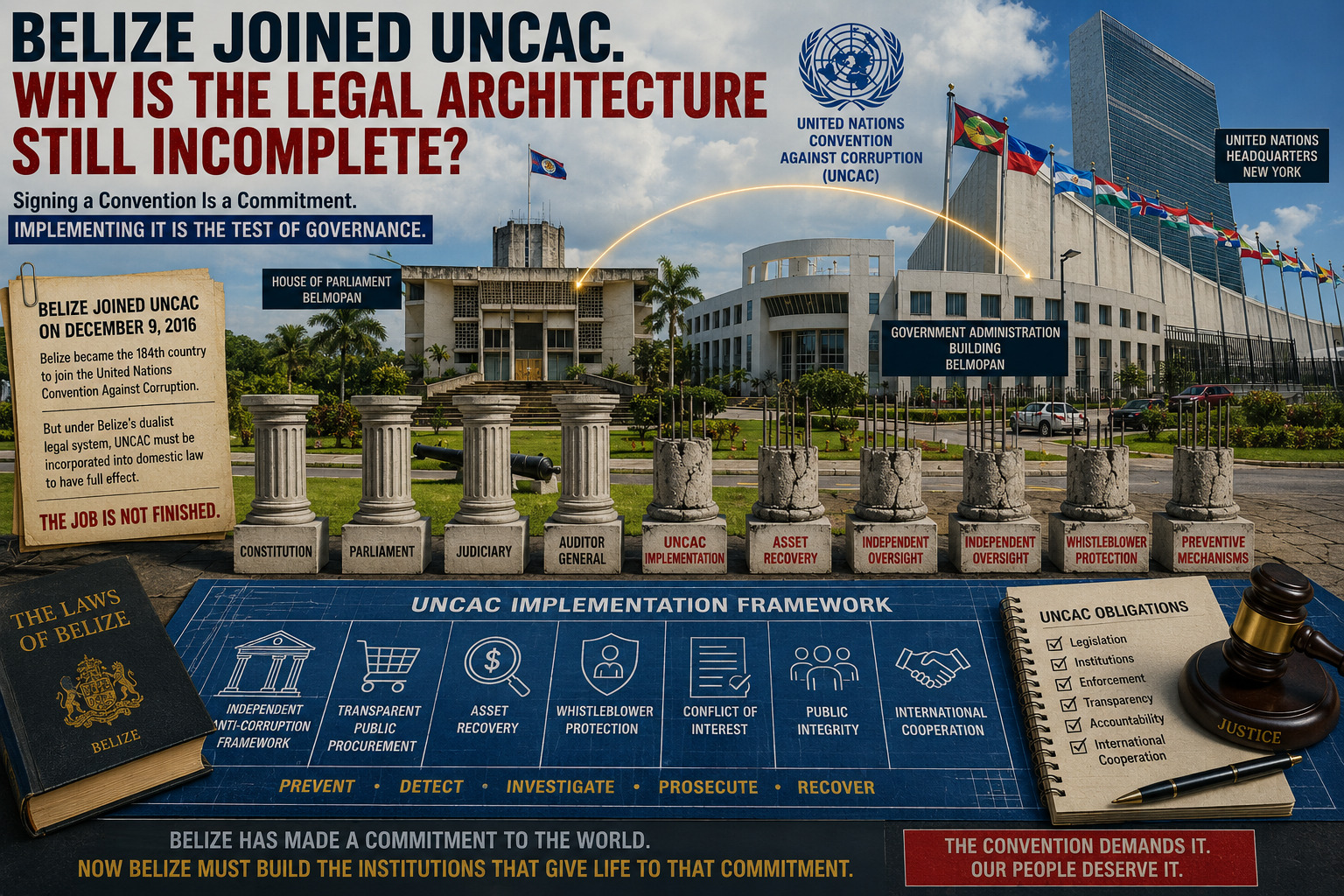
Ten Years Later, Is Belize Still Missing the Legal Architecture Needed to Fight Corruption?
Belize City: Sunday 12th July 2026: When discussions about corruption arise in Belize, one fact is frequently repeated: Belize signed and ratified the United Nations Convention against Corruption (UNCAC) on the 9 December 2016: The Government of Belize held an official ceremony in Belmopan on International Anti-Corruption Day, Belize became the 184th country to join the Convention.
Subsequently, on the 12 December 2016: Belize formally acceded to UNCAC by depositing its instrument of accession with the United Nations. Because Belize acceded rather than signed during the original signature period (2003–2005), the UN treaty record lists "Accession – 12 December 2016" rather than "Signature."
That statement is true.
But it is also incomplete.
Signing an international convention is the beginning of a national commitment—not the end of one.
UNCAC was never intended to be a symbolic declaration or a diplomatic achievement to be filed away in government archives. It is a legally binding international framework that requires participating States to construct a comprehensive domestic system capable of preventing, detecting, investigating, prosecuting, and recovering the proceeds of corruption.
The Convention is not self-executing.
- It depends entirely upon each country creating the legislative, institutional, administrative, and judicial mechanisms necessary to give effect to its obligations.
That raises an important question for Belize:
Going into a decades after joining UNCAC, has Belize completed the legal and institutional reforms required by the Convention?
More specifically:
- Has Belize established every independent institution envisioned by UNCAC?
- Are procurement and public contracting systems sufficiently transparent and independently supervised?
- Are conflict-of-interest laws comprehensive and consistently enforced?
- Are whistleblowers adequately protected?
- Does Belize possess a modern and effective asset recovery framework?
- Are oversight institutions adequately funded, staffed, and insulated from political influence?
- Are investigations into allegations of corruption conducted with sufficient independence and public confidence?
These are not partisan questions.
They are governance questions.
UNCAC Is About Building Institutions
- The Convention recognizes that corruption cannot be defeated merely by prosecuting individuals after public money has disappeared.
Its philosophy is preventive.
- It calls upon governments to build systems that make corruption more difficult before it occurs.
That means creating transparent procurement systems, strengthening public financial management, protecting those who expose wrongdoing, empowering independent oversight institutions, criminalizing corrupt conduct, recovering stolen assets, and ensuring that justice operates without political interference.
In other words, UNCAC is not simply about punishment.
It is about prevention through institutional design.
Why Has Belize Moved So Slowly?
This is where today's debate becomes significant.
- The Briceño administration has repeatedly expressed its commitment to transparency and accountability. It has not introduced reforms in areas such as procurement and financial administration.
Yet many observers continue to ask whether those measures amount to the comprehensive legal architecture envisioned by UNCAC.
If Belize has accepted the Convention as binding international law, why have some reforms advanced while others appear incomplete?
- Why do concerns about procurement, institutional independence, public accountability, and oversight continue to arise in public debate?
- Why do successive corruption controversies continue to expose perceived weaknesses in the machinery of government rather than isolated failures by individuals?
These questions deserve careful public discussion.
Beyond Political Narratives
This discussion should not become another contest between the People's United Party and the United Democratic Party.
UNCAC predates the current administration.
- Responsibility for implementing it extends across successive governments.
Nevertheless, every administration inherits the responsibility to complete the work left unfinished.
The Briceño Government therefore has an opportunity—not merely to respond to individual controversies—but to demonstrate that Belize is prepared to modernize its anti-corruption framework in a comprehensive manner.
The Larger Constitutional Question
Belize's challenge may ultimately be institutional rather than political.
When oversight bodies remain under-resourced, procurement systems require continual reform, vacancies persist in key accountability offices, or enforcement depends upon political will, the issue extends beyond one scandal.
It becomes a question of whether the State itself possesses the institutional resilience envisioned by UNCAC.
That is why the conversation should not stop at asking whether Belize signed the Convention.
The more important question is whether Belize has built the legal and institutional foundation necessary to honour it.
Conclusion
Belize does not need another declaration against corruption.
It has already made one before the international community.
The challenge today is different.
The challenge is implementation.
- If the Government believes Belize has fulfilled the Convention's requirements, it should demonstrate how.
- If gaps remain, the country deserves a clear legislative roadmap identifying what reforms are outstanding, why they have not yet been enacted, and when they will be completed.
For corruption is not defeated by treaties alone.
- It is defeated by institutions that are independent, transparent, adequately resourced, and capable of enforcing the rule of law without fear or favour.
That is the true promise of UNCAC.
And that is the standard against which Belize should measure itself.
UNCAC WITHOUT IMPLEMENTATION?
Why Has Belize Yet to Complete the Legal Architecture Required by the United Nations Convention Against Corruption?
By: Omar Silva - Editor/Publisher
- Log in to post comments