WHO DRAWS THE LINE? The Bacalar Chico Incident Raises Bigger Questions About Belize’s Maritime Sovereignty
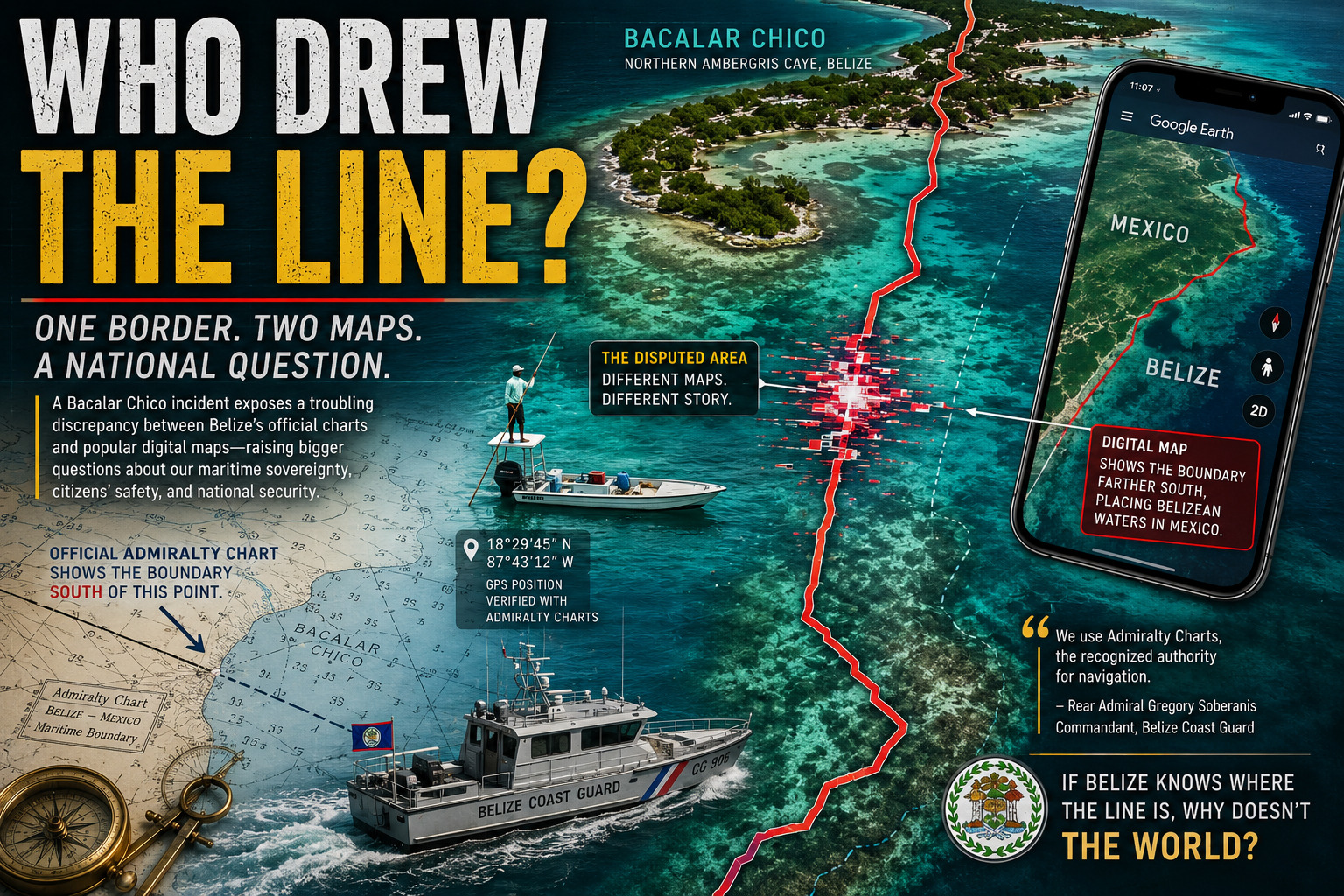
Belize City: Tuesday 2nd June 2026: A recent confrontation in the waters of Bacalar Chico between Belizean tour operators and members of the Mexican Navy has exposed a question far larger than fly-fishing rights, tourism, or a disagreement over location.
It raises a fundamental national question:
Who draws Belize's borders in the digital age?
According to Belize Coast Guard Commandant Rear Admiral Gregory Soberanis, the Belizean tour guides involved in the incident provided GPS coordinates that were subsequently verified against official Admiralty Charts and confirmed to be within Belizean maritime territory.
Yet the confrontation reportedly arose because digital mapping platforms appeared to indicate otherwise.
If that assessment is correct, then Belize is confronting an issue that extends well beyond a single encounter at sea.
It is confronting the possibility that one of the world's most widely used mapping systems may not accurately reflect Belize's recognized maritime boundary in a strategically sensitive area.
That should concern every Belizean.
The Real Question Is Not About Google
Many will be tempted to dismiss the matter as a technological error.
That would be a mistake.
The larger concern is not whether a digital map contains an error.
The larger concern is how long such an error may have existed, who knew about it, and what actions have been taken to correct it.
If Belize's official maritime boundary differs from what appears on widely used digital platforms, several uncomfortable questions immediately emerge.
- How many foreign fishermen have unknowingly crossed into Belizean waters based on incorrect digital information?
- How many Belizean tour operators have been challenged while operating lawfully within Belize's territorial jurisdiction?
- How many incidents have occurred without reaching public attention?
- How many government agencies were aware of the discrepancy?
- Most importantly, why has it remained unresolved?
Sovereignty In The Digital Era
In previous generations, borders were defended by maps stored in government archives, military headquarters, and diplomatic offices.
Today, millions of people rely on digital mapping platforms as their primary source of geographic information.
- Fishermen use them.
- Tour operators use them.
- Researchers use them.
- Journalists use them.
- Investors use them.
Even military personnel occasionally reference them for situational awareness.
The practical reality is that for many users, the map displayed on a smartphone becomes the perceived reality of a nation's borders.
This creates a new challenge for small nations such as Belize.
A border can be legally established through treaties and international law, yet still be perceived differently by millions of people if a digital platform displays something else.
The consequence is confusion.
The danger is confrontation.
Bacalar Chico Is Not Just Another Piece Of Water
The Bacalar Chico region occupies one of the most strategically sensitive locations in Belize.
- It sits near the maritime interface between Belize and Mexico.
- It contains valuable marine resources.
- It supports tourism activity.
- It supports fly-fishing operations.
- It forms part of an environmentally sensitive ecosystem that attracts international attention.
Because of these realities, even minor misunderstandings regarding jurisdiction can quickly become diplomatic concerns.
This is why precise mapping matters.
This is why accurate public information matters.
And this is why governments must be proactive rather than reactive.
The Questions Belize Deserves Answered
The public deserves clarity on several issues.
- Has Belize formally notified Google and other mapping providers regarding the discrepancy?
- When was the discrepancy first discovered?
- Has Mexico also acknowledged the difference between official charts and digital mapping platforms?
- Have previous complaints been filed by fishermen, tour guides, conservation groups, or maritime operators?
- What steps are being taken to ensure that Belizean citizens are not challenged while operating lawfully within Belizean waters?
- Has Belize undertaken a broader review of how its land and maritime boundaries are represented on major global mapping platforms?
These are not political questions.
They are national questions.
A Matter Of National Security
The issue should not be viewed solely through the lens of tourism or fisheries.
Border representation forms part of national security.
A nation that does not actively monitor how its territory is represented internationally risks allowing confusion to take root.
- Confusion eventually creates misunderstanding.
- Misunderstanding creates disputes.
- Disputes create tension.
- Tension creates instability.
Belize has spent decades defending its territorial integrity through diplomacy, international law, and responsible statecraft.
Allowing uncertainty to persist in the digital representation of national boundaries undermines those efforts.
The Line Must Be Clear
The recent Bacalar Chico incident should serve as a wake-up call.
Not because Belize and Mexico are adversaries.
In fact, both countries maintain one of the strongest diplomatic and security relationships in the region.
- The concern is not hostility.
- The concern is ambiguity.
Ambiguity is dangerous wherever borders are involved.
Belizeans should not have to wonder where their maritime boundary begins and ends.
Neither should foreign visitors, fishermen, researchers, or navigation platforms.
A nation's borders are among its most sacred responsibilities.
In the twenty-first century, defending those borders requires more than patrol vessels and diplomatic notes.
It also requires ensuring that the digital maps viewed by millions accurately reflect reality.
Because in today's world, sovereignty is defended not only on the sea and on land.
It is also defended on the screen.
By Omar Silva – Editor/Publisher
National Perspective Belize – Digital
- Log in to post comments