BEFORE BELIZE BECAME A NATION: Settlement, Slavery and the Struggle to Belong
National Perspective Belize | Historical analysis
Belize deserves a history that can withstand questions.
Belize City: Sunday 18th October 2026: The disagreement involving Pastor Louis Wade and Nuri Muhammad raises questions larger than either commentator. What kind of society existed before British Honduras formally became a colony? Who built its wealth? Who was free? Who could vote? And what can population records, military events and colonial symbols actually tell us?
- The answers require a connected account. A population figure cannot explain an entire political system. An election cannot establish equality. A battle cannot, by itself, establish emancipation.
Our responsibility is to examine the evidence, including evidence that complicates a preferred interpretation.
A SETTLEMENT BEFORE A COLONY
- In 1829, the community centered on Belize was a British-administered timber settlement. Formal designation as the colony of British Honduras came in 1862, followed by Crown Colony government in 1871. These dates describe changes in constitutional administration; they do not mark the beginning of British involvement.
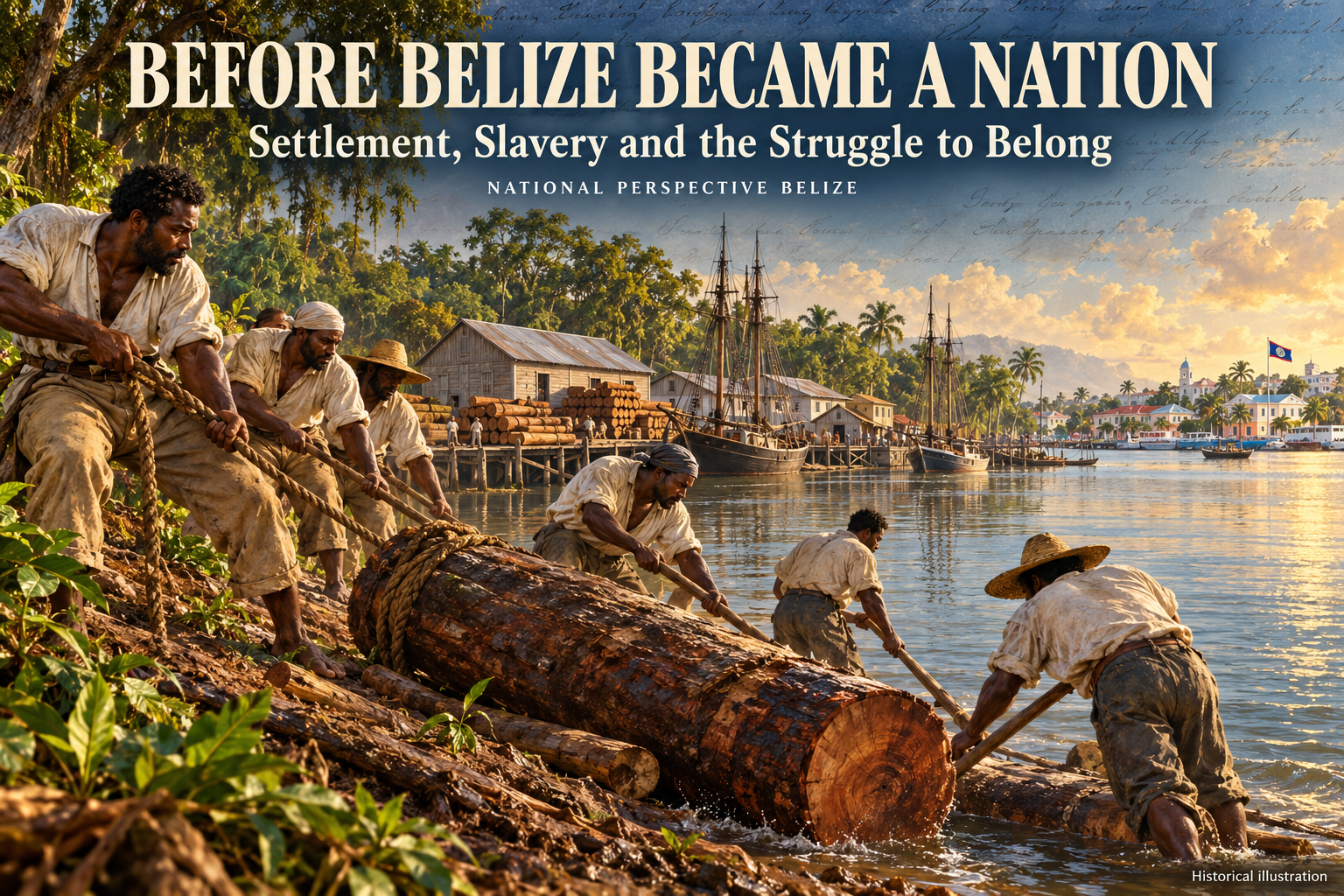
Nor was the settlement merely an isolated collection of logwood cutters. Henry Dunn’s contemporary account describes mahogany operations, merchants, stores, shipping, a British-appointed superintendent and magistrates elected by settlers. Timber extraction supported an organized commercial and political society.
- This matters because colonial relationships can exist before a particular constitutional label is adopted. Slavery, commercial dependence and unequal authority did not wait for the proclamation of a colony.
- Equally, the timber settlement cannot stand for the whole human history of the territory. Maya history preceded British settlement. The surviving settlement records must be read alongside the histories of peoples and communities beyond their administrative reach. A colonial archive’s boundaries are not the boundaries of Belizean history.
WHAT DUNN ACTUALLY TELLS US
- The population figures attributed to Dunn are real features of his account: approximately 2,400 enslaved people, 1,400 free Black people, 1,000 people he classified as “coloured Creoles,” and 300–400 White people. Those are historical categories, reproduced here to explain the source rather than endorse its racial classifications.
But the dates need care. The Library of Congress catalogues an 1828 edition of Dunn’s account of travels in 1827–1828. A reference to an 1829 publication therefore cannot automatically be treated as an 1829 population count. Publication, observation and enumeration are different events.
- There is a further discrepancy. Dunn’s footnote calls its detailed population return an 1827 census. Its civilian total of 5,197, plus 456 troops, matches the totals the Statistical Institute of Belize assigns to 1826. The original return must be checked before resolving that discrepancy.
- For 1829, SIB reports 1,856 free persons, 2,027 enslaved persons and 352 troops: 4,235 people altogether. It also explains that free-person participation in these early returns was incomplete and that censuses up to 1835 concentrated around the Belize District. These figures cannot supply a complete population portrait of modern Belize’s territory.
The central conclusion is nevertheless clear: free people and enslaved people coexisted. An account that erases either group misrepresents the society.
FREEDOM WAS NOT THE SAME AS EQUALITY
- A free Black resident could possess agency, skills, property and influence while living within a discriminatory system.
Recognizing those achievements gives people their proper place in history. It does not establish that everyone of similar ancestry enjoyed the same opportunities.
- Bolland records sixteen electors choosing five magistrates in 1786 and twenty voters in 1788. Electoral institutions existed, but participation was narrowly restricted. He also describes restrictions on free people of colour holding timber works, including a provision for magistrates’ approval, and an 1805 requirement linking access to a logwood work to ownership of four enslaved adult Black men.
These details connect economic power to political standing. Who could acquire an independent livelihood mattered alongside who could enter a meeting or hold office.
The system also contained uncomfortable complexities. Bolland documents slave ownership among some free people of color. Race, wealth and legal status intersected; they did not produce two perfectly uniform social camps.
None of these excuse’s slavery or discrimination. It makes the account more precise.
WHERE 1798 FITS
- The Battle of St. George’s Caye belongs within this society’s history. Remembering the defense of the settlement does not require claiming that society was equal.
- Conversely, identifying inequality does not justify erasing the contribution of free Black people or assuming that every African-descended participant had the same legal status.
The evidentiary limits matter. Population figures from the 1820s cannot identify the status of particular participants in 1798. Claims that individuals were free, were enslaved, volunteered, or secured freedom through service require evidence relevant to those individuals and that period.
- Slavery’s continuation after the battle establishes that the event did not produce general emancipation. It does not, on its own, settle every question about individual participation.
Collective action and unequal conditions can coexist. Our historical account must be capable of explaining both.
EMANCIPATION DID NOT ARRIVE IN ONE STEP
- Britain’s abolition legislation took effect on 1 August 1834, but many formerly enslaved people remained subject to compulsory apprenticeship. That system ended in 1838. This distinction explains why both years appear in discussions of emancipation.
- Full emancipation in this context means the end of slavery and apprenticeship. It should not be mistaken for the immediate achievement of equal wealth, opportunity or political influence.
Freedom changed the legal relationship. Understanding the society that followed requires asking what access people had to land, employment, education and public authority. Those are questions for further evidence, rather than benefits we should simply assume followed automatically.
1859, 1862 AND 1871 WERE DIFFERENT DEVELOPMENTS
- The 1859 Anglo-Guatemalan treaty addressed the boundary between Guatemala and Britain’s settlement and possessions. Formal colonial designation followed in 1862. Crown Colony government followed in 1871.
A boundary agreement, a colonial designation and a change in governing institutions concern different aspects of history.
- They must also be distinguished from the much later creation of an independent Belize. The people living through the earlier events did not inhabit the constitutional arrangements or share every national identity that exists today.
Historical explanation becomes clearer when we resist reading the final outcome backwards into every earlier date.
THE COAT OF ARMS: AUTHENTICITY AND MEANING
The emblem controversy requires two separate investigations.
- First, is the disputed image an accurate reproduction of the 1907 arms? That should be established through the original grant, an authenticated reproduction and associated documentation. Shoman’s reported account of obtaining the image from the College of Arms should be attributed as his account until independently corroborated.
- Second, what does the evidence establish about the figures and their intended meaning?
A symbolic timber worker cannot automatically be assigned a personal biography. Claims that a figure represents an identifiable free man, an enslaved person or a veteran require supporting evidence.
- Authenticity also does not end discussion about presentation. An authentic colonial image can still require explanation when placed before contemporary readers, especially students. Conversely, discomfort with an image does not establish that it is fabricated.
The documentary question and the educational question both deserve answers.
ONE STANDARD FOR EVERY ACCOUNT
- Colonial documents are indispensable evidence. They also reflect the interests, classifications and limitations of the institutions and individuals that produced them.
Dunn provides an instructive example. His descriptions of the settlement appear alongside derogatory generalizations about Black residents. His proximity to events makes his testimony valuable; it does not make every judgment reliable.
- The same discipline applies to later historians and present-day commentators. Quotations need context. Numbers need dates. Exceptions need acknowledgment. Interpretations need to be distinguished from documentary findings.
- Neither a defense of the traditional Baymen narrative nor a criticism of it is exempt.
This analysis does not pronounce every argument in Wade’s original lessons, which have not been examined here in full. It assesses the historical propositions raised in the response supplied for review. That limitation should be stated openly.
- Belizeans need more than competing fragments. We need an account that connects labor to wealth, freedom to rights, and governing institutions to the people they included and excluded.
- Our ancestors were human beings acting within unequal and changing circumstances. Some resisted; some exercised influence; some defended the settlement; some endured bondage; and individual lives could cross several of those experiences.
National history earns trust by explaining that complexity, showing its evidence and remaining open to correction.
Editorial note: Obtain Wade’s complete three lessons and the authenticated 1907 heraldic documentation before publishing a direct claim-by-claim judgment about his argument or the specific emblem. Resolve Dunn’s 1826/1827 census discrepancy from the original return if an exact enumeration year is required.
Sources and editorial verification notes
Library of Congress country study, “The Early Colony”: https://countrystudies.us/belize/9.htm
Library of Congress country study, “Formal Establishment of the Colony, 1862–71”: https://countrystudies.us/belize/11.htm
Henry Dunn, Guatimala, or, The United Provinces of Central America in 1827–8, Part I, Chapter II, including population footnote: https://en.wikisource.org/wiki/Guatimala_or_the_United_Provinces_of_Central_America_in_1827-8/2
O. Nigel Bolland, The Formation of a Colonial Society: Belize, from Conquest to Crown Colony (1977), especially chapters 2, 3 and 6. Online transcription consulted; check quotations against a printed or scanned edition before verbatim publication: https://dokumen.pub/the-formation-of-a-colonial-society-belize-from-conquest-to-crown-colony-0801818877.html
Library of Congress, Dunn catalogue entry, New York, 1828: https://www.loc.gov/resource/gdcmassbookdig.guatimalaorunite00dunn/?st=list
Statistical Institute of Belize, “History of Censuses in Belize,” especially 1823–1835 and coverage discussion: https://sib.org.bz/census/census-history-in-belize/
UK National Archives, “The 1833 Abolition of Slavery Act and compensation claims”: https://www.nationalarchives.gov.uk/explore-the-collection/explore-by-time-period/georgians/1833-abolition-of-slavery-act-and-compensation-claims/
US Department of State, Office of the Historian, historical correspondence reproducing discussion of the 1859 boundary treaty: https://history.state.gov/historicaldocuments/frus1882/d204
- Log in to post comments