BISHKEK 2026: EURASIA IS BUILDING THE MACHINERY OF A MULTIPOLAR WORLD
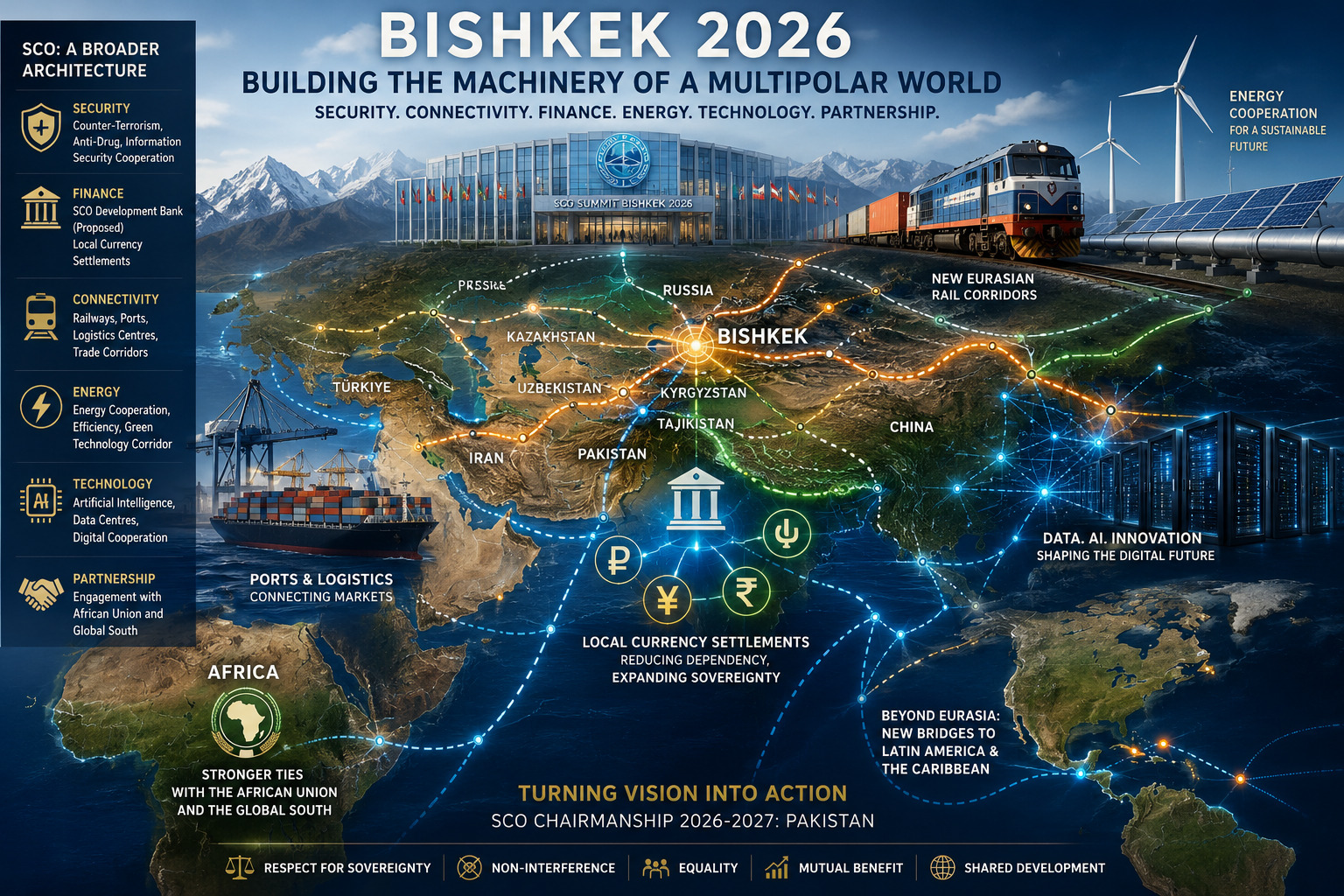
The Shanghai Cooperation Organisation has moved beyond the summit photograph. From security institutions and ports to artificial intelligence, energy, development finance and new partnerships with the Global South, Bishkek revealed an international order quietly being reconstructed — but the new architecture remains unfinished, contested and far from replacing the old one.
INTERNATIONAL ANALYSIS
Belize City: Thursday 3rd September 2026: For years, the expression “multipolar world” has been repeated so often that it risks becoming another diplomatic slogan.
Bishkek may have changed that.
On September 1, 2026, the leaders of the Shanghai Cooperation Organisation gathered in Kyrgyzstan for the organisation's 26th Council of Heads of State meeting and its 25th anniversary.
Around that table sat an extraordinary concentration of geopolitical weight: China, Russia, India, Iran, Pakistan, Kazakhstan, Kyrgyzstan, Tajikistan, Uzbekistan and Belarus.
But the significance of Bishkek was not simply who attended.
- It was what they began putting together.
- Twenty-eight documents emerged from the summit.
- They covered security, narcotics, artificial intelligence, information security, climate cooperation, energy, ports, logistics, nuclear security and institutional reform.
The SCO also approved a formal pathway for cooperation with the African Union Commission, strengthened relationships among Eurasian organisations and handed its 2026–2027 chairmanship to Pakistan under the revealing theme:
“Turning Vision into Action: Connectivity, Innovation and Shared Prosperity.”
That tells us something.
- The conversation is moving from what multipolarity means to how multipolarity might actually work.
THIS IS NOT YET A NEW WORLD ORDER
Before getting carried away, one distinction must be made.
Bishkek did not create a replacement for the Western international system.
- It did not dethrone the United States dollar.
- It did not establish an operational SCO common currency.
- It did not transform the organisation into an Eastern NATO.
- And it did not suddenly erase the profound differences separating China and India, India and Pakistan, or the competing national interests of its Central Asian members.
The SCO itself continues to insist that it is not a military-political bloc directed against other countries or organisations.
That matters.
Because what is emerging may be more complicated — and potentially more durable — than another Cold War divided neatly between two camps.
What Bishkek revealed is an attempt to create options.
- Alternative financing.
- Alternative payment arrangements.
- Alternative transport corridors.
- Regional security institutions.
- Energy cooperation.
- Technology platforms.
- New relationships among regional organisations.
Not necessarily a system designed to destroy the existing architecture tomorrow — but one intended to make dependence upon that architecture progressively less absolute.
And therein lies the real story.
THE BANK THAT DOES NOT YET EXIST — BUT NOW MATTERS
Perhaps no issue illustrates the distinction better than the proposed SCO Development Bank.
The bank was not launched in Bishkek.
There is no completed financial institution waiting Monday morning to begin lending billions across Eurasia.
But something important did happen.
India has entered discussions over establishing the bank, and reporting following Bishkek indicates that the proposal secured support among SCO member states.
That is significant because India has often been one of the indispensable balancing powers inside the organisation.
- Russia and Iran have obvious reasons for wanting financial mechanisms less vulnerable to Western sanctions.
- China has its own enormous financial infrastructure.
- The Central Asian states need development capital for transportation, industrialisation, energy and connectivity.
India, however, remains deeply integrated with Western markets and maintains major strategic relationships with the United States and Europe.
Its participation therefore changes the equation.
The question is no longer simply whether Russia, China and Iran want another financial institution.
It is whether the broader SCO can eventually construct one capable of financing roads, railways, ports, energy systems, industrial projects and technology infrastructure across a gigantic Eurasian economic space.
And that brings us to perhaps the most important misconception surrounding “de-dollarisation.”
THE DOLLAR DOES NOT HAVE TO DIE FOR THE SYSTEM TO CHANGE
Too much commentary reduces the changing international monetary order to one sensational question:
- When will the dollar collapse?
That may be the wrong question.
- A multipolar monetary system does not require the dollar to disappear.
- It requires countries to acquire additional ways of conducting commerce.
- If two countries can increasingly trade using their national currencies;
- if banks can settle transactions through alternative mechanisms;
- if development projects can eventually be financed through new institutions;
- and if energy transactions can be conducted without every transaction passing through traditional dollar-centred channels —
- then the dollar can remain enormously powerful while its exclusivity gradually diminishes.
That is a far more realistic pathway than imagining some dramatic morning when the world awakens and discovers that the dollar has vanished.
Bishkek should therefore be understood not as the funeral of the dollar, but as part of a much longer experiment in financial redundancy.
- And redundancy is power.
- Because the country possessing two financial doors is less vulnerable than the country possessing only one.
BUT IRAN EXPOSES THE WEAKNESS
- Iran provides the brutal counterargument.
- Tehran can advocate alternative payments.
- It can participate in the SCO.
- It can deepen relations with Russia and China.
- It can receive political support from fellow members.
But none of that automatically makes Western financial pressure disappear.
- That is precisely why the Iranian case matters.
- Bishkek demonstrated that political multipolarity is developing faster than complete financial independence.
Sanctions, access to international banking, shipping, insurance, energy markets and physical maritime chokepoints remain enormously consequential.
Washington has already warned countries against helping Iran circumvent sanctions following Prime Minister Narendra Modi's Bishkek engagement with Iranian President Masoud Pezeshkian.
And there lies the stress test.
- It is relatively easy to announce that a country wants alternatives.
- The real test comes when using those alternatives carries a price.
- Will banks use them?
- Will companies risk secondary sanctions?
- Will governments protect those companies?
- Will there be sufficient liquidity?
- Can goods physically reach their markets?
That is where rhetoric ends and sovereignty begins.
EURASIA IS BUILDING MORE THAN BANKS
This is why one of the least glamorous Bishkek agreements may ultimately prove among the most important.
The summit adopted an Action Plan for the Development of Ports and Logistics Centres for 2026–2030.
Think carefully about that.
- Ports.
- Logistics.
- Railways.
- Payment systems.
- Energy.
- Data.
- Artificial intelligence.
- Security.
- Taken individually, these look like technical agreements.
- Taken together, they begin looking like an economic operating system.
Bishkek also adopted a concept for regional data-processing centres, computing capacity and development of the artificial-intelligence industry.
Governments signed an AI cooperation memorandum.
- They established a Green Technology Corridor programme for 2026–2030.
- They adopted statements on energy systems, energy conservation and efficiency.
- They established programmes dealing with information security.
- And they approved new permanent security mechanisms.
This is where the larger picture comes into focus.
The struggle over the future international order will not be decided exclusively by aircraft carriers, nuclear weapons or presidents standing behind podiums.
It will also be determined by:
- Who finances the infrastructure?
- Who owns the ports?
- Which railway carries the cargo?
- Which currency settles the transaction?
- Which bank processes the payment?
- Whose data centre stores the information?
- Whose technology operates the network?
- And which security architecture protects it?
That is the machinery of geopolitical power.
THE SCO IS ALSO BUILDING A SECURITY SYSTEM
Bishkek approved regulations for a Universal Centre for Countering Challenges and Threats to the Security of SCO Member States, together with the Executive Committee of an SCO Anti-Drug Centre.
The summit also approved an information-security cooperation plan covering 2026–2028 and expanded cooperation against synthetic drugs and organised crime.
Again, this does not create an Eastern NATO.
There is no SCO equivalent of NATO's Article 5 collective-defence guarantee.
- But it would be equally mistaken to conclude that nothing consequential is happening.
The SCO may not be constructing a conventional military alliance.
- It is nevertheless developing an increasingly elaborate regional security architecture.
That distinction will matter greatly over the next decade.
AND THEN CAME AFRICA
Perhaps one of Bishkek's most underestimated decisions was approval for an agreement between the SCO Secretariat and the African Union Commission.
This should not be exaggerated.
Africa has not joined the SCO.
The African Union has not become part of a China-Russia geopolitical bloc.
But an institutional bridge is being built between an organisation containing much of Eurasia's geopolitical weight and the continental organisation representing Africa.
At the expanded SCO Plus meeting, the gathering became wider still.
Mongolia participated alongside dialogue partners including Türkiye, Azerbaijan, Armenia, Egypt and Laos, while Vietnam and Togo attended as guests. Representatives from other Eurasian and international institutions were also present.
The meeting's theme openly referred to the SCO Plus contribution toward the formation of a multipolar world.
- That tells us that the SCO's ambition is no longer purely internal.
- It is developing outward-facing connections.
- And this is precisely where Latin America and the Caribbean should begin paying attention.
THE CARIBBEAN SHOULD NOT ASK: EAST OR WEST?
That would be the wrong question.
Belize should not exchange dependence upon Washington for dependence upon Beijing.
- CARICOM should not substitute one distant centre of power for another.
- Nor should Caribbean countries romanticise the SCO, BRICS, China, Russia, India or anybody else.
Great powers pursue interests.
- So should small states.
The question for Belize is therefore not:
- Should we choose America or Eurasia?
The question should be:
- How does Belize acquire enough economic, diplomatic and institutional capacity to negotiate intelligently with all of them?
That is an entirely different foreign-policy philosophy.
A genuinely multipolar world could provide small states with greater bargaining opportunities.
- Development finance could come from several directions.
- Markets could diversify.
- Currencies could diversify.
- Technology partnerships could diversify.
- Energy investment could diversify.
- Infrastructure financing could diversify.
But none of that automatically produces sovereignty.
- A weak state with ten foreign partners can still be a weak state.
- It can simply become dependent in ten different directions.
CARICOM MUST THINK REGIONALLY
The African Union connection should particularly concern Caribbean policymakers.
- Africa increasingly approaches major geopolitical negotiations with the institutional weight of a continent.
- The Caribbean remains fragmented into tiny economies whose individual bargaining power is extremely limited.
- That model becomes increasingly dangerous in a world where major regions are building networks of institutions.
- The SCO is strengthening connections with other Eurasian organisations.
- It is establishing formal engagement with the African Union.
- China has extensive institutional relationships throughout the Global South.
BRICS continues expanding its diplomatic reach.
Meanwhile, Caribbean countries frequently approach major powers individually — each negotiating financing, infrastructure, technology and investment from positions of limited scale.
That raises an uncomfortable question:
If the emerging world increasingly negotiates bloc-to-bloc, why should the Caribbean continue negotiating with global powers island-by-island?
- CARICOM's greatest geopolitical asset may ultimately not be the sovereignty of its individual members alone.
- It may be the collective bargaining power those sovereign states have never fully learned to exercise.
INDIA MAY BE THE COUNTRY TO WATCH
China and Russia naturally dominate the headlines surrounding the SCO.
But India may tell us more about where the international system is actually going.
- India participates in the SCO.
- India participates in BRICS.
- India maintains deep relationships with Russia.
- It competes strategically with China.
- It maintains important relations with Iran.
And simultaneously, India maintains an enormous economic and strategic relationship with the United States and Western partners.
- That is not ideological confusion.
- It is strategic autonomy.
- India does not need to agree with China on everything to sit beside China.
- It does not need to endorse every Russian policy to trade with Russia.
- And it does not need to abandon Washington to participate in institutions Washington does not control.
That may ultimately become the defining behaviour of the multipolar age:
- not permanent allegiance, but permanent national interest.
PAKISTAN NOW INHERITS THE TEST
The ceremonial phase has ended.
Pakistan now holds the SCO chairmanship for 2026–2027.
Its theme could hardly be more appropriate:
“Turning Vision into Action.”
Because that is exactly where the credibility of Bishkek will be determined.
- Can the proposed Development Bank become operational?
- Can financial cooperation move beyond declarations?
- Can major transport projects secure financing?
- Can ports and logistics centres become interconnected?
- Can India and Pakistan cooperate sufficiently to prevent their rivalry from paralysing the organisation?
- Can China and India manage their strategic competition?
- Can Iran obtain meaningful economic benefits despite sanctions?
- Can Central Asian countries use new corridors to industrialise rather than merely become transit territory?
- And can the SCO expand cooperation with the Global South without becoming another arena for great-power domination?
Those are the measurements that matter.
- Not communiqués.
- Not photographs.
- Not diplomatic applause.
Implementation.
BISHKEK'S REAL MESSAGE
- The world did not change overnight on September 1.
- The dollar remains dominant.
- Western capital markets remain enormously powerful.
- The United States remains the world's formidable military power.
- The IMF, World Bank and Western financial institutions remain central to international finance.
The SCO remains internally divided.
And many Bishkek initiatives remain proposals, frameworks or programmes whose effectiveness has yet to be demonstrated.
But dismissing Bishkek because the old order still exists would be equally shortsighted.
International orders rarely disappear overnight.
- They erode, adapt and become surrounded by alternatives.
- A railway appears.
- Then a port.
- Then another payment mechanism.
- Then another development institution.
- Then another trading relationship.
- Then another regional partnership.
Eventually, what once looked like isolated projects begins resembling architecture.
That may be what we witnessed in Bishkek.
- Not the arrival of the post-American world.
- Not the death of the dollar.
- Not the birth of an Eastern empire.
Something subtler.
And perhaps more consequential:
the construction of a world in which increasingly powerful countries are determined never again to have only one door through which they can trade, finance, communicate, transport energy or conduct diplomacy.
For Belize and the Caribbean, the warning is therefore not that we must rush toward Eurasia.
- The warning is that the international system is changing whether we prepare for it or not.
- The countries that understand that change will negotiate.
- Those that do not will merely be negotiated over.
NATIONAL PERSPECTIVE BELIZE
BISHKEK 2026: EURASIA IS BUILDING THE MACHINERY OF A MULTIPOLAR WORLD
The question for Belize is not which great power we should follow.
The question is whether we will build enough national and regional strength that, in the world now emerging, Belize can finally negotiate from its own interests rather than somebody else's.
By: Omar Silva – Editorial Director @ www.nationalperspectivebz.com
NATIONAL PERSPECTIVE BELIZE ©
- Log in to post comments