FROM NATIONAL PERSPECTIVE TO NATIONAL TRANSFORMATION
The Architecture of a Conscience-Driven FUTURE Belize
REALITY → PERSPECTIVE → UNDERSTANDING → CONSCIOUSNESS → VISION → PARTICIPATION → TRANSFORMATION → ACCOUNTABILITY
Belize does not have to think alike. But Belize must learn how to think together.
THE QUESTION BENEATH ALL THE OTHER QUESTIONS
Belize City: Sunday 16th August 2026: There comes a time in the life of a nation when its greatest challenge is no longer simply finding answers.
The deeper challenge becomes understanding the questions.
Belize stands increasingly within such a moment.
- Technology is transforming societies faster than institutions can comfortably respond. Information travels instantaneously, but truth competes with misinformation, political messaging, algorithms, partisan interpretation and competing versions of reality.
Trust in institutions is fragile.
- Economic pressures affect families differently.
- Citizens increasingly question political institutions that previous generations accepted almost automatically.
The world around Belize is changing geopolitically, technologically, economically and environmentally.
- And yet much of our national political conversation remains trapped inside frameworks inherited from another period.
Government versus Opposition.
- PUP versus UDP.
- Blue versus Red.
- Success versus failure.
- Supporter versus opponent.
But what happens when the questions confronting Belize can no longer be adequately understood through those divisions?
What happens when citizens no longer agree merely about solutions, but increasingly disagree about what the problems themselves actually are?
This is where Belize requires something deeper than another political argument.
- Belize requires national sensemaking.
And from national sensemaking must eventually emerge something even greater:
National Consciousness. PART I
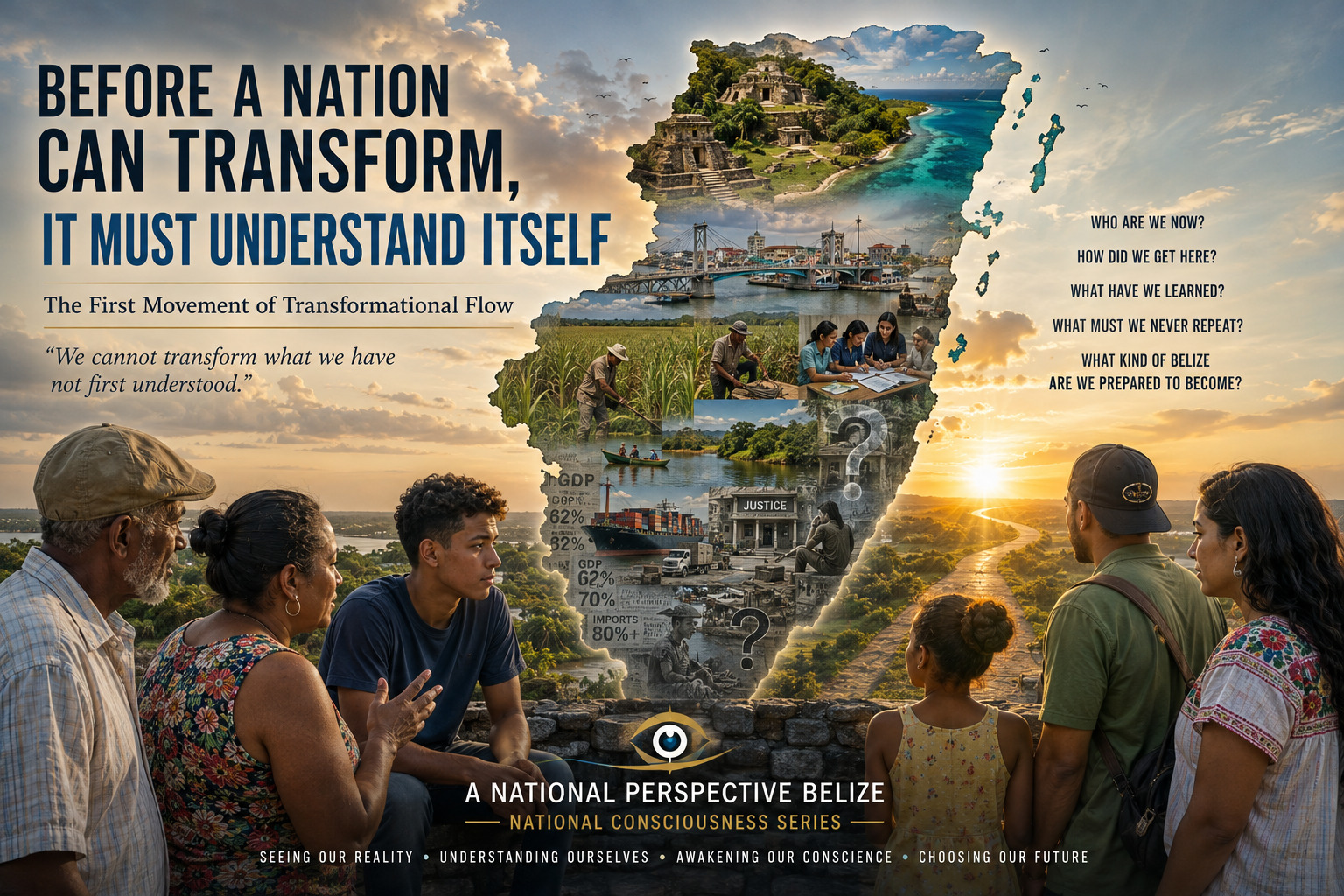
BEFORE A NATION CAN TRANSFORM, IT MUST UNDERSTAND ITSELF
The First Movement of Transformational Flow: From Reality to Understanding
Before we speak about changing Belize, we must confront a more fundamental question:
DO WE SUFFICIENTLY UNDERSTAND THE BELIZE WE ARE TRYING TO CHANGE?
It sounds simple.
It is not.
- A country can know its population, calculate its GDP, measure its imports, publish its budgets, count its schools, record its elections and celebrate the anniversaries of its Independence—and still fail to understand itself.
Because information about a nation is not necessarily understanding of a nation.
Understanding requires something deeper.
- It requires us to connect events.
- To recognize patterns.
- To examine history.
- To question inherited assumptions.
- To distinguish symptoms from causes.
- To separate what we know from what we merely believe.
And sometimes, most painfully, to look at conditions we have lived with for so long that we have stopped recognizing them as abnormal.
That is where national transformation must begin.
THE FIRST TRANSFORMATION IS NOT POLITICAL
There is a temptation whenever people become dissatisfied with their country's direction to immediately search for a political solution.
- Change the Government.
- Change the Prime Minister.
- Change the party.
- Change the Constitution.
- Change the law.
- Change the institution.
Some of those changes may indeed become necessary.
But none of them constitutes the first transformation.
- The first transformation must occur within our individual understanding.
Because if we change governments without understanding the political culture that repeatedly produces similar behaviours, those behaviours can return.
- If we create new institutions without understanding why previous institutions became weak, the new institutions may eventually suffer the same weaknesses.
- If we write new laws without understanding why existing laws were poorly enforced, legislation alone will not rescue us.
- If we attempt economic transformation without understanding the structural reasons Belize remains heavily dependent upon imports, we may simply replace one programme with another.
And if we reform a Constitution without developing a citizenry that understands the responsibilities accompanying constitutional democracy, we can change the architecture of government while leaving the political culture largely untouched.
That leads us to a difficult but necessary principle:
WE CANNOT TRANSFORM WHAT WE HAVE NOT FIRST UNDERSTOOD.
BELIZE MUST LOOK AT BELIZE
For much of our political history, Belizeans have been encouraged to understand the country primarily through political competition.
- Blue explains Belize one way.
- Red explains Belize another.
- Government presents evidence of progress.
- Opposition presents evidence of failure.
- Supporters defend.
- Critics attack.
- Election arrives.
- Government changes—or survives.
- And the cycle begins again.
But beneath the political competition, certain national questions remain.
- Why do some institutional weaknesses survive different administrations?
- Why do similar controversies reappear under different governments?
- Why do citizens repeatedly complain about the same public systems?
- Why does economic growth not always translate into economic security at the household level?
- Why does a country blessed with agricultural land and natural resources continue importing so many finished products?
- Why do national development discussions repeatedly return to the same unresolved questions?
These cannot always be understood by asking:
- Who is in Government?
Sometimes the more important question is:
WHAT IS IT ABOUT THE SYSTEM THAT CONTINUES REGARDLESS OF WHO GOVERNS IT?
- That is a very different national conversation.
- And it requires a very different kind of thinking.
FROM EVENTS TO PATTERNS
- A nation that merely reacts to events remains trapped in the present.
- A nation that identifies patterns begins to understand itself.
- One controversy may be an isolated incident.
Repeated controversies involving similar institutional weaknesses may reveal something structural.
- One administrative failure may be human error.
Repeated failures across years and administrations may tell us something about institutional capacity.
- One economic shock may come from outside Belize.
Persistent vulnerability to external shocks may reveal something about the structure of our economy.
Therefore, the first responsibility of national sensemaking is to stop seeing Belize merely as a succession of headlines.
- We must begin connecting the dots.
EVENT → PATTERN → STRUCTURE → CONSEQUENCE
- The event tells us what happened.
- The pattern asks whether it has happened before.
- The structure asks why it keeps happening.
The consequence asks:
- What is this doing to Belize?
Now we are beginning to make sense.
BUT UNDERSTANDING ALSO REQUIRES HONESTY
There is another danger.
It is easy to examine national problems and conclude that somebody else is responsible.
- Politicians.
- Colonialism.
- Foreign governments.
- Business interests.
- Public officers.
- Political parties.
- International institutions.
- Previous generations.
Any of these may carry responsibility in particular circumstances.
But national understanding becomes incomplete when responsibility is always located somewhere outside us.
A conscious Belize must eventually ask:
- What have we tolerated?
- What have we normalized?
- What have we rewarded politically?
- What have we ignored because it benefited our side?
- What have we accepted from one political party that we would condemn from another?
- What responsibilities of citizenship have we surrendered to politicians?
Those questions are uncomfortable.
They are also transformational.
- Because national consciousness begins when citizens stop seeing themselves merely as victims or spectators of the system and begin recognizing themselves as participants capable of changing it.
THE COLLAPSE OF SIMPLE STORIES
For generations, societies have relied upon shared stories to make complicated realities understandable.
Belize has its own.
- Independence would produce sovereignty.
- Education would produce advancement.
- Economic growth would produce prosperity.
- Elections would guarantee democracy.
- Institutions would protect citizens.
- Political parties would represent competing visions of national development.
Some elements of those stories remain valid.
- Others require examination.
- And some may no longer sufficiently explain the Belize of the twenty-first century.
That does not mean Belize should abandon its national story.
- It means we must become mature enough to re-examine it.
Because when lived experience begins contradicting the story people have been told, trust deteriorates.
And when trust deteriorates without a credible process for understanding why, people become vulnerable to cynicism, misinformation, conspiracy, political manipulation and hopelessness.
This is why modern leadership cannot merely promise certainty.
It must help people make sense of uncertainty.
LEADERSHIP AS NATIONAL SENSEMAKING
The transformational leader therefore does not begin by declaring:
“I HAVE ALL THE ANSWERS.”
The transformational leader begins differently:
- Let us establish what we know.
- Let us identify what we do not know.
- Let us examine how we arrived here.
- Let us hear competing explanations.
- Let us test them against evidence.
- Let us identify the choices before us.
- Let us understand the consequences of those choices.
And then:
LET US DECIDE CONSCIOUSLY.
- This is leadership as sensemaking.
- And applied to an entire country, it becomes something much larger:
NATIONAL SENSEMAKING.
NATIONAL SENSEMAKING IS NOT NATIONAL AGREEMENT
This distinction is fundamental.
The objective is not to make every Belizean think alike.
That would be neither democratic nor desirable.
The objective is to create sufficient shared understanding that Belizeans can disagree meaningfully.
- We can disagree about the solution while agreeing about the evidence.
- We can disagree about economic philosophy while understanding the numbers.
- We can disagree about constitutional reform while understanding the existing constitutional structure.
- We can disagree about development while understanding its environmental and social consequences.
- We can disagree about Government without inventing different realities.
Therefore: WE DO NOT HAVE TO THINK ALIKE TO THINK TOGETHER.
That is the intellectual beginning of National Consciousness.
THE JOURNEY FROM INFORMATION TO CONSCIOUSNESS
There is a progression here that must not be rushed.
- INFORMATION
Something happened. ↓
- KNOWLEDGE
We establish the relevant facts ↓
- CONTEXT
We understand what surrounds those facts ↓
- PERSPECTIVE
We recognize patterns and competing interpretations. ↓
- UNDERSTANDING
We begin comprehending why the condition exists. ↓
- CONSCIENCE
We ask what that understanding requires of us. ↓
- NATIONAL CONSCIOUSNESS
Enough citizens begin thinking about their individual concerns within the larger interests of Belize.
That is the first great movement of Transformational Flow.
And notice something important: FUTURE has not yet entered.
Nor should it.
- First comes understanding.
- First comes the citizen.
- First comes Belize.
Only after a society begins understanding its condition does it become meaningful to ask what alternative future should replace it.
UNDERSTANDING OURSELVES ALSO MEANS RECOVERING OUR MEMORY
A nation without institutional memory can be persuaded that every recurring problem is new.
- It can celebrate recycled solutions as innovation.
- It can repeat failed policies because few remember why they failed.
- It can allow political narratives to replace historical evidence.
National understanding therefore requires memory.
- What decisions did Belize make twenty years ago?
- What were we promised?
- What succeeded?
- What failed?
- What institutions were created?
- Why were they created?
- What happened to them?
- Which recommendations were never implemented?
- Which warnings were ignored?
- Which national opportunities were lost?
- Which achievements should be preserved?
This is not about living in the past.
- It is about preventing national amnesia from controlling the future.
MEMORY → UNDERSTANDING → BETTER CHOICE
- That too is regeneration.
AND NOW NATIONAL PERSPECTIVE ENTERS
Once we understand this first principle, the role of National Perspective Belize becomes almost self-evident.
Belize needs somewhere capable of asking:
Not merely: What happened today?
But:
WHAT DOES WHAT HAPPENED TODAY TELL US ABOUT BELIZE?
That is the distinction between reporting and perspective.
National Perspective becomes one instrument of national sensemaking.
- Not to dictate conclusions.
- Not to manufacture consciousness.
- Not to prepare political propaganda.
- But to gather evidence, recover memory, establish context, identify patterns, expose contradictions and place the national question before the citizen.
Its responsibility becomes: HELP BELIZE SEE ITSELF.
Because only after Belize sees itself can Belize consciously ask:
WHAT SHOULD WE BECOME?
And only after that question emerges does the next stage of Transformational Flow become possible.
That is where National Perspective encounters the Belizean conscience.
- And from thousands upon thousands of individual Belizean consciences can gradually emerge something no newspaper, political party, government or movement can manufacture or own:
NATIONAL CONSCIOUSNESS.
THE FIRST PRINCIPLE OF TRANSFORMATIONAL FLOW
We therefore begin our entire journey with one proposition:
- BEFORE A NATION CAN TRANSFORM, IT MUST UNDERSTAND ITSELF.
- Before vision — reality.
- Before ideology — understanding.
- Before persuasion — evidence.
- Before political organization — consciousness.
- Before transformation — sensemaking.
And before FUTURE asks Belizeans to travel toward a different national destination, we must first be willing to stand together, look honestly at where we are, understand how we arrived here, and ask ourselves:
- WHO ARE WE NOW?
- HOW DID WE GET HERE?
- WHAT HAVE WE LEARNED?
- WHAT MUST WE NEVER REPEAT?
And finally: WHAT KIND OF BELIZE ARE WE PREPARED TO BECOME?
That is not yet the answer.
It is the awakening of the question.
And sometimes, in the life of a nation, asking the right question is the first act of transformation.
By: Omar Silva -Editorial Director @ www.nationalperspectivebz.com
- Log in to post comments