
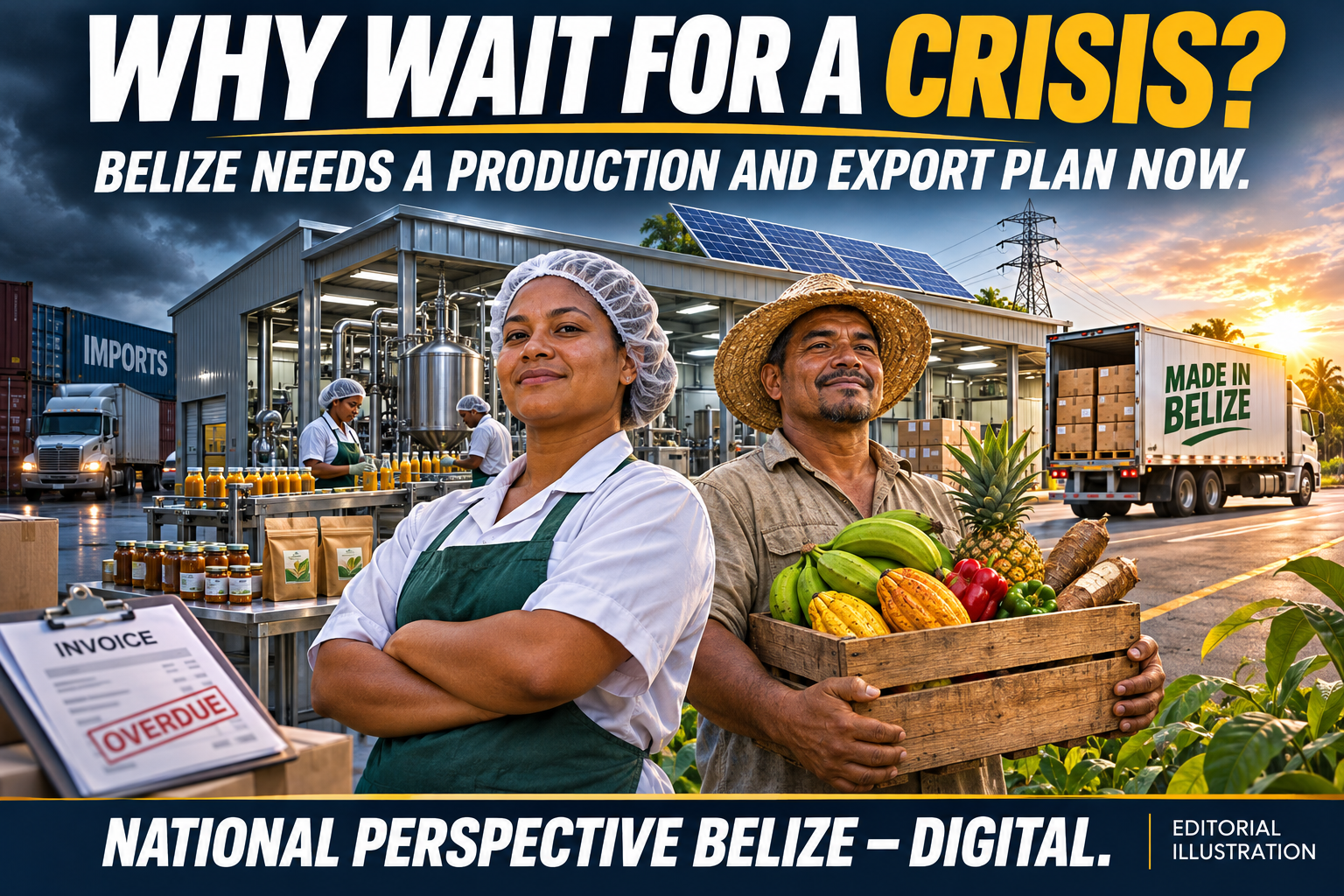
WHY WAIT FOR A CRISIS? BELIZE NEEDS A PRODUCTION AND EXPORT PLAN NOW.
Analysis and Editorial |
Belize City: Thursday 5th November 2026
Nearly half a billion Belize dollars in annual merchandise purchases from Mexico and Guatemala should sharpen the national question: what is Belize doing to build the industries, secure the buyers and earn more from the markets next door?
- Belize should not have to reach a critical foreign-exchange emergency before treating production and exports as an urgent national priority.
The warning is already practical. When an essential utility has Belize dollars available but struggles to obtain the foreign currency needed to pay an overseas supplier, economic management has consequences beyond a ministerial briefing. Payments, business continuity and the cost of keeping the country functioning come into view.
- On Tuesday November 3, Belize Electricity Limited told the media that they are facing difficulty in obtaining U.S. currency for payments to Mexico's electricity supplier. Economic Transformation Minister Dr. Osmond Martinez acknowledged increased foreign-exchange pressure and identified faster project implementation, tourism and business process outsourcing among the responses.
Those avenues deserve scrutiny and support where they deliver results. But Belize also needs a sustained expansion of competitive production and export earnings. Temporary financing can buy time. The country must use that time to strengthen its capacity to earn.
The neighbors already sell to us
The Statistical Institute of Belize's 2025 merchandise trade summary records the following imports:
Source country Belize's merchandise imports, 2025
Mexico BZ$264.7 million
Guatemala BZ$233.0 million
Combined BZ$497.7 million
- These are import values, not bilateral trade deficits. Calculating each deficit requires the corresponding export figures on a consistent basis. Nevertheless, almost BZ$498 million demonstrates the scale of Belize's purchasing relationship with its two immediate neighbors.
- The question follows: where is the measurable program to help Belizean enterprises sell more into those markets?
- Our purchases do not oblige Mexican or Guatemalan businesses to buy an equivalent amount from Belize. They do establish substantial commercial relationships within which government and industry should identify products, buyers, investment partners and obstacles to trade.
- Belize needs to enter discussions with a practical offer: these are the goods and services we can competitively supply; these are the standards we must meet; these are the barriers requiring negotiation; and these are the investments needed to deliver reliably.
A new regional report strengthens the case
- The Latin American Economic Outlook 2026, published on November 4 by the OECD, ECLAC, CAF and the European Commission, identifies Belize, Uruguay and Ecuador as economies with particularly large opportunities to expand regional trade relative to GDP. Its model compares actual trade with expected trade, using structural characteristics and data covering 2002–2024.
That is potential, rather than a guaranteed order book or money immediately available to government. The period also spans successive administrations. It describes a longstanding weakness for which the present government must demonstrate an effective response.
- The report links stronger alignment with regional demand to diversified productive capabilities. It also recognises Belize's relative strength in knowledge-intensive services. A national strategy should develop both goods and export services.
For National Perspective Belize, the policy implication is direct: Belize must systematically establish what regional buyers need and organise investment around products and services the country can supply competitively.
From the farm to a product someone will buy
- Agriculture can support more employment and income when additional stages of production take place here: grading, processing, preservation, packaging, testing, storage and distribution.
Belize should assess opportunities in processed foods, juices, sauces, packaged agricultural goods, seafood preparation and other manufacturing activities against actual market evidence. These are candidates for commercial evaluation, not claims that every proposed factory would succeed.
- A processing plant needs dependable inputs, suitable technology, affordable financing, skilled workers and buyers. Its product must arrive at the required quality, quantity, price and time. Building capacity without establishing demand can leave expensive machinery idle.
Government should bring producers, processors, financiers and prospective buyers into the same program. Farmers need predictable purchasing arrangements. Processors need reliable supply. Buyers need consistent delivery. Small enterprises need access to shared testing, packaging and storage services that may be too costly to provide individually.
- Industrial policy becomes credible when those relationships produce commercially sustainable sales.
Trade diplomacy must deliver beyond the meeting
Belize already has a Partial Scope Agreement with Guatemala, in force since 2010. The Directorate General for Foreign Trade describes provisions addressing tariff preferences, trade barriers, transport and investment. BELTRAIDE identifies opportunities involving products such as orange juice, beans, seafood, meat and corn.
- Government should publish how the agreement is being used: which products receive preferences, how many Belizean firms export under it, what they sell and which obstacles remain unresolved. Where expanded coverage would benefit viable producers, negotiations should be pursued with specific objectives.
With Mexico, the government announced discussions with Quintana Roo in February 2025 covering value-added trade, customs facilitation, logistics and business connections.
- That announcement provides a concrete basis for accountability. What followed? Which barriers were removed? Which buyers were secured? Which enterprises increased shipments? Government should disclose the current status of wider trade negotiations and the next dated milestones.
Belize should seek suitable tariff treatment, workable health and food-safety approvals, predictable customs procedures and transport arrangements. Negotiating access and building the ability to use it must proceed together.
Electricity belongs inside the production plan
- A processor must power equipment, preserve stock and meet delivery schedules. Unreliable supply can interrupt production; expensive electricity can undermine the price offered to a buyer.
- Energy policy therefore belongs inside any serious export strategy. Government should explain how planned energy investments will improve the operating conditions of farms, processors and manufacturers, including the expected timing and cost implications.
- The same discipline applies to public borrowing. A project presented as supporting productive growth should identify its expected economic benefits, repayment obligations and performance measures. Construction spending alone cannot establish that an investment will generate sufficient lasting returns.
The foreign-exchange test is what Belize retains
- SIB reports that merchandise imports reached BZ$2.449 billion during January–September 2026, up 13.5% from the corresponding period in 2025. Domestic merchandise exports fell 9.3% to BZ$320.7 million.
These figures exclude important flows such as tourism receipts and do not constitute the full balance of payments. They show rising goods purchases alongside weaker earnings from domestic goods exports.
- An export program should measure the additional foreign currency retained after paying for imported inputs and overseas obligations. Factories may initially need imported equipment and later require packaging, fuel or ingredients. Gross export sales alone cannot show the net benefit.
- Competitive local production can also save on foreign exchange where it efficiently replaces imports. The objective should be better productive capacity and value for consumers. Raising barriers to shelter expensive, unreliable output could add to household hardship.
- Temporary supplier credit or a negotiated settlement facility could help address immediate payment problems if the terms are workable. Any such arrangement requires financing and eventual settlement of unmatched balances. Changing the invoice currency does not extinguish the bill.
- The immediate task is to keep legitimate payments moving. The sustained task is to expand earnings and reduce avoidable external costs. Both need attention now.
A timetable Belizeans can judge
National Perspective Belize calls for government to publish, within 90 days of adopting this program, a funded production and export action plan developed with businesses and producers. This is our proposed accountability deadline, not an announced government commitment.
The plan should identify:
- Products and buyers: A commercially tested shortlist for Mexico, Guatemala and other regional markets, with demand, delivery costs and supply requirements assessed.
- Negotiation targets: The specific tariff, certification, customs and transport obstacles to address, with responsible officials and dated milestones.
- Investment and access: Financing, processing, storage, training and energy requirements, with transparent eligibility for small firms, cooperatives and established producers.
- Results: Quarterly reporting on shipments, additional export earnings, net foreign exchange benefits, jobs and wages, alongside public expenditure and guarantees.
Existing programs should be incorporated and evaluated. Where they work, expand them. Where results fall short, disclose the constraint and correct it.
- Families need to see how national investment translates into dependable work, improved earnings and affordable goods. Producers need operating conditions that allow them to fulfil contracts. The country needs a stronger capacity to meet its external obligations through sustained earnings.
Belize should be negotiating market access and building productive capacity while there is room to act. Government must name the products, identify the buyers, fund the necessary improvements and publish the results. Why wait for a crisis?
By: Omar Silva - Editorial Director/Publisher @ www.nationalperspectivebz.com
National Perspective Belize – Digital | ©
- Log in to post comments
