
SAN PEDRO AT THE CROSSROADS: MOVING THE AIRPORT, MOVING THE ECONOMY—WHO BENEFITS?
Sunday Analysis and Commentary |
Belize City: Sunday 1st November 2026: Congestion, inadequate services and a proposed northern airport belong in one public conversation. Before another development frontier opens, Belizeans deserve the costs, the transport plan and the proposed future of the downtown airport land.
- San Pedro’s development problem can no longer be measured simply by how many buildings go up or how many visitors arrive. It must be measured by whether people can move safely, whether sewage is treated, whether neighborhoods receive reliable services, and whether public decisions improve the lives of those who sustain the island.
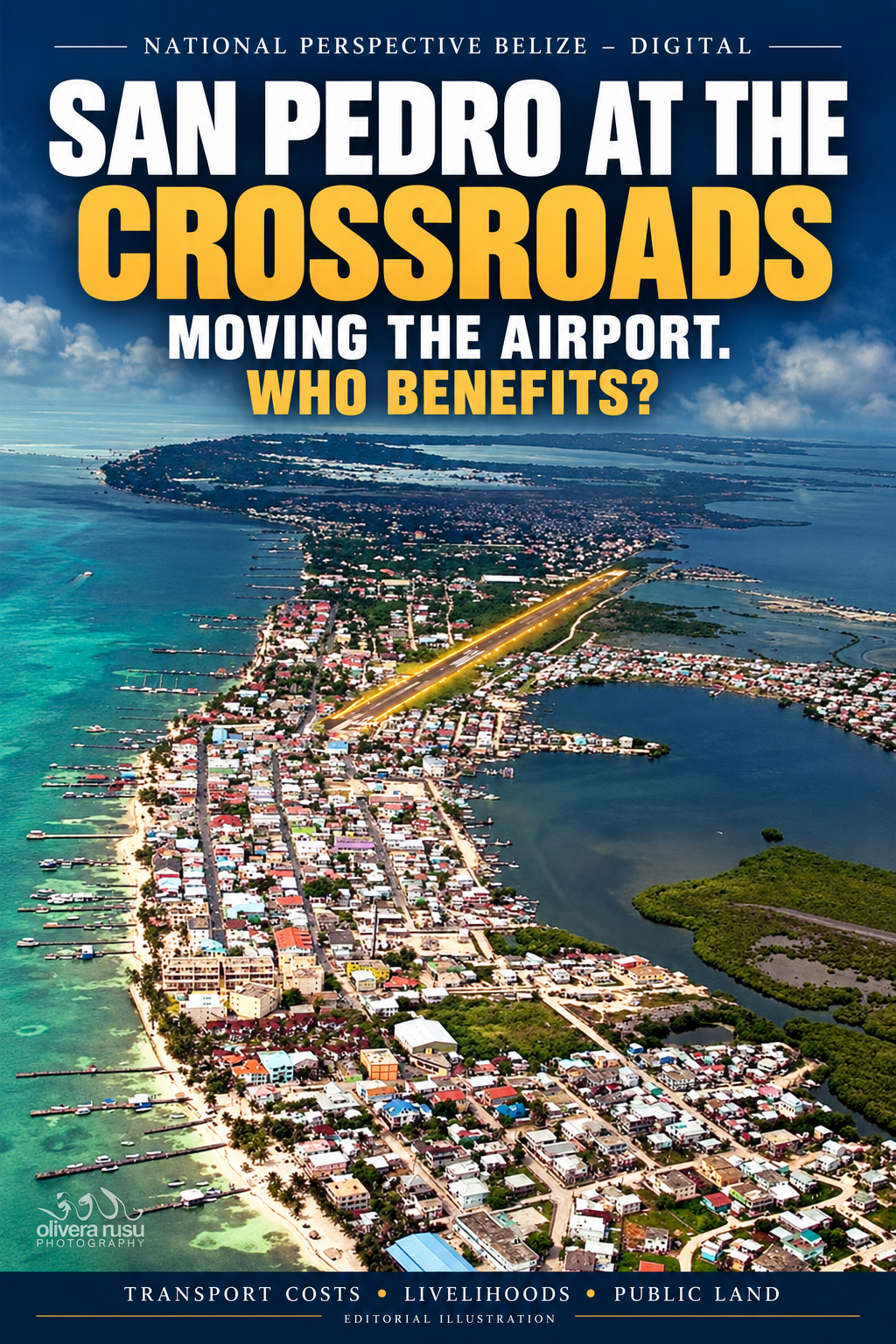
- The proposed relocation of the John Greif II Airport brings those questions together. Moving an airport changes the point around which transport, commerce and investment operate. For Ambergris Caye, the decision could reshape both the established town and the next area of expansion.
The question is whether public planning will guide that change—or once again struggle to catch up with it.
Growth without the necessary public systems
The World Bank’s Belize Blue Cities and Beyond project document identifies a serious mismatch: tourism-driven property development has extended beyond the town council’s administrative boundary without adequate planning for municipal services. It links that pattern to service gaps, higher investment costs, untreated waste and wastewater, and coastal erosion.
- That diagnosis describes a development-management failure. Approving buildings and selling property do not by themselves create a functioning community. Streets, drainage, wastewater treatment, water supply, waste collection and emergency access must be planned and financed together.
- A separate government-hosted strategic assessment records repeated master-planning exercises that had not achieved official adoption at the time of its assessment. Its findings concern that historical position; the current legal status of the latest plan requires public clarification.
Government and the Town Council should publish the applicable planning instrument, its approval date, maps and enforcement arrangements. Residents should not have to guess which rules govern the next subdivision or resort.
The congestion argument needs a complete answer
There is a legitimate case to examine the limitations of the existing airport. Government-hosted airport material identifies operational and capacity constraints. A Belize Tourism Board planning document also identifies the congested junction around Coconut Drive, Almond Street and Pescador Street, where the airport limits road options.
- Those concerns deserve technical examination. However, relocation must be compared with realistic alternatives, including improvements to the existing facility and traffic network.
- Removing the airport could create opportunities to reconnect streets and provide public space. It could also generate additional traffic if redevelopment introduces intensive commercial or residential uses without adequate access and services.
The public needs traffic modelling for both sites: what happens around the new airport, and what replaces the old one?
The missing price: getting to and from the aircraft
- For a passenger, the journey begins before check-in and continues after landing. The useful comparison is the total journey: airfare, ground transport, waiting time, baggage handling and reliability.
- Golf carts are central to island mobility. Their suitability for a longer airport journey must therefore be addressed explicitly. Families carrying suitcases, elderly passengers, people with disabilities and workers reporting for early shifts have different needs from visitors making a short recreational trip.
- What vehicles will provide airport transfers? Will there be scheduled shared transport? What will passengers pay? How will services operate in heavy rain, after dark or when a flight is delayed?
A longer journey could increase fuel or electricity consumption, vehicle wear and the time a driver spends on each transfer. Those are costs to be calculated. No verified future airport-transfer fare is established in the evidence reviewed for this feature.
- Nor should Tropic Air CEO Max Greif’s description of a journey “two hours north” be presented as an independently verified travel time. The actual journey will depend on the final site, route, road conditions, vehicle and any new transport system.
Government should publish door-to-door comparisons for residents, workers and visitors under realistic operating conditions.
Greif raises a question bigger than Tropic
- In a media interview supplied for this analysis, Greif argues that San Pedro’s economy developed around the existing airstrip. He asks how relocation would affect small shops and food businesses in the established town. He also says Tropic can survive the change and refers to its 270 employees. These are his statements.
His commercial interest warrants scrutiny. It does not dispose of the wider economic question.
- A visitor arriving directly in town has different spending opportunities from one transferred from a northern airport straight to a resort. Relocation could redistribute spending between neighbourhoods and businesses. The scale and direction of that change require evidence.
An independent assessment should examine employment, local purchasing, taxi income, accommodation, small retail and food businesses. It should identify transition measures where substantial losses are expected.
- The interviewer also raised questions about Tropic’s property and loan security. Greif rejected the suggestion of an encumbrance that would compromise operations. The interview establishes no documentary basis for asserting a hidden financial arrangement.
The runway land must be part of the discussion
- The published strategic plan contemplates mixed redevelopment of the released downtown airport area, including public facilities, green space and social housing. These are proposals, not guarantees of delivery.
The San Pedro Sun separately reported that a business case considered redevelopment proceeds as a possible contribution to airport-related financing. That reporting does not establish an executed sale or a selected buyer.
- Rumours about buyers already positioning themselves remain unverified. They cannot responsibly be presented as proof of political greed or a completed deal. They do justify direct questions.
Who owns the airport parcels? Who has authority to dispose of them? Have offers, options, expressions of interest or negotiations occurred? What independent valuations exist? What public uses would be protected before any commercial allocation?
- Any sale, lease or development arrangement should disclose its beneficiaries, selection process, valuation and treatment of conflicts of interest. Public infrastructure should not create private advantages concealed from the people funding it.
Government must clarify what has actually been decided
- On October 29, Prime Minister John Briceño said the airport proposal remained under study and no final decision had been made. Earlier reporting attributed more definite statements about approval, land and funding to Area Representative Andre Perez.
The authorities should explain whether those statements concern studies, a preferred design, land identification, financing negotiations or an authorized construction project. These are different stages.
- A proposed timetable is not a construction commitment. Financing for project preparation is not proof that construction and associated infrastructure are fully funded.
Duties today, decisions for tomorrow
- The Town Councils Act assigns councils duties concerning garbage removal, streets and public drains. San Pedro’s council also administers local building and traffic functions within the applicable legal framework. Its published traffic responsibilities include licensing, inspections, parking and traffic management.
- Central government controls major parts of land subdivision, environmental approval and national building regulation. The Department of the Environment’s clearance process requires applicable projects to obtain clearance and accept environmental compliance conditions before proceeding.
Responsibility is therefore shared, although the powers are different. The council must perform its local duties; national authorities must account for decisions and infrastructure beyond municipal control.
For the proposed airport, National Perspective Belize recommends a jointly published island development program covering:
- A clear legal planning framework and responsibility for areas beyond town limits.
- An independent comparison of airport alternatives, including environmental and climate risks.
- A funded transport system with passenger access and affordability assessed before relocation.
- Water, wastewater, drainage, electricity, waste and emergency infrastructure timed to serve new growth.
A publicly debated land-use plan for the existing airport area.
Transparent project costs, guarantees, procurement, beneficiaries and continuing maintenance obligations.
- These are recommendations for accountable development, distinct from the existing legal duties described above.
- San Pedro’s residents should be able to support better aviation infrastructure with a clear understanding of what it will cost and how it will affect them. They should also be able to challenge a proposal without being dismissed as opponents of progress.
- Before the airport moves, government must show how people will move, how businesses will adapt, how services will keep pace and how the public interest in the old site will be protected.
San Pedro’s future cannot be reduced to the value of its runway land. It must account for the lives and livelihoods built around it.
By: Omar Silva – Editorial Director/Publisher @ www.nationalperspectivebz.com
National Perspective Belize – Digital
- Log in to post comments
