
ANOTHER STATE OF EMERGENCY—WHERE IS BELIZE’S LASTING PUBLIC SAFETY PLAN?
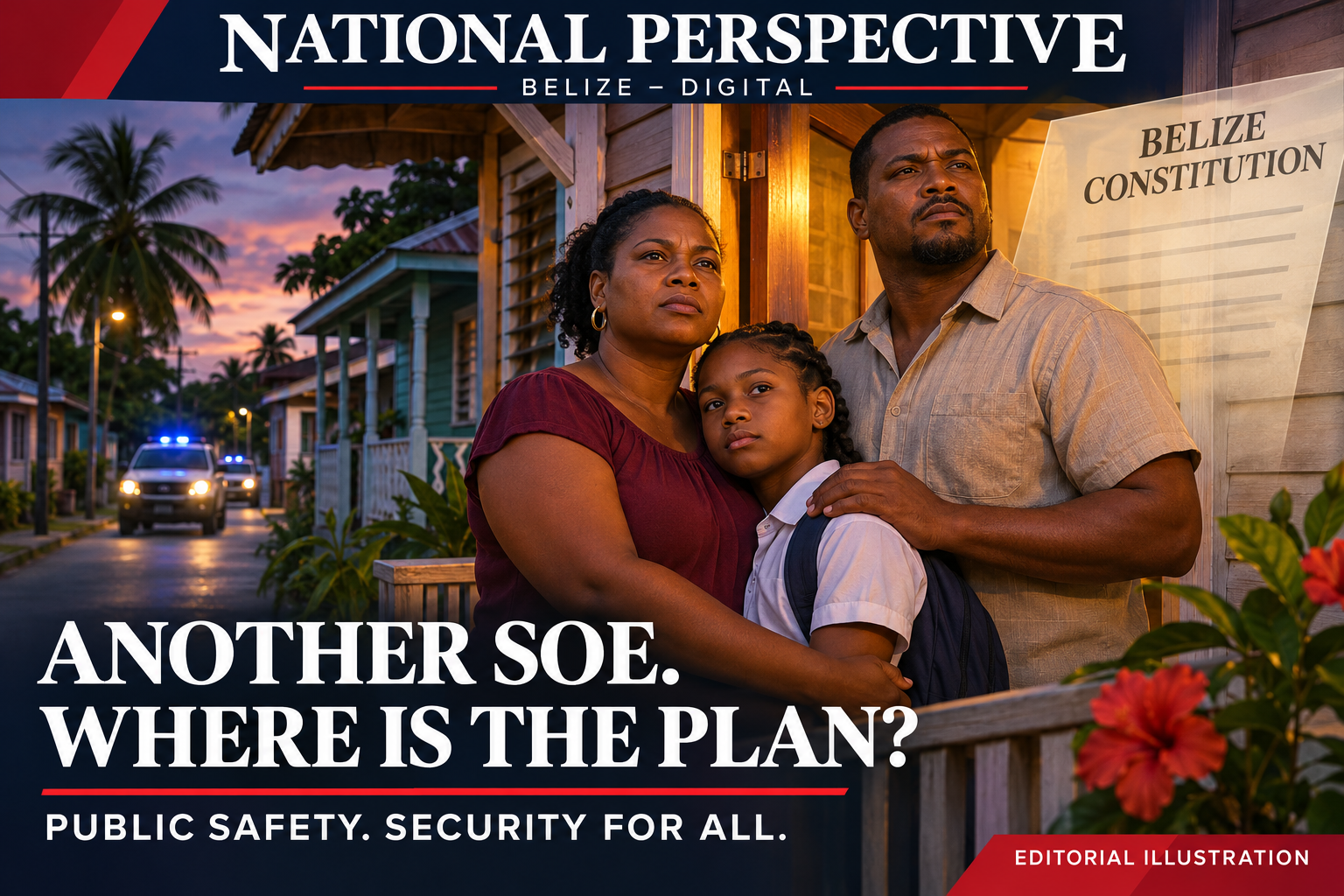
Public safety for all. Constitutional accountability. A government answerable for results.
Editorial analysis
Belize City: Monday 2nd November 2026
A family should be able to travel a Belizean highway without fearing an ambush. Children should be able to reach home safely. Residents should be able to sit outside their houses, open their businesses and move through their communities without calculating whose conflict might claim the next life.
- That is the standard by which the Briceño administration must be judged.
- The latest State of Emergency follows another eruption of shootings and killings, including the quadruple homicide on the Coastal Plains Highway.
- The immediate duty to prevent further bloodshed is undeniable. But after repeated resort to emergency measures, Belizeans are entitled to ask a harder question: what is being built that will keep them safe after those measures end?
- An emergency declaration is an exercise of power. Lasting public safety requires institutions that can investigate violence, prosecute offenders, protect witnesses, interrupt retaliation and prevent recruitment into armed groups. The government must demonstrate how its current operation strengthens those institutions.
The deterioration is measurable
The official figures already provide grounds for serious concern. The Belize Crime Observatory reports 58 murder victims during January–June 2026, compared with 41 during the same period in 2025. That is 17 additional victims—an increase of approximately 41 per cent. These are first-half figures, not a verified November total.
- We do not need to label crime an “all-time high” to recognize the gravity of that deterioration. Every victim represents a lost life and a family whose future has changed permanently.
- Government must publish current figures alongside its operational announcements. Belizeans need to know how many people are being killed and shot, where violence is spreading, how many cases result in charges, and how many reach a lawful conviction. Arrest totals alone cannot answer those questions.
Responsibility reaches the Prime Minister
Michel Chebat now carries responsibility for police and defence. His performance must be judged through the decisions he makes, the resources he secures and the results he delivers. The Prime Minister remains accountable for the appointment and the administration’s overall direction.
- A change of minister cannot, by itself, repair an investigative failure, protect a threatened witness or prevent a teenager from being recruited to carry a gun. Those tasks require continuity, competent management and sustained funding.
- If the administration has a comprehensive strategy, it should publish an accessible version with budgets, responsible agencies, deadlines and measures of success. Sensitive intelligence can remain protected while policy and spending are explained. Citizens should not have to infer a national strategy from press conferences held after another killing.
Emergency powers must meet constitutional tests
- Reports of the latest declaration identify Statutory Instrument 130 of 2026 and affected areas in the Belize and Cayo districts. News accounts differ on whether commencement was October 31 or November 1. The gazetted instrument must settle the precise commencement, boundaries and applicable powers.
The constitutional issue is larger than that discrepancy. Section 18 permits emergency action subject to constitutional conditions. Section 19 expressly provides safeguards for people detained under emergency laws: particularised written grounds within seven days, Gazette notification within fourteen days, review by an independent and impartial tribunal within one month, and reasonable facilities for private consultation with a legal practitioner.
- These are duties the State must fulfil while exercising extraordinary power.
The September 3 Court of Appeal judgment is a warning that government cannot ignore. Reporting on the decision says the court found the challenged March and July 2020 SOEs unconstitutional, including failures to sufficiently justify emergency powers and defects in detention safeguards. Those declarations occurred before the Briceño administration took office. The present administration is responsible for ensuring its own actions meet the law. The earlier ruling does not automatically invalidate this new declaration.
- The government should explain what distinguishes the present circumstances and how it has addressed the deficiencies identified by the court. An assurance that an internal protocol was followed does not settle the legality of a proclamation or an individual detention.
Public trust matters to public safety
- The Association of Defence Attorneys has alleged unlawful detention, denial of access to lawyers and repeated release and rearrest. Those allegations require investigation and a substantive response. They should not be presented as findings already established against every officer involved.
Under ordinary constitutional rules, a person detained on suspicion and not released must be brought before a court without undue delay, and within forty-eight hours. Lawful grounds are required from the outset. The constitutional maximum is not a routine allowance to hold someone merely because the clock has not expired. Emergency detention operates under a different legal framework, with its own safeguards.
- Police need community cooperation to identify offenders and obtain evidence. Arbitrary treatment can undermine that cooperation. Residents must be able to report threats and assist investigations with confidence that the authorities will protect them and act lawfully.
El Salvador: identify what Belize intends to learn
Chebat’s announced intention to study El Salvador’s anti-gang approach requires a clear public explanation of the proposed lessons.
- The legal comparison must be accurate. El Salvador’s state of exception originated in Legislative Decree 333 of March 27, 2022. Its legislature approved the suspension of specified constitutional guarantees. Describing it simply as presidential rule by decree misses that legal mechanism.
- Belize must assess any proposed practice against its own Constitution, laws and institutional capacity. Officials should specify whether they are studying intelligence coordination, prison management, investigations or exceptional detention powers. Upon returning, they should publish recommendations, costs and the legal basis for implementation.
- A foreign visit becomes useful when it produces a concrete, lawful improvement that Belize can sustain.
Mediation, prevention and the LIU require evidence
- Dialogue can help interrupt an immediate cycle of retaliation. Its value should be assessed alongside credible investigations and sustained protection for communities.
- Claims that changes to the Leadership Intervention Unit caused the present violence require evidence. Government should disclose whether the LIU was discontinued, reduced or re-organized; what happened to its staff and funding; which services continued; and what evaluations show about outcomes.
- The announced Second Chance program must also have substance: trained staff, identified participants, safe access, counselling, education, employment pathways and follow-up. The proposed age range of 15–23 covers children and adults with different needs. A program name does not tell families how assistance will reach them.
Tougher sentences: show how the cases will succeed
- The announced consultations on firearms, drugs and gang legislation must be assessed through actual draft provisions. Proposals remain proposals until enacted.
Government must explain how higher penalties will be accompanied by stronger evidence gathering, forensic capacity, witness protection, competent prosecution and timely hearings. A heavier sentence only takes effect after a case reaches conviction.
- Proposals to charge minors as adults require particular scrutiny of the offences, ages, procedures and applicable legal obligations. Adults who recruit children must face effective investigation and prosecution. Children at risk must also have credible routes out of exploitation.
What a lasting plan must deliver
National Perspective Belize calls for a public strategy that commits the government to:
- Immediate protection: lawful action against specific threats, rapid response to retaliation risks and practical protection for threatened people.
- Stronger investigations: adequate forensic support, competent case preparation and regular reporting on case outcomes.
- Disruption of criminal networks: investigation of gun supply, financing and those directing or facilitating violence, including official misconduct where evidence warrants it.
- Sustained prevention: evaluated interventions for young people, families and communities, with funding that continues beyond an emergency.
- Accountable emergency operations: clear powers, detention safeguards, accessible complaints procedures and independent scrutiny.
- A public transition plan: defined responsibilities and resources for maintaining safety when extraordinary powers expire.
Belizeans should be able to see whether the measures work, where they fail and what changes follow. Parliamentary oversight should examine those results and the money spent.
- The Briceño administration cannot discharge its responsibility by asking for patience each time violence escalates. It must earn confidence through protection that lasts.
Public safety must reach every community. The government must use its lawful powers effectively, account for its decisions and show how Belize will remain safer after this SOE ends.
By: Omar Silva – Editorial Director/Publisher @ www.nationalperspectivebz.com
National Perspective Belize – Digital | ©
- Log in to post comments
