
FUTURE BELIZE | THE FIRST TRANSFORMATION: A path to economic independence beyond 2030
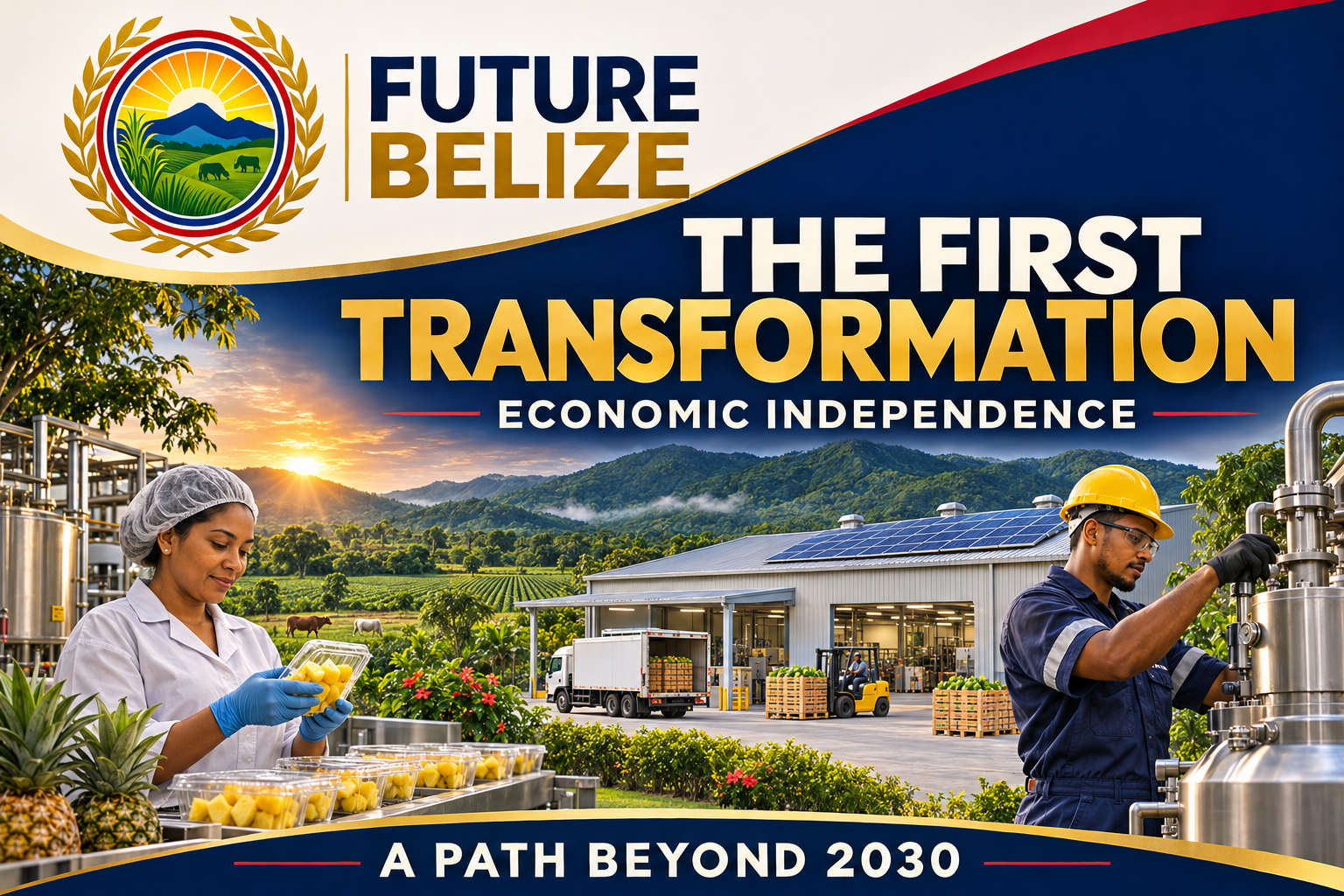
What Belize can learn from Plan México, what the first Plan Belize still owes the public, and what it will take to build an economy that produces, earns and reinvests at home.
A Future Belize policy feature | 17 November 2026
In 2025, Belize imported BZ$2.911 billion in merchandise and recorded BZ$390 million in domestic merchandise exports. Sugar accounted for roughly BZ$114 million of those exports, down from BZ$182 million the year before. These are goods figures. A full picture of what Belize earns and spends abroad also includes tourism and other services, re-exports and financial flows. The goods figures tell us something specific about our productive capacity. A setback in one established industry can take tens of millions of dollars out of export earnings, while Belizean households and businesses still need to pay for imported fuel, food, machinery and supplies. Statistical Institute of Belize, 2025 external trade release
In Shenzhen, President Claudia Sheinbaum Pardo used her APEC CEO Summit address to tell investors what Mexico wants to build with their capital. She spoke about domestic suppliers, regional production, energy, food, skills and higher wages. Belize has its own question to answer. When we seek investment or negotiate a trade agreement, can we say which Belizean firms will supply the project, who will be trained to run it, and what the nation will be able to produce five years later? Sheinbaum’s delivered address
For Future Belize, the First Transformation is economic independence. It means earning and retaining more value in Belize, securing essential supplies, broadening Belizean ownership and building enough capacity to negotiate with foreign partners on terms that serve our people. It requires stronger trade relationships and the ability to use them. The transformation is regenerative when rising production also leaves farms with healthier land, communities with stronger institutions, and the next generation with skills and assets it can build on.
Before another plan, account for the first
The Government’s November 12 launch release describes Plan Belize 2.0 as a national development strategy for 2026–2030, with 14 objectives across five strategic areas. Those areas include economic transformation, rural and agricultural development, environmental protection, social resilience and public-service modernisation. These priorities deserve attention. A public account of the first plan would show what the new strategy inherits, which commitments already have funding and which require a new approach. Ministry of Economic Transformation, national plans · Government launch release
Commitment in the original plan and what the public should be able to verify
- Raise the minimum wage to at least BZ$5 an hour: The statutory increase took effect on January 1, 2023. Publish subsequent enforcement, price-adjusted pay and what workers can buy with their earnings.
- Create 50,000 jobs in five years : Reconcile the commitment against comparable labour-force data. Show net employment gains, the effect of post-pandemic recovery, and the wages and durability of new jobs.
- Contribute to building at least 10,000 affordable concrete homes: Count completed, no exact total, occupied homes by district and delivery programme. Show how many were publicly funded, how many were facilitated and what families paid.
- Cut estimated poverty from 52% to 26% over ten years: Publish the comparable baseline and latest estimate, measurement methods and the remaining gap. The original plan gave this target a ten-year horizon.
The Ministry of Finance has previously reported progress on individual commitments. The next step is a consolidated return with the original target, actual result, amount spent, responsible ministry, source of verification and any obligation carried into 2.0. Give every inherited commitment a date for resolution. If the government revises a target, publish the reason and retain the old figure so the public can follow the change. Future Belize should accept the same terms for every promise it makes. Original #planBelize strategy · Minimum wage announcement · 2023–24 budget speech
What Sheinbaum took to Shenzhen
Sheinbaum called the objective “Prosperidad Compartida”, or shared prosperity. She set out five principles. They were shared prosperity, energy and food sovereignty, public and private investment in infrastructure, incentives tied to what each region can produce, and environmental responsibility in the face of climate change. The address linked wages and public welfare to the strength of the domestic market. It also made a case for acquiring foreign technology, absorbing it and developing the national scientific and industrial capacity to use it. Her proposition to other economies was that trade, investment and the exchange of knowledge should strengthen the productive capabilities of all participants. Transcript of the APEC CEO Summit address
The infrastructure Sheinbaum described had a productive purpose. Expanded generation and transmission would support industry. Rail, ports and roads would connect production regions to markets. Water and sanitation would support communities and investment. She presented those alongside scholarships, pensions and support for small producers. Belize should ask those same questions of a road, power project or processing facility. Which producers will use it, what will it cost to operate, and how will the public know whether it improved incomes or lowered costs? APEC address
She cited minimum-wage gains and poverty reduction over a period beginning in 2018. Those were claims she made about Mexico’s broader transformation, which predates Plan México. The test for the plan itself is whether its published targets translate into sustained employment, domestic supplier contracts and higher household incomes. The programme’s targets include 1.5 million additional jobs in specialised manufacturing and strategic sectors, 150,000 trained professionals and technicians annually, and 50 percent of public purchases from national production. Mexico also aims to increase domestic content across selected global value chains. APEC address · Mexico’s Secretariat of Economy, Plan México targets
What Plan México puts to work:
- Supplier development and public purchasing
- Industry-linked training and technology transfer
- Regional development poles backed by infrastructure
- Food and energy sovereignty
- Shared prosperity and environmental responsibility
How Belize could apply it
- Give small firms a fair chance through open tenders, smaller lots, advance purchasing schedules, common product standards and prompt payment. Pilot categories with capable suppliers and verify the local production behind each award.
- Agree on paid placements with Belizean employers. Require publicly supported ventures to specify the technicians they will train, the equipment they will teach them to maintain and the skills Belizean instructors will be able to pass on.
- Identify each district’s commercial strengths and infrastructure gaps. Share processing, testing, storage or repair facilities across districts where demand supports one viable facility.
- Link farms to stable buyers and preserve more of Belize’s harvest. Improve efficiency, local generation, storage and grid reliability. Measure delivered costs, reliability and the exposure to imported fuel and power.
- Link farms to stable buyers and preserve more of Belize’s harvest. Improve efficiency, local generation, storage and grid reliability. Measure delivered costs, reliability and the exposure to imported fuel and power.
- Make public support conditional on decent work, fair access for small producers, and measured effects on water, soils and waste. Report whether households and communities actually gained.
- Mexico can build on industrial supply chains and a domestic market of a scale Belize will never need to reproduce. Belize’s advantage is the chance to focus. A processor serving domestic institutions and hotels, a cooperative with a regional buyer, or a Belizean firm that keeps industrial refrigeration running can add more durable value than a large estate with few tenants. Investment approval should have clear timelines and one point of contact, with labour, land and environmental obligations visible from the start.
Mexico is next door. Bring a Belizean agenda.
- Mexico was the first country to establish diplomatic relations with independent Belize. The relationship already has practical foundations, including technical education and formal cattle trade. The WTO’s 2025 goods figures show Belize imported about US$132.4 million from Mexico and exported about US$10.3 million there. Belmopan should use the trade relationship to make specific requests of its neighbour and bring producers to the table. Mexico’s Foreign Ministry · WTO Belize trade profile · Belize agriculture ministry technical report
- Start with three negotiating priorities. First, work with Mexican technical institutes and employers to train Belizean instructors and apprentices in refrigeration, industrial maintenance, food safety and electrical systems. Build on Escuela Secundaria Técnica México and the wider bilateral training relationship. Second, work with Quintana Roo buyers and the relevant Mexican authorities to establish a route for a small number of Belizean products, from sample and inspection to a paid shipment and a repeat order. Third, invite joint ventures that do meaningful processing in Belize, buy from Belizean producers and develop Belizean plant supervisors. Publish the milestones and make any incentive contingent on delivery. Use the same standards with partners in CARICOM and elsewhere. Confirm tariffs, sanitary requirements and rules of origin market by market. Mexico’s cooperation programme in Belize · Belize–Quintana Roo cooperation · Belize’s trade negotiating track with Mexico
The projected path through 2040
Period : - 2027–2029 · Establish the baseline and test demand
Work to complete: - Publish the original Plan Belize scorecard and a productive-economy baseline. Map opportunities in all six districts with growers, workers, cooperatives, businesses, councils and buyers. Test two or three value chains using existing facilities where possible. Candidates include processed fruit and peppers, beans and animal feed, and livestock processing where volumes and standards support it.
Period 2030–2032 · Fund and deliver the first projects
Work Complete: - In the first 100 days of a Future Belize administration, table the costed programme with named leads. Use existing agencies for trade, standards, training, credit and energy. Compete for contracts to provide shared testing, cold storage and processing where the pilots establish demand. Launch paid apprenticeships and working-capital support for eligible suppliers with confirmed orders.
Period : 2033–2035 · Expand enterprises that can compete
WorK Complete: - Extend viable lines into new domestic and export markets. Support producer equity and long-term supply contracts. Add power, storage and logistics capacity where use and costs justify the investment. Establish practical pathways for Belizean firms to move from supplying raw materials to processing, maintenance and ownership.
Period: - 2036–2040 · Renew the assets that sustain production
Work Complete: - Reinvest in equipment, instructors, product development and resource restoration. Enact a regular public review of industrial incentives and publish a new rolling plan every five years. Require incoming governments to report against the same baseline and explain material policy changes.
Evidence required to advance
2027–2029 · Establish the baseline and test demand:
Publish unit costs against landed import prices, buyer interest and paid trial orders, input and power requirements, certification costs and environmental constraints. Use these findings to set numerical targets and publish costed proposals before 2030.
2030–2032 · Fund and deliver the first projects
Measure repeat sales, Belizean supplier payments, wage levels, apprenticeship completion and job placement, facility use and delivery costs. Release further capital in stages as independently checked milestones are met.
2033–2035 · Expand enterprises that can compete
Track retained value, operating cash flow, reliable delivery, repeat customers and market concentration. Resize or close publicly supported projects that cannot demonstrate a viable route to these results.
2036–2040 · Renew the assets that sustain production
Show whether real wages, domestic value added, export diversity, energy resilience and the condition of productive land and water improved across a full decade.
Future Belize’s vision of six districts and six economic poles gives each district a place in the national production strategy. The 2027–2029 work should establish what each district can sustain in practice. Growers in one district may supply a facility in another. Packaging, training and repair businesses can serve several industries. Each district should have a published plan for the income, jobs and ownership opportunities it can build, with costs and expected demand visible before construction.
Who pays, who owns, and who answers
Make the money follow the order. Use the national budget for public goods such as testing, training and essential infrastructure. Use competitive grants for time-limited trials and repayable development finance where trading revenues can support it. Where a buyer has accepted an invoice, invoice financing can help a qualifying supplier meet payroll and fill the next order. Ask private investors and cooperatives to put their own capital at risk in commercial projects. Finance should publish the cost of incentives, guarantees and debt exposure, with spending ceilings and rules for recovering support when obligations go unmet. Nacional Financiera’s supplier finance model
Give Belizeans a stake in what grows. Structure opportunities for local entrepreneurs, producer cooperatives and worker-owned enterprises to hold equity and earn returns. Publish beneficial ownership and conflicts of interest in publicly supported projects, along with award decisions, material changes and performance results. Public buyers should use fair, published eligibility and product standards, with legal review of procurement and trade obligations. Apply transparent eligibility and an appeal process to household relief as well. Families need protection from immediate shocks while businesses and workers build the capacity that reduces exposure over time.
Require regeneration in the project accounts. A plant that relies on an unreliable water supply or damages a watershed eventually raises costs for everyone. Assess water availability, flood exposure, waste handling and energy costs at appraisal. Set measurable requirements for efficient use, effluent, soil and watershed protection where relevant. Give workers and affected communities access to the monitoring results and a way to raise grievances. Report the cost of meeting these obligations as part of the cost of production.
Give the public one set of numbers it can follow. Economic Transformation should coordinate quarterly reporting with Finance. The Statistical Institute and other competent institutions should supply indicators within their mandates, with independent scrutiny of spending and results. Publish domestic value added by supported industry, repeat export sales and earnings after imported inputs, net formal jobs and real wages, the share of trainees finding relevant work, local ownership, energy reliability and costs, and district-level environmental outcomes. Show every indicator’s baseline, target, actual result and source. Reserve fixed numerical commitments for the costed programme after the baseline work. Hold an annual public hearing where officials explain misses and publish the correction deadlines.
In 2040, the measure of this First Transformation will be visible in ordinary decisions. A farmer can sign a contract before planting. A technician can qualify in Belize and build a career keeping Belizean industry running. A processor can pay suppliers, meet standards and win repeat orders in more than one market. A family can see its purchasing power improve. And citizens can open the same public record across successive governments and see who delivered. That is the economic independence Future Belize should put before the country.
By: Omar Silva - Editorial Director/Publisher
NATIONAL PERSPECTIVE BELIZE ©
- Log in to post comments
