
BELIZE’S $50 MILLION CUT: CAN WE SAVE IT WITHOUT WEAKENING PUBLIC SERVICES?
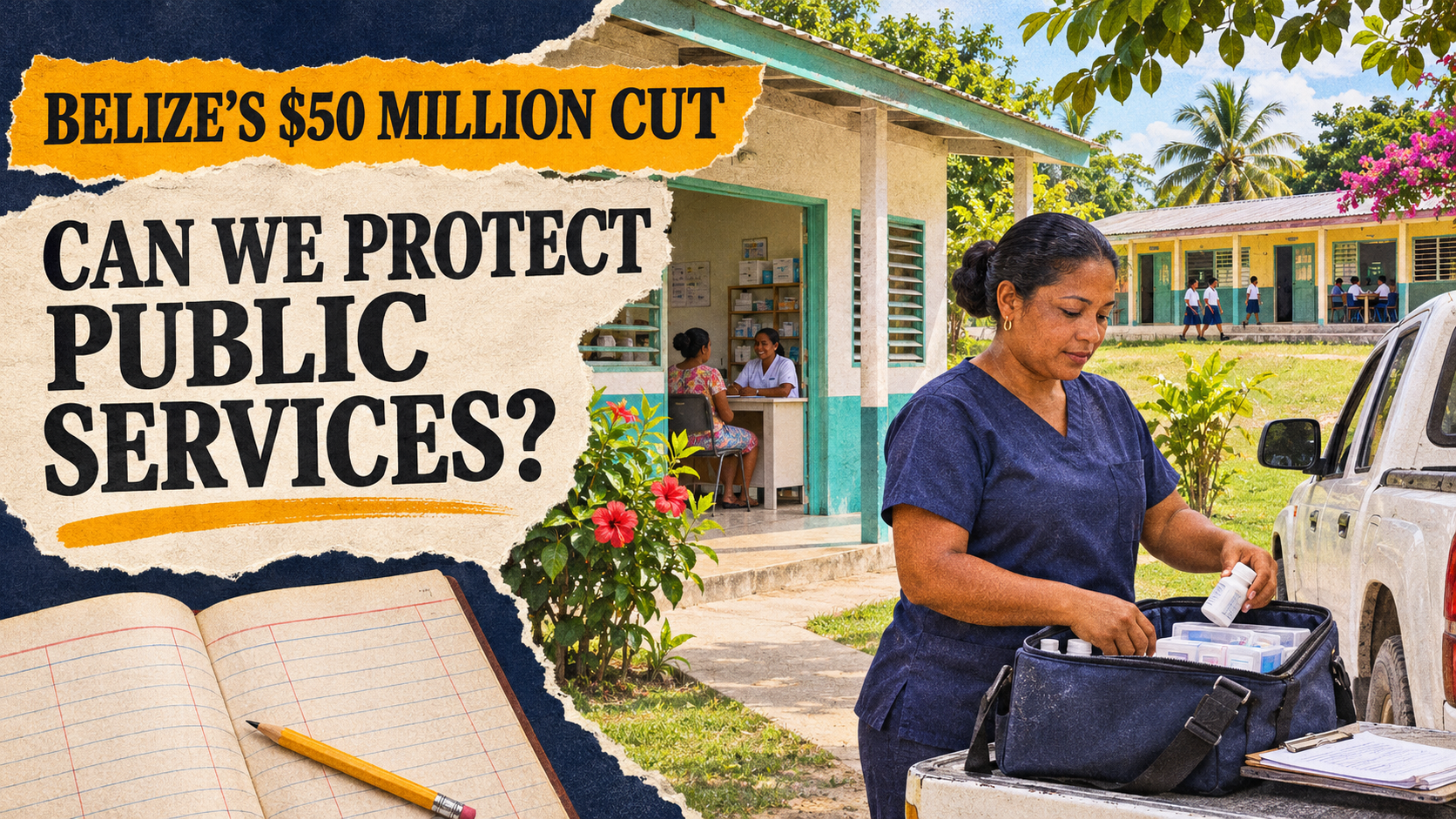
The Government promises to protect education, health and social program. Belizeans need to see whether that promise covers the fuel, transport, maintenance and supplies those services depend on.
National Perspective Belize – Digital | Where Is the Ledger?
PART 1 - SUNDAY ANALYSIS
Belize City | Sunday 15 November 2026
A clinic can keep its staff on the payroll and still have to cancel an outreach visit if there is no fuel for the vehicle. A school can remain open while a roof repair moves into next year’s budget. Those are the practical tests of the Government’s promise to protect public services while cutting BZ$50 million from spending.
- At the November 12 House sitting, Prime Minister John Briceño set out two targets: BZ$35 million from goods and services and BZ$15 million from Capital II. He subsequently said education, health and social programs would be protected and cited office expenses as one place to save. Minister Francis Fonseca said education commitments would be maintained and described the exercise as a reallocation for cost-of-living program.
- Public Service Union President Dean Flowers warned that reducing operational spending could leave Belizeans with weaker services. The ministry-by-ministry decisions will determine where that warning applies.
How far can office savings go?
- The March budget speech put annual spending on goods and services at about BZ$264 million. The BZ$35 million target equals 13.3% of that full-year budget. The separate 25% figure discussed by the Government needs its own calculation showing which spending is eligible, what remains unspent and what ministries have already committed.
An analysis put the annual office-supplies allocation at about BZ$6.3 million. That would cover only 18% of the target even if every dollar were available to cut.
- Broaden the calculation to include printing, computer supplies, books and household sundries and the annual total reaches about BZ$24 million. Removing that entire allocation would still leave BZ$11 million to find. This is an upper-bound illustration using annual allocations. Some of that money may already have been spent or committed
- The same analysis identified larger annual lines for maintenance, fuel, travel and subsistence, and professional services. Each needs to be examined on its merits. A ministry can cancel an unneeded trip or postpone a laptop replacement where the current one still works.
- The decision to postpone repairing a public vehicle has a different consequence if that vehicle takes nurses to rural communities. Finance should identify what will go ahead in schools, clinics and social program, even where the relevant operating costs sit in another budget line
A project postponed can still leave a bill
- Fonseca cited Capital II projects that might move into the next fiscal year and spoke of finding BZ$30 million to BZ$50 million for cost-of-living program. That range needs to be reconciled with the BZ$50 million gross reduction announced in the House. Treasury can free cash this year by postponing a project that has yet to start, but the cost may return in the next budget. A cancelled purchase removes a cost.
- A deferred repair may cost more later. An invoice for work already completed remains payable.
- The approved budget already projected a BZ$110.3 million overall deficit and a BZ$79.4 million primary surplus, the latter measured before interest costs. If a dollar removed from one line is spent on relief elsewhere in the same year, the two spending changes offset each other in the overall balance, all else equal.
- Finance should show the revised forecast so the House can see how much is redirected, how much reduces spending overall and whether there is a financing gap.
For scale, the Central Bank reported BZ$1.484 billion in central government tax collections in 2025/26. The BZ$50 million target amounts to about BZ$3.37 for every BZ$100 collected that year. Those receipts include taxes across the economy, and the ratio measures the size of the proposed cuts. How much reaches families depends on which relief measures are funded and delivered.
Show what Belizeans will still receive
- The November 13 protest in Belmopan brought the two sides of the budget into view. Workers asked for relief from rising living costs. A teacher said publicly that she had already spent nearly BZ$1,000 of her own money on her classroom in September. Her account illustrates how a cost can move from a public budget to a worker’s pocket. It is also why the promise to protect education must be measured in what schools can provide.
The Ministry of Finance should publish the revised spending schedule.
For each affected ministry, show the original allocation, amounts already spent or committed, the amount cancelled or deferred, and the cash available for relief. Name the Capital II projects that will move into next year. Identify the services protected and show which relief programmes receive the money and when.
- A Belizean should be able to look at that schedule and answer two questions. Will the service my family relies on still be there? When will the relief we were promised reach us?
Next in the series
Who gets the BZ$3 million in housing assistance? The next installment will examine what the announced five-month distribution means for each constituency, how families are selected, and what records can verify the PSU president’s separate claim about BZ$42 million in past constituency allocations.
- Log in to post comments
