THE GENERAL COMES TO BELIZE: Washington's Military Agenda and Belize's Sovereign Interests
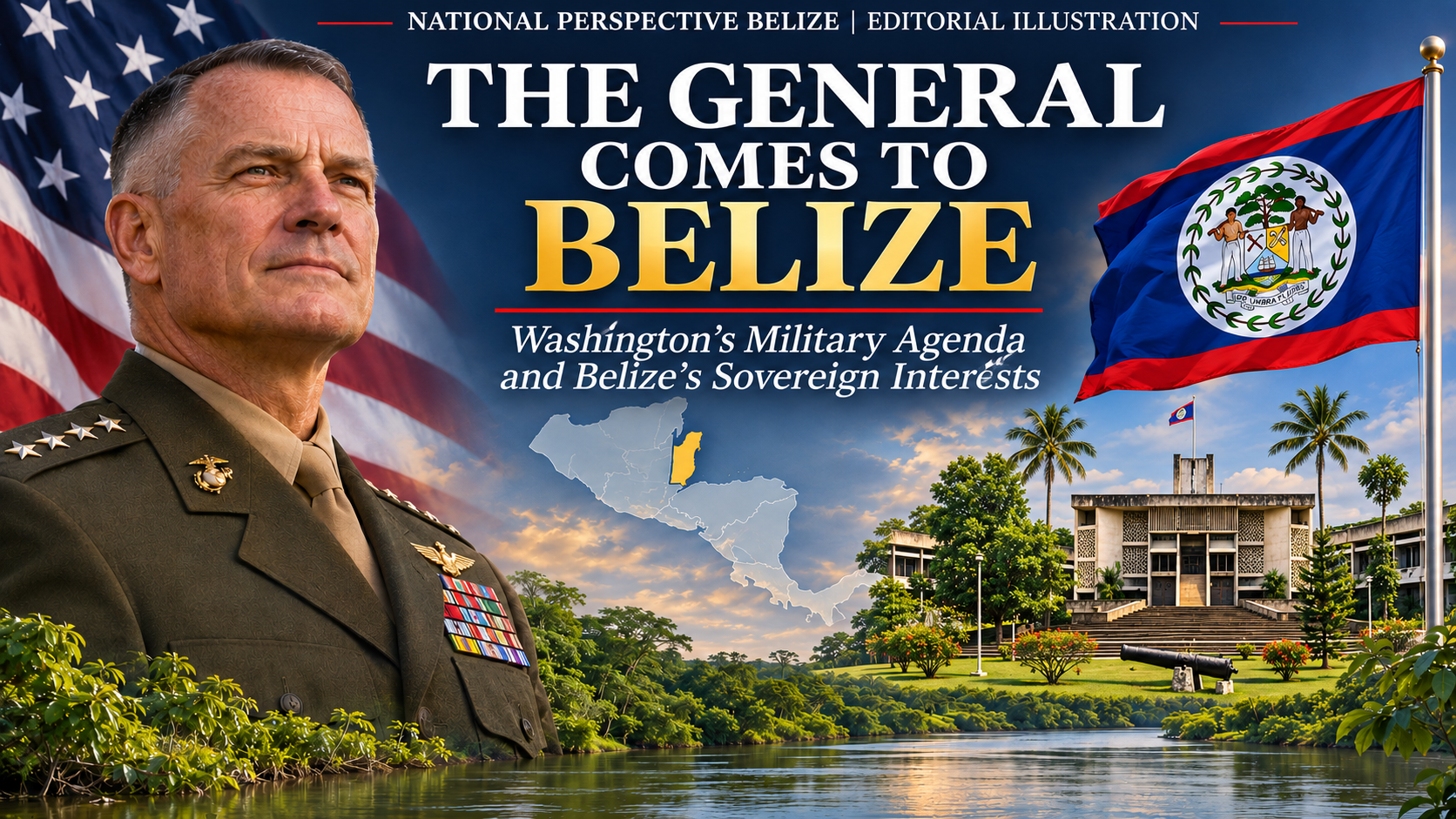
Washington's Military Agenda and Belize's Sovereign Interests
Special Feature
Belize City 24th November 2026 |
Who is General Francis L. Donovan, what does his command represent, and what does Washington expect from Belize?
- The reported impending visit of the commander of United States Southern Command (SOUTHCOM), General Francis L. Donovan, deserves considerably more public attention than the ceremonial reception normally afforded to distinguished foreign visitors.
- It has been reported that the general is coming to Belize, against the background of an increasingly visible American military presence in Central America. Its report also refers to the presence of a United States Air Force Boeing C-40 aircraft in Belize and questions put to Foreign Affairs Minister Francis Fonseca.
As of this writing, the purpose, agenda and anticipated outcomes of the visit have not been independently established by this publication. That distinction is important. We must not manufacture an agreement where none has been disclosed, but neither should we ignore the documented policy of the institution its commander represents.
A general with four decades of military experience
- Francis L. “Frank” Donovan entered the United States Marine Corps in 1986. On February 5, 2026, he assumed leadership of SOUTHCOM, succeeding acting commander Lieutenant General Evan L. Pettus. He is a four-star general and formerly held one of the senior leadership positions in United States Special Operations Command.
- His career spans service in conventional Marine units, reconnaissance, special operations, joint military planning and senior command. His professional assignments have included postings across Europe, the Middle East and Africa, as well as experience in other regions.
- His academic qualifications are equally substantial: a geography degree from Towson University, postgraduate qualifications from the Marine Corps Command and Staff College and the United States Army War College, and executive management studies at Harvard Business School.
The following milestones illustrate the breadth of his experience:
Period Appointment or milestone
1986 Entered the Marine Corps
2011–2013 Led the 24th Marine Expeditionary Unit
2013 Completed Harvard's Advanced Management
Program; subsequently directed the Expeditionary Warfare School
Before 2020 Senior leadership in the 5th Marine Expeditionary Brigade and Joint Special Operations Command
2020–2022 Commanding General, 2nd Marine Division
By 2023 Vice Commander, United States Special Operations Command
February 5, 2026 Assumed leadership of SOUTHCOM
- Donovan's professional record is that of an experienced military leader, not a civilian diplomat. His current responsibilities must be interpreted in the context of United States national policy, not as a personal foreign policy devised independently of Washington.
Washington's strategic priorities are already on the public record
In March 2026, Donovan presented SOUTHCOM's posture to the United States Congress. His command has published four broad imperatives: stronger hemispheric coordination, action against designated terrorist organizations, modernization of military capabilities, and protection of geographically significant areas.
- In testimony to the Senate Armed Services Committee on March 19, he also emphasized limiting the influence and military presence of powers Washington regards as adversaries in the Western Hemisphere.
- The public record provides a framework for understanding SOUTHCOM's regional engagements. Anti-cartel cooperation is a priority, but the command's mandate also reflects larger geopolitical concerns.
Therein lies an important distinction for Belize: a regional strategy conceived to protect United States national interests cannot automatically be equated with a national defence strategy conceived to protect Belizean interests.
The Guatemala dimension
- On June 4, 2026, SOUTHCOM announced that Donovan had concluded a visit to Guatemala, during which he met President Bernardo Arévalo and senior Guatemalan defence officials. The stated purpose included expanding bilateral defence cooperation against criminal cartels through the Americas Counter Cartel Coalition.
Belize has a legitimate interest in understanding what its own security relationship with Washington means when the same United States command maintains a substantial relationship with our neighbour.
- We must neither assume American complicity in Guatemalan conduct nor mistake parallel security partnerships for a commitment to defend Belize against territorial encroachment. The two are fundamentally different propositions.
Recent reports of confrontation in the Sarstoon and the pending territorial proceedings before the International Court of Justice make this distinction especially pressing. Belize has every right to raise its sovereign concerns directly, request diplomatic clarity and insist upon respect for its territorial integrity.
- The more extensive Washington's regional engagements become, the more important it is for Belmopan to articulate its own independent national position.
The aircraft is not the agenda
The C-40 aircraft referred to in the media news report belongs to a class of executive transports based on the Boeing 737. The United States Air Force identifies senior officials, including combatant commanders, among its principal users.
- The significance of its reported arrival is therefore understandable, but an aircraft's presence cannot tell us what officials intend to discuss. Nor is it evidence of the conclusion of a military agreement or the establishment of a foreign base.
What matters is the substance of the diplomatic engagement, the authority under which commitments may be made and the safeguards governing any resulting relationship.
The questions Belmopan must answer
- The government should disclose, to the extent consistent with legitimate confidentiality:
- What is the official purpose of General Donovan's visit, and at whose invitation is it taking place?
- Who will represent Belize in the discussions, and what national objectives will they advance?
Is Belize considering participation in additional United States-led regional security initiatives, including those associated with the Shield of the Americas?
- Are any new agreements being considered concerning military cooperation, access, jurisdiction or the legal status of foreign personnel?
- What safeguards will ensure that Belize retains sovereign control over decisions made in its name?
- Will the government raise Belize's concerns over the Sarstoon and seek a clear reaffirmation of respect for its territorial integrity?
- Will any resulting agreements, financial obligations or policy commitments be made public and subjected to appropriate legislative scrutiny?
These questions are not an expression of hostility towards the United States. They are an expression of the responsibilities of democratic government and responsible citizenship.
Partnership without subordination
- Belize can maintain friendly relations with the United States, cooperate against transnational crime, benefit from disaster-response partnerships and participate in legitimate regional security discussions without surrendering its independence of judgment.
- Our foreign policy must be anchored in our Constitution, international law, peaceful relations and the protection of Belizean interests. Our national defence policy must arise from our own assessment of our country's needs, resources and responsibilities.
No foreign general, regardless of rank, distinction or professional accomplishment, bears the constitutional responsibility of our elected government to the Belizean people.
The responsibility rests here, in Belmopan.
- General Donovan should be received with the dignity and professional courtesy appropriate to his office. But the Belizean people should receive something equally important from their own government: information, accountability and the assurance that no international partnership will compromise their country's sovereign decision-making.
Belize is a sovereign nation, not an extension of another country's security establishment. Friendship between nations is strongest when it is founded upon mutual respect, transparency and equality before international law.
- The general comes to Belize representing Washington. The fundamental question is whether our own representatives will speak with equal clarity for Belize.
By Omar Silva | Editor/Publisher, National Perspective Belize – Digital @ www.nationalperspectivebz.com
National Perspective Belize – Digital ©
- Log in to post comments