BELIZE HAS A FUEL PORT. SO WHY DOES FUEL COME THROUGH GUATEMALA?
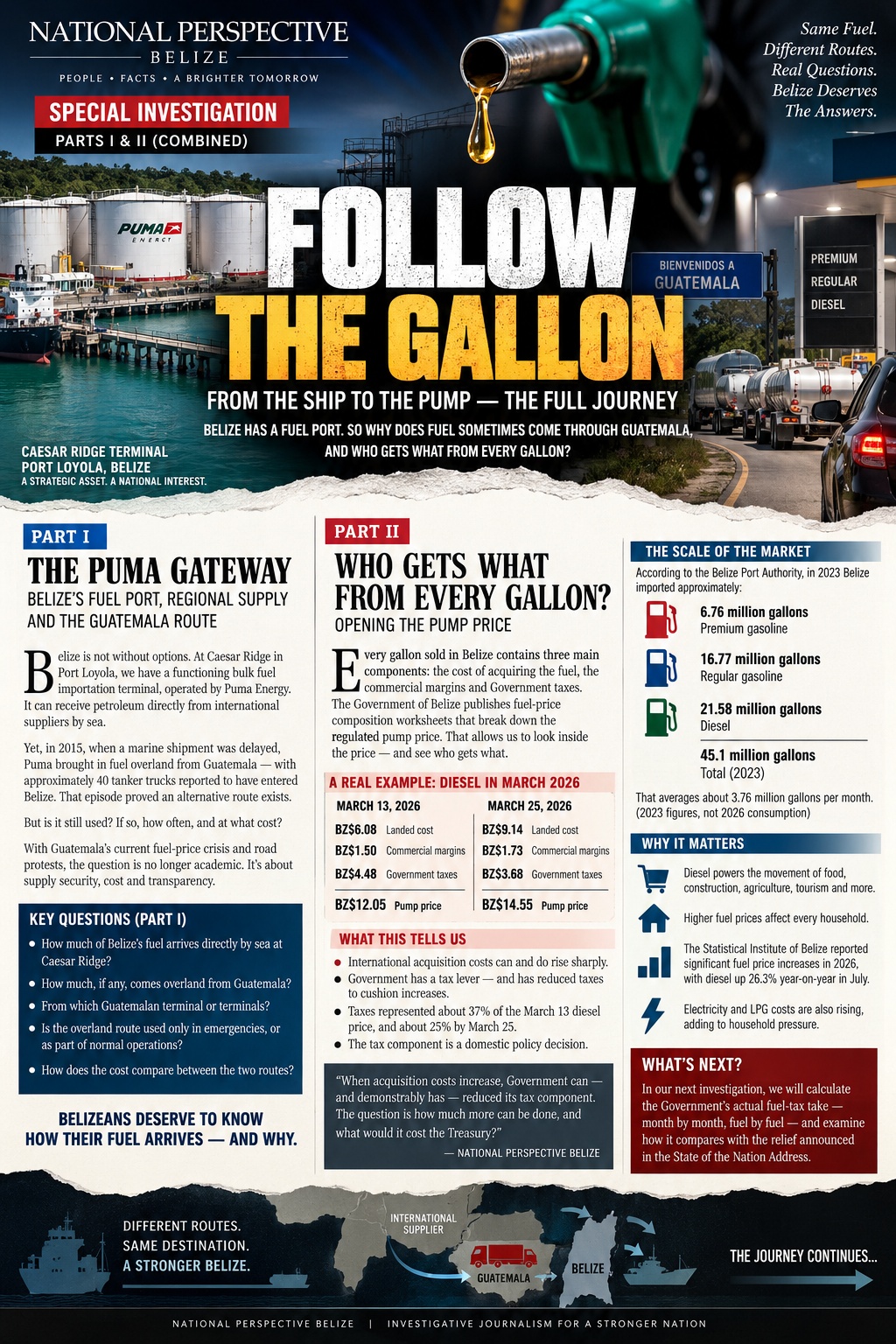
THE PUMA GATEWAY — INVESTIGATION I
BELIZE CITY: Sundday 20th September 2026: Belizeans know what they pay for fuel.
What they generally do not know is the journey that gallon took before reaching their vehicle—or precisely who was paid along the way.
That distinction has become increasingly important as petroleum prices climb throughout Central America and neighbouring Guatemala experiences serious public discontent over fuel costs.
But Belize presents an unusual case.
- Belize possesses its own bulk petroleum-import facility at Caesar Ridge in Belize City.
The Belize Port Authority identifies the facility as a bulk fuel importation port. Belize's Energy Unit has historically identified Puma Energy as the country's sole importer of petroleum products and documented a terminal equipped with a marine mooring facility and substantial petroleum-storage capacity.
So, National Perspective Belize begins this investigation with a remarkably simple question:
If Belize possesses the infrastructure to receive petroleum directly by sea, under what circumstances does fuel destined for Belize instead enter through Guatemala by road?
The question matters because every additional stage in a supply chain potentially carries a cost.
- There is the international acquisition price.
- There is marine freight.
- There is terminal handling.
- There is storage.
- There is overland transportation.
- There are importer and distributor margins.
- There are retail margins.
- And finally there are Government taxes and duties.
By the time the Belizean motorist squeezes the trigger at the pump, all those components have been compressed into one number displayed above the dispenser.
- But that number does not tell consumers where their money went.
BELIZE IS NOT A PETROLEUM BACKWATER
Official Belize Port Authority information provides important perspective.
In 2023, Belize imported approximately 6.76 million gallons of premium gasoline, 16.77 million gallons of regular gasoline and 21.58 million gallons of diesel.
- Combined, that represents approximately 45.1 million gallons of motor fuel in one year—an average approaching 3.8 million gallons every month.
This is therefore not a marginal trade.
- Petroleum represents one of the essential arteries of the Belizean economy.
- Diesel moves buses, trucks and agricultural machinery.
- Fuel moves tourists.
- Fuel moves merchandise.
- Fuel helps move practically everything that eventually arrives on a supermarket shelf.
An increase at the petroleum gateway therefore does not remain at the gasoline station.
- It migrates throughout the economy.
THE CAESAR RIDGE QUESTION
- Belize has infrastructure specifically designed for bulk petroleum importation.
- Petroleum can arrive aboard marine vessels and enter storage before being distributed throughout the country.
Yet Belize has also previously received petroleum transported overland from Guatemala during supply disruptions.
There may be perfectly legitimate operational explanations.
- Guatemala could provide emergency redundancy when marine shipments are delayed.
- Regional inventories may sometimes make overland replenishment faster.
- Shipping economics may occasionally favour transferring product from another Puma terminal.
- Weather, vessel scheduling, terminal inventories or regional purchasing arrangements could also influence the decision.
- But these possibilities produce questions—not answers.
National Perspective therefore wants to establish: How much of Belize's petroleum currently arrives directly by sea?
- How much, if any, arrives through Guatemala?
- What determines which route is used?
- What is the cost difference between those routes?
And most importantly: Does the Belizean consumer ultimately pay any additional cost created by that routing decision?
ONE COMPANY — TWO MARKETS
There is another dimension.
- Puma Energy's own corporate material categorizes Belize as a fully regulated petroleum market while Guatemala operates as a free market.
That gives Belizeans an unusual opportunity for comparison.
Guatemala's Ministry of Energy and Mines publishes detailed petroleum information including vessel imports, volumes, reported FOB prices, terminal prices and inventories.
Belize's Ministry of Finance publishes fuel-price composition information showing the components eventually incorporated into the regulated pump price.
Those two sets of records potentially allow us to follow petroleum through the regional supply chain.
- Not through allegations.
- Through numbers.
FOLLOW THE GALLON
That will be the governing principle of this investigation.
We intend to follow one gallon of fuel backwards from a Belizean pump.
From the service station—
- to the distributor—
- to the storage terminal—
- to the importer—
- to the vessel or tanker truck—
- to the regional terminal, where applicable—
- to the international supplier—
- and ultimately to its acquisition price.
Then we will follow the money forward again.
Because Belizeans deserve to know something considerably more useful than tomorrow's pump price.
- They deserve to know why that gallon costs what it costs.
And once that answer is established, another investigation begins: WHO GETS WHAT FROM EVERY GALLON SOLD IN BELIZE?
That is where National Perspective will go next.
CONTINUE — INVESTIGATION II: FOLLOW THE GALLON
The Government's own numbers already reveal something important: in March, when diesel's landed cost jumped from BZ$6.08 to BZ$9.14 per gallon, Government reduced its tax component from BZ$4.48 to BZ$3.68. That means the tax lever is real and measurable.
- But I would not yet claim a precise annual “Briceño fuel haul.” The Ministry has published monthly 2026 fuel-composition worksheets through August, while the Port Authority gives us a 2023 volume benchmark of roughly 45.1 million gallons of premium, regular and diesel. We can use that to illustrate scale, but not pretend it is 2026 consumption.
Here is the publication-ready opening to Investigation II.
FOLLOW THE GALLON — Investigation II
BEFORE YOU BLAME THE WORLD GAS PRICES, SHOW BELIZEANS WHERE EVERY DOLLAR AT THE PUMP GOES
- When a Belizean pulls into a service station and sees diesel approaching sixteen dollars a gallon, there is one number staring back from the pump.
- But there isn't one price behind that number.
- There are several.
- There is the cost of acquiring the petroleum.
- There is the cost of getting it to Belize.
- There are commercial margins.
- And there are Government taxes.
The motorist pays all of them together.
National Perspective Belize therefore asks a question considerably more useful than simply asking why fuel is expensive:
WHO GETS WHAT FROM EVERY GALLON?
And, unusually, the Government of Belize provides part of the answer itself.
The Ministry of Finance publishes fuel-price composition worksheets breaking the regulated pump price into three broad components:
LANDED COST
COMMERCIAL MARGINS
GOVERNMENT TAXES
That allows Belizeans to look inside the pump price.
And what we find deserves examination.
ONE GALLON — THREE CLAIMANTS
- Consider diesel earlier this year.
On March 13, 2026, the Ministry of Finance recorded the Belize City diesel price approximately as follows:
- Landed cost — BZ$6.08
- Commercial margins — BZ$1.50
- Government taxes — BZ$4.48
- Pump price — BZ$12.05
Government taxes therefore represented approximately 37 cents of every dollar paid for that gallon of diesel.
Then something important happened.
By March 25, the landed cost of diesel had climbed dramatically to approximately: BZ$9.14 per gallon.
- Commercial margins rose to approximately: BZ$1.73.
- But Government taxes were reduced to approximately: BZ$3.68.
- The resulting pump price became approximately: BZ$14.55.
That tells us something fundamental about Belize's petroleum pricing system.
GOVERNMENT HAS A LEVER.
- The international acquisition price is largely external.
- But the Government tax component is not.
When acquisition costs increase, Government can—and demonstrably has—reduced its tax component to cushion the resulting pump-price increase.
That does not mean Government can eliminate petroleum taxation without consequences.
Fuel taxation finances public expenditure.
But it does mean that when Belizeans are told that high pump prices are principally the consequence of international petroleum prices, another question must follow:
- HOW MUCH OF THE TAX LEVER IS GOVERNMENT USING?
- NOW MULTIPLY ONE GALLON BY MILLIONS
This is where the investigation becomes considerably larger.
A Belize Port Authority assessment reports that in 2023 Belize imported approximately:
- 6.76 million gallons of premium gasoline
- 16.77 million gallons of regular gasoline
- and : 21.58 million gallons of diesel.
Combined:
APPROXIMATELY 45.1 MILLION GALLONS
That works out to an historical benchmark averaging approximately 3.76 million gallons per month.
- These are 2023 figures—not 2026 consumption—and National Perspective will not misrepresent them as current volumes.
- But they demonstrate the scale of the petroleum economy.
If Government were hypothetically collecting an average of only BZ$1 per gallon across 45 million gallons, that would represent approximately BZ$45 million.
- At BZ$2, approximately BZ$90 million.
- At BZ$3, approximately BZ$135 million.
- At BZ$4, approximately BZ$180 million.
Those are illustrations, not estimates of actual Government collections.
- To determine the real number, we must match actual fuel volumes against the applicable tax component for each fuel and each pricing period.
- That calculation is now part of this investigation.
AND THE PRIME MINISTER HAS ACKNOWLEDGED THE DEPENDENCE
Against the backdrop of diesel approaching sixteen dollars per gallon, Prime Minister John Briceño has acknowledged that successive Belizean governments have depended heavily upon fuel excise taxation as a reliable source of revenue.
- He has also said his Government has already reduced fuel taxation and will examine whether additional relief can be provided.
- That acknowledgement is important.
- Because the issue is no longer whether petroleum taxation is significant to Government revenue.
The question becomes: HOW SIGNIFICANT?
- How much does Government collect from premium gasoline?
- How much from regular?
- How much from diesel?
- How much has Government actually surrendered through tax reductions?
- How much remains collected?
- And how dependent has the national budget become upon money collected every time Belizeans squeeze the trigger at a fuel pump?
THIS IS NOT SIMPLY ABOUT MOTORISTS
- Diesel does not stop at the service station.
- It enters the cost of transporting food.
- It enters agriculture.
- It enters construction.
- It enters public transportation.
- It enters tourism.
- It enters fishing.
- It enters distribution.
- And ultimately some portion of those costs travels into the price of almost everything else Belizeans purchase.
That is why the present fuel shock cannot be examined separately from the cost-of-living crisis.
The Statistical Institute of Belize reported that in July 2026, compared with July 2025, premium gasoline had risen 17.6 percent, regular gasoline 16.1 percent, and diesel 26.3 percent.
- Diesel averaged BZ$14.32 per gallon in July.
- It has since approached BZ$16.
Meanwhile, Belizeans are confronting increased electricity pressures and, on September 15, another 17-cent-per-gallon increase in LPG, which authorities attributed mainly to higher acquisition costs.
The household does not experience these increases in separate Government departments.
It experiences them in one place: THE FAMILY BUDGET.
GOVERNMENT IS ALSO PROVIDING RELIEF
Fair examination requires acknowledging the other side of the ledger.
In his September 15 State of the Nation Address, Prime Minister Briceño announced additional electricity relief, including an expansion of the GST exemption affecting residential electricity bills and an expansion of eligibility for BEL's Social Rate.
- Government also points to salary adjustments, minimum-wage policy, transportation subsidies and GST-free shopping initiatives as measures intended to cushion household costs.
Those policies have measurable fiscal value.
So National Perspective Belize intends to measure them too.
Because the appropriate comparison is not: Government bad versus Government good.
It is:
WHAT IS GOVERNMENT COLLECTING, WHAT IS GOVERNMENT GIVING BACK, AND WHAT IS THE NET EFFECT ON THE BELIZEAN HOUSEHOLD?
THE $4 QUESTION
- There is one particularly important clue inside Government's own fuel worksheets.
- In March, Government taxes accounted for approximately BZ$4.48 of a BZ$12.05 gallon of diesel.
When diesel's landed cost subsequently jumped by more than three dollars, Government reduced that tax component to approximately BZ$3.68.
Government therefore absorbed part of the international increase. But not all of it.
That presents policymakers with a genuine fiscal dilemma.
- Reducing petroleum taxation leaves more money with motorists and businesses.
- But it also reduces Government revenue available for public expenditure.
That trade-off is real.
What Belizeans are entitled to know is the magnitude.
If Government says another dollar cannot reasonably be removed from the tax component, Belizeans should be able to see what that dollar represents nationally.
- If it represents tens of millions of dollars annually, say so.
- If Government has already sacrificed tens of millions through tax reductions, document that too.
Transparency works in both directions.
NEXT: WE CALCULATE THE GOVERNMENT TAKE
- National Perspective Belize is now assembling the next layer of the Fuel Ledger.
We want: actual 2025 and 2026 petroleum volumes;
- the Government tax component applicable during each pricing period;
- the commercial margin applicable to each fuel;
- the corresponding landed cost;
- and Government's actual petroleum-related revenue collections.
Only then can we responsibly calculate the number everyone wants to know:
HOW MUCH DOES THE GOVERNMENT OF BELIZE COLLECT FROM THE FUEL PUMP?
- Not an allegation.
- Not a political slogan.
- A number.
- And once we have that number, we will ask the harder question:
WHEN INTERNATIONAL FUEL PRICES SURGE, HOW MUCH MORE RELIEF CAN GOVERNMENT PROVIDE—AND WHAT WOULD IT COST THE TREASURY?
The gallon will answer: TO BE CONTINUED.
INVESTIGATION III:
THE GUATEMALA CONNECTION — WHY DOES A COUNTRY WITH ITS OWN PETROLEUM IMPORT PORT SOMETIMES RECEIVE FUEL OVERLAND?
The underlying evidence is strong. The Ministry of Finance explicitly says it manages fuel-price adjustments using international prices, foreign exchange, transportation/distribution costs and broader fiscal considerations. SIB's latest published CPI figures confirm that fuel has been a major pressure point, while the September 15 LPG adjustment adds another energy cost. And Briceño's comments about Government's dependence on fuel excise taxation give us a direct reason to quantify the revenue rather than speculate about it.
NEXT: PART III - THE GUATEMALA CONNECTION — WHY DOES A COUNTRY WITH ITS OWN PETROLEUM IMPORT PORT SOMETIMES RECEIVE FUEL OVERLAND?
By: Omar Silva - Editorial Director @ www.nationalperspectivebz.com
NATIONAL PERSPECTIVE BELIZE
- Log in to post comments