THE PURCHASING POWER PARADOX Why Inflation Matters More Than Income
THE PURCHASING POWER PARADOX
Why Inflation Matters More Than Income
CHAPTER III
Belize City: Sunday 2nd August 2026: "The true value of a paycheck is determined not by the number printed on it, but by what it can actually buy."
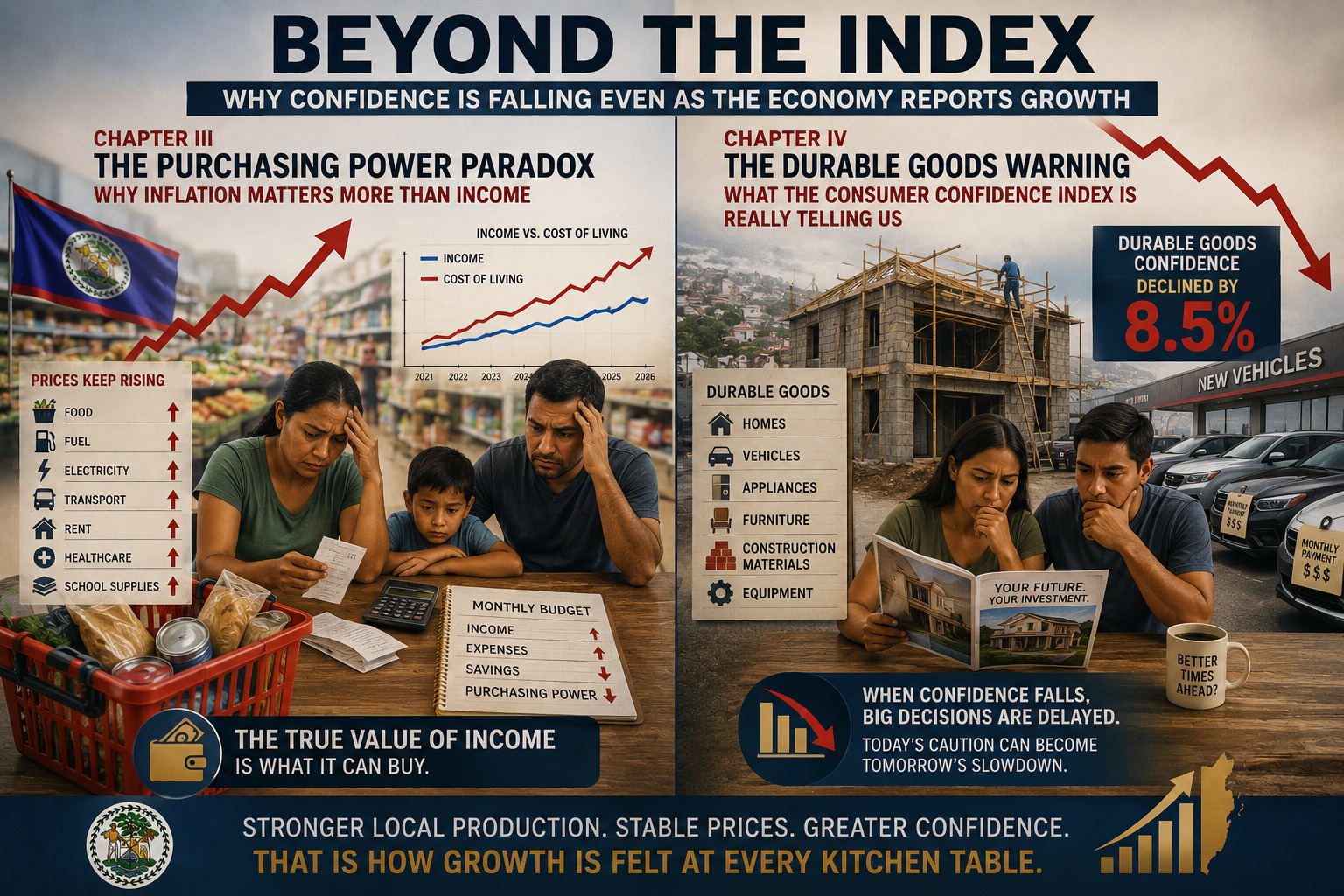
One of the greatest misconceptions surrounding economic growth is the belief that rising national income automatically translates into greater prosperity for every household. In reality, what matters most to families is not simply how much they earn, but how much their earnings can purchase.
Economists describe this as purchasing power.
Purchasing power represents the quantity of goods and services that a household's income can buy at prevailing market prices. When prices rise faster than incomes, purchasing power declines. Families may receive the same salary—or even a modest wage increase—yet find themselves able to purchase fewer groceries, fewer household necessities, and fewer long-term investments than they could only a few years earlier.
This is one of the principal ways inflation quietly affects everyday life.
Unlike an economic recession, inflation often arrives gradually. It is rarely announced with dramatic headlines. Instead, it reveals itself through the cumulative increase in everyday expenses.
- The weekly grocery bill becomes noticeably higher.
- Transportation consumes a larger share of household income.
- Electricity, cooking gas, school supplies, healthcare, rent, and imported household items steadily absorb a greater portion of the family budget.
Eventually, households begin making adjustments.
- They postpone replacing an aging refrigerator.
- They delay repairing their home.
- They reconsider purchasing a vehicle.
- They reduce discretionary spending.
- They save less because a greater share of income is required simply to maintain their existing standard of living.
For Belize, this challenge is compounded by the country's structural dependence on imported goods.
As an import-driven economy, Belize imports not only consumer products but also many of the raw materials, machinery, equipment, construction supplies, medicines, and household goods upon which domestic commerce depends.
Consequently, inflation is not generated solely within Belize's borders.
- International fuel prices.
- Global shipping costs.
- Supply chain disruptions.
- Higher manufacturing costs abroad.
- Exchange-rate pressures in supplier countries.
All of these external forces eventually influence prices paid by Belizean consumers.
This reality places important limitations on what any government can immediately control.
No administration can dictate world fuel prices or international freight costs.
However, governments can influence how resilient the domestic economy becomes in responding to those external shocks.
That resilience is built through expanding domestic production, encouraging value-added manufacturing, improving agricultural productivity, strengthening competition, investing in efficient logistics, and reducing unnecessary costs that increase the final price paid by consumers.
In other words, while Belize cannot eliminate imported inflation, it can reduce its vulnerability to it.
The challenge facing policymakers is therefore not simply controlling prices.
- It is strengthening the purchasing power of Belizean households.
Ultimately, families measure economic progress through a simple calculation.
- Not the growth of GDP.
- Not the size of government revenues.
- But whether today's income provides greater security, greater opportunity, and greater peace of mind than yesterday's.
That is the true test of purchasing power.
CHAPTER IV
THE DURABLE GOODS WARNING
What the Consumer Confidence Index Is Really Telling Us
Among all the findings contained in the latest Consumer Confidence Index, one statistic deserves particular attention.
Confidence in purchasing durable goods declined by 8.5 percent.
Although this may appear to be another technical economic indicator, it is often one of the earliest signals that households are becoming increasingly cautious about their financial future.
- Durable goods are products intended to last for many years.
- They include homes, vehicles, refrigerators, stoves, washing machines, furniture, construction materials, computers, and other long-term household investments.
Unlike groceries or electricity, these purchases can usually be postponed.
That is precisely why economists monitor them so closely.
When consumers become uncertain about their future income, employment, borrowing costs, or the direction of the economy, they rarely stop purchasing food or paying utility bills.
Instead, they postpone major investments.
- A family may decide to repair an aging appliance rather than replace it.
- A homeowner may postpone constructing an additional room.
- A young couple may delay purchasing their first vehicle.
- A small business may continue operating older equipment instead of investing in new machinery.
These individual decisions may appear insignificant on their own.
- Collectively, however, they affect the entire economy.
- Lower demand for durable goods can reduce activity in retail trade, construction, manufacturing, vehicle sales, transportation, financing, and professional services.
In that sense, consumer confidence does more than describe current conditions.
- It often provides an early indication of future economic activity.
- This is why central banks, finance ministries, investors, and economists around the world pay close attention to consumer confidence surveys.
- They help identify changes in household behaviour before those changes become visible in broader economic statistics.
For Belize, the decline in confidence regarding durable goods should therefore be interpreted neither as a sign of economic collapse nor dismissed as an isolated statistic.
- Rather, it reflects increasing caution among households faced with persistent uncertainty over purchasing power and future financial obligations.
Whether that caution proves temporary or develops into a longer-term trend will depend on several factors.
- The future path of inflation.
- The affordability of credit.
- Employment opportunities.
- Household income growth.
- And perhaps most importantly, whether Belize's economic expansion increasingly translates into stronger financial confidence among ordinary families.
Economic growth becomes truly sustainable when households no longer feel compelled to postpone investing in their own future.
When families once again feel confident enough to purchase a home, replace essential household equipment, expand a small business, or invest in long-term improvements, the benefits of economic growth have begun to move beyond statistical reports and into everyday life.
That is the signal policymakers should ultimately strive to achieve.
BE ATTENTIVELY EXPECTANT: for Chapter V, title:
“FROM IMPORT DEPENDENCE TO ECONOMIC RESILIENCE
Why Belize Cannot Consume Its Way to Prosperity”
A MUST READ. By: Omar Silva – Editor/Publisher
- Log in to post comments