THE DIFFERENCE BETWEEN AN INVESTIGATION AND ACCOUNTABILITY: Who Answers to the People?
CHAPTER I: Feature
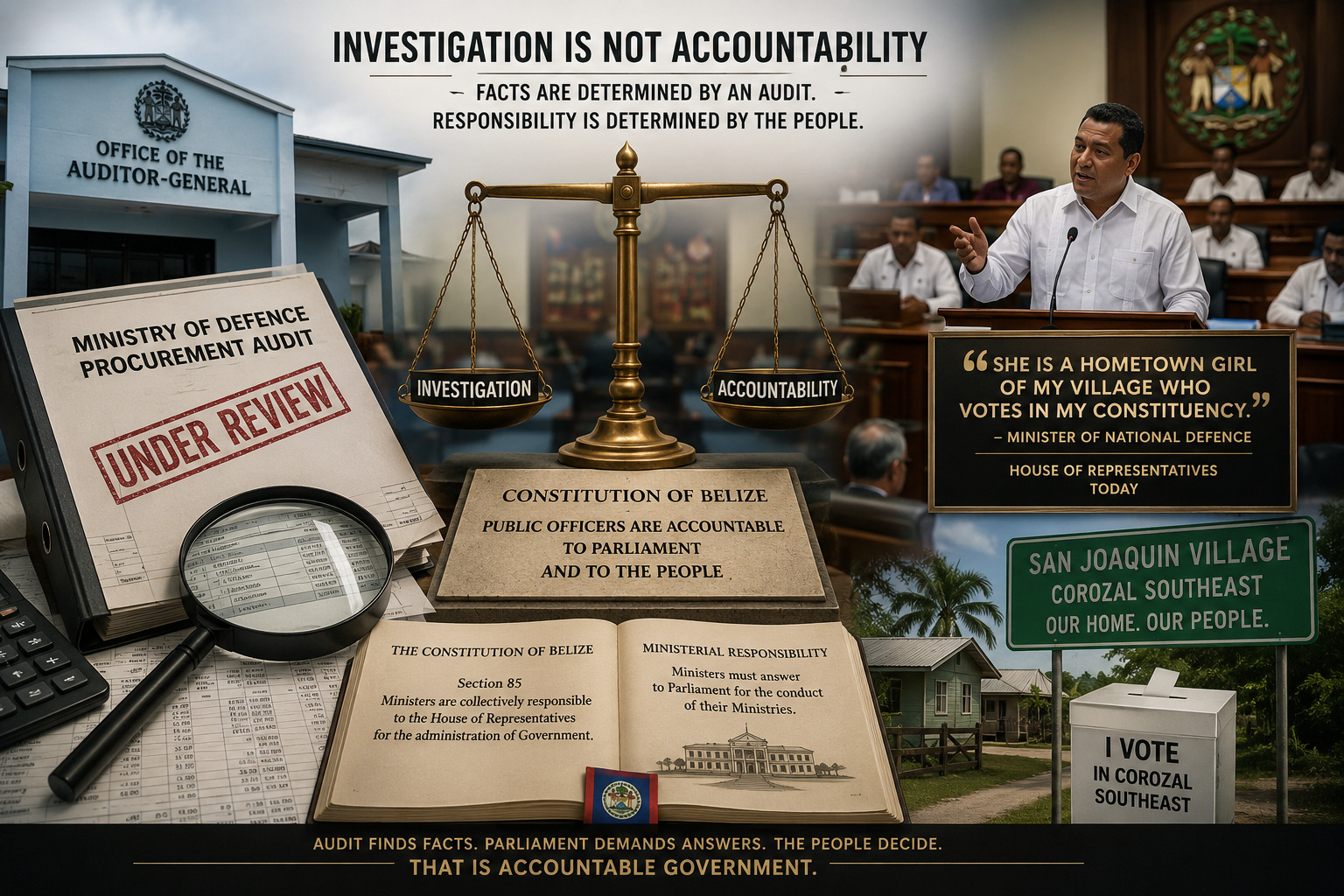
Belize City: Friday 31st July 2026: One of the most frequently repeated responses surrounding the Ministry of Defence procurement controversy has been simple:
"The Auditor-General is investigating."
At first glance, that statement appears reassuring. It suggests that the constitutional machinery of accountability has been activated and that the facts will eventually emerge.
Indeed, an independent audit is an essential safeguard in any democratic society. The Office of the Auditor-General exists to examine whether public funds have been managed in accordance with the Constitution, the Finance and Audit (Reform) Act, the Public Procurement Act, Treasury Regulations, and other applicable laws and financial standards. Its work provides Parliament and the public with an independent assessment of whether government resources have been administered lawfully, efficiently, and transparently.
Yet, there is an important constitutional distinction that should never be overlooked.
An audit is an instrument of accountability—it is not accountability itself.
Too often in public debate, these two concepts become confused.
- An investigation gathers evidence.
- An audit evaluates compliance.
- A report identifies findings.
But none of these actions, by themselves, satisfy the constitutional obligation of those entrusted with public office to answer for their decisions.
In Belize's Westminster parliamentary system, political accountability rests first with ministers, not with auditors. Every minister is individually responsible for the administration of the ministry entrusted to his or her care. Collectively, Cabinet is responsible to the House of Representatives for the conduct of government. Public officers administer policies and procurement, but elected officials remain accountable to Parliament—and ultimately to the people—for how those ministries are governed.
This principle is often described as ministerial responsibility, one of the oldest constitutional conventions inherited from the Westminster tradition. It does not require that a minister personally approve every transaction or sign every procurement document. Rather, it recognizes that public administration operates under political leadership, and that leadership carries responsibility for the systems, controls, and culture established within a ministry.
That distinction is critical.
- An Auditor-General may determine whether procurement rules were followed.
- Law enforcement authorities may determine whether criminal offences occurred.
- The courts may determine legal liability.
But only Parliament—and ultimately the electorate—can determine political accountability.
- No audit can remove that responsibility from those elected to govern.
- Nor should an audit become a convenient shield behind which political actors defer legitimate public questions by simply responding:
"Let us wait for the audit."
- Patience for evidence is appropriate.
- Silence in the face of constitutional responsibility is not.
This distinction protects both democracy and the integrity of independent oversight institutions. The Office of the Auditor-General must be allowed to conduct its work free from political interference and without being pressured toward predetermined conclusions. At the same time, ministers and governments must not use the existence of an audit to postpone their own obligation to explain decisions, answer questions, or account for the administration under their authority.
The two processes are complementary, not interchangeable.
- An independent audit strengthens democracy by establishing facts.
- Political accountability strengthens democracy by ensuring those facts are answered before the representatives of the people.
One cannot substitute for the other.
As Belize now watches the Ministry of Defence procurement audit unfold, it is worth remembering that the constitutional health of the nation will not be measured only by what the Auditor-General discovers.
- It will also be measured by whether those entrusted with governing the country fully embrace their own responsibility to explain, justify, and, where necessary, accept responsibility for the decisions made under their watch.
For that is the true meaning of accountable government.
National Perspective Belize — Constitutional Reflection
"An Auditor-General may investigate public administration. A court may determine legality. But in a parliamentary democracy, no audit and no courtroom can relieve elected leaders of their constitutional duty to answer to the people's representatives—and, ultimately, to the people themselves."
In Chapter II, we will then examine "Why Conflict of Interest Matters" and explain the legal difference between conflict of interest, trafficking in influence, favouritism, procurement breaches, and corruption under Belizean law, giving readers the legal framework to assess the allegations without prejudging the outcome. Look Out For It.
- Log in to post comments