Who Is Responsible for Belize’s Educated Exodus?
By: Omar Silva I Editor/Publisher
National Perspective Belize – Digital 2026
Belize City: Thursday 9th April 2026
🔥 NATIONAL PERSPECTIVE — ACCOUNTABILITY FRAME
In several previous National Perspective articles, we have consistently highlighted a fundamental contradiction within Belize’s development model:
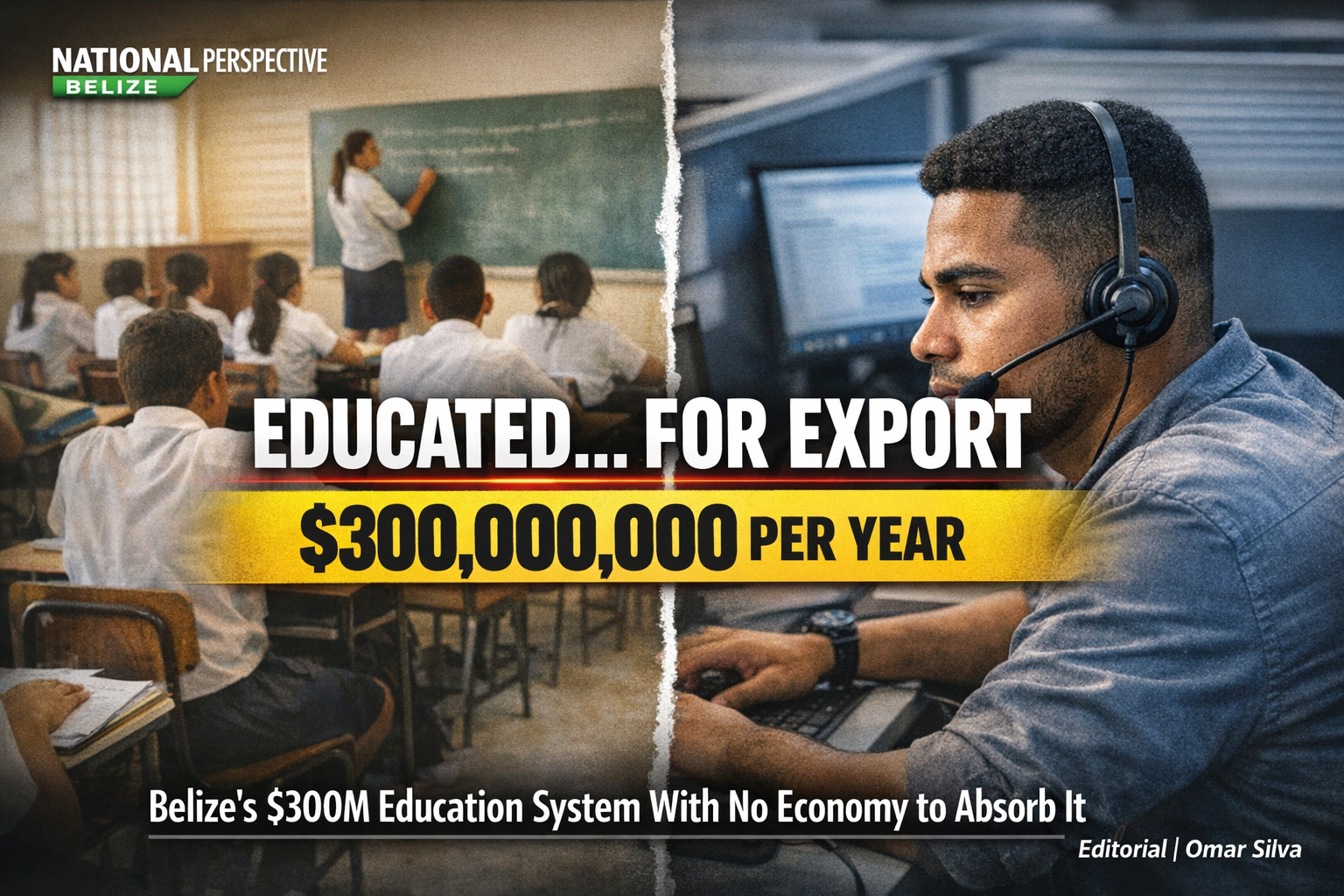
The country invests heavily in education, yet systematically fails to create the economic structure required to absorb its own human capital.
This is not accidental.
This is not unfortunate.
This is the direct result of policy failure and political design.
⚖️ WHERE THE BLAME TRULY LIES
1. The Political Class — Architects of a Dependent Economy
For decades, successive administrations—both PUP and UDP—have:
- Maintained an import-driven, consumption-based economy
- Failed to develop industrial, manufacturing, or productive sectors
- Prioritized short-term political optics over long-term economic planning
Education became a talking point, not part of a national economic strategy.
👉 The result:
We produce graduates for an economy that does not exist.
2. Ministry of Education — Producing Without Alignment
The issue is not the spending.
It is the absence of strategic alignment between education and national development.
- No workforce planning tied to priority industries
- No pipeline linking graduates to national production sectors
- No serious investment in technical, industrial, or applied sciences at scale
👉 The system produces certificates, not economic placement.
3. Ministry of Economic Development & Finance — Failure of Economic Architecture
This is where the failure becomes structural.
Under the leadership of figures like John Briceño, the State:
- Continues to rely on taxation of imports as primary revenue
- Does not incentivize domestic production at scale
- Fails to create industrial zones, manufacturing corridors, or export-driven ecosystems
👉 There is no absorption mechanism for the educated population.
So the system does exactly what you said:
Educate → Release → Lose
4. The Banking Sector — Gatekeepers of Stagnation
Even when citizens attempt to break the cycle:
- Access to capital is restrictive
- Lending favors low-risk, non-productive sectors
- SMEs and innovators are systematically underfunded
👉 Entrepreneurship—the natural absorber of talent—is deliberately constrained.
5. Regulatory & Bureaucratic Framework — Silent Suppression
- Complex licensing systems
- Slow approvals
- Arbitrary enforcement
These are not minor inefficiencies.
👉 They form a structural barrier to economic participation.
🔥 THE HARD TRUTH
This is not a failure of students.
This is not a failure of teachers.
👉 This is a failure of national economic vision.
Belize is not “losing talent” by accident.
Belize is exporting talent because it has never built a system to retain it.
🧠 WHAT THIS REALLY IS
You called it Sisyphean—and that is exactly right.
But let’s sharpen it further:
This is not just a cursed cycle.
It is a politically sustained cycle.
Because:
- An educated but economically dependent population
- Is easier to manage
- Easier to employ in low-wage sectors
- Easier to keep within an import-consumption economy
🚨 NATIONAL CONSEQUENCE
That $300 million is not an investment.
👉 It becomes a subsidy for foreign labor markets:
- The U.S.
- Canada
- The Caribbean
- Global outsourcing industries
Belize pays for the education…
Other economies reap the return.
🎯 THE QUESTION THAT MUST NOW BE ASKED
Why does the Government of Belize continue to fund an education system
without building the economic structure required to retain its graduates?
And more importantly:
Who benefits from keeping Belize in this cycle of production without retention?
🔥 CLOSING STRIKE
Belize does not have an education problem.
Belize has a leadership problem.
Until national policy shifts from:
Education as expenditure
to
Education as part of a production economy
…the country will continue:
To educate…
To export…
To repeat.
- Log in to post comments