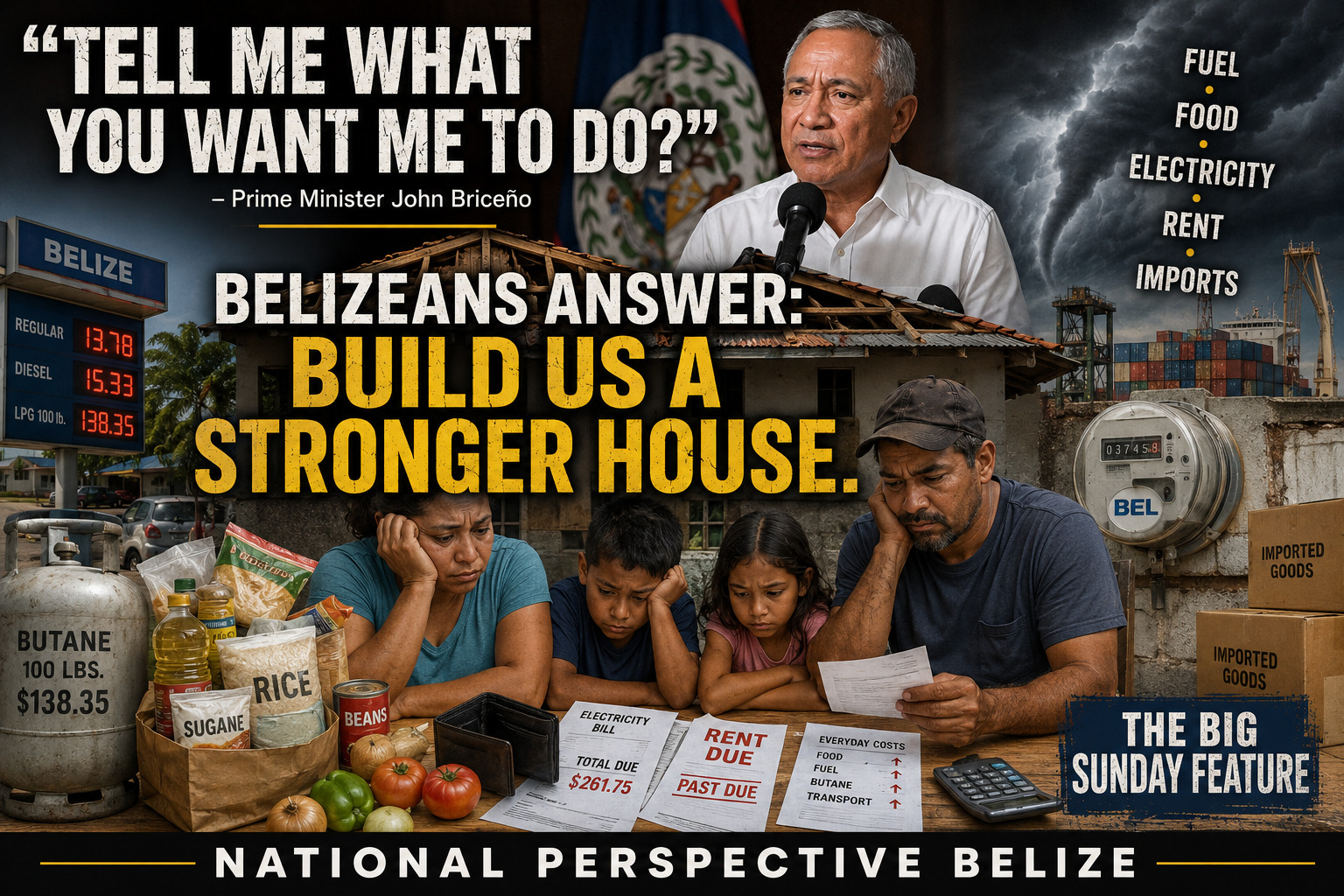
“TELL ME WHAT YOU WANT ME TO DO?” When a Prime Minister's Answer Becomes the National Question
NATIONAL PERSPECTIVE BIG SUNDAY FEATURE
Belize City: Sunday 23rd August 2026: There comes a moment in government when an explanation stops being an explanation and becomes an admission of the limits of the government's economic strategy.
Belize may have reached one of those moments.
Prime Minister John Briceño was confronted with a question that thousands of Belizean households confront without microphones, television cameras or political speeches every single week:
How much longer can ordinary people afford to live like this?
- Fuel is expensive.
- Electricity is hurting household budgets.
- Butane is expensive.
- Food costs more.
- Transportation costs feed into practically everything else.
- Rent consumes an increasingly painful portion of household income.
- And wages at the bottom of the economy struggle to keep pace with what families actually have to buy.
The Prime Minister's answer deserves to be examined carefully and fairly.
- His essential argument is that Belize does not control international fuel prices or the prices of imported goods.
That part is true.
But then came the sentence that should cause every Belizean—not merely supporters or opponents of the People's United Party—to think seriously about what government is supposed to do:
- “Tell me what you want me to do?”
Mr. Prime Minister, that may be the most important economic question you have asked during your administration.
Because Belizeans should answer it.
WE DON'T EXPECT GOVERNMENT TO CONTROL THE WORLD
- Nobody serious expects John Briceño to determine the international price of petroleum.
- Nobody expects the Cabinet of Belize to dictate what a manufacturer in China, Mexico or the United States charges for its products.
- Nobody expects Belize to abolish imported inflation.
That would be nonsense.
But that isn't the real question.
The question is:
What has Belize done to reduce how violently those external prices are transmitted into the lives of Belizean families?
That is where economic leadership begins.
A small import-dependent country cannot control the economic hurricane.
- It can build a stronger house.
And after decades of PUP and UDP governments, Belizeans have every right to ask:
- Where is that stronger economic house?
- IMPORT DEPENDENCE IS NOT AN EXCUSE. IT IS THE PROBLEM TO BE SOLVED.
- The Prime Minister says Belize cannot control the prices of the goods it imports.
Precisely : That is why excessive import dependence should have been treated as a national economic-security problem years ago.
The Statistical Institute of Belize reported that during only the first six months of 2026, merchandise imports reached approximately BZ$1.651 billion.
- Domestic exports during the same period were approximately BZ$166.6 million.
That is not a small imbalance.
- It illustrates something much bigger.
Belize sends enormous amounts of purchasing power abroad to obtain the products required to operate the country.
- Food inputs.
- Fuel.
- Machinery.
- Construction materials.
- Manufactured goods.
- Vehicles.
- Equipment.
- Consumer products.
- Industrial inputs.
- And countless other necessities.
Every international disruption therefore finds a transmission belt directly into the Belizean household.
- That is not John Briceño's personal creation.
- It is the accumulated result of decades of economic policy.
- But after years in office, it is his government’s responsibility to demonstrate how Belize is systematically escaping it.
THE CONTRADICTION: THE ECONOMY CAN GROW WHILE THE FAMILY GETS POORER
Here is where Belize's economic conversation becomes dangerous.
The statistics can say:
- GDP is growing.
- Unemployment is low.
- Debt indicators have improved.
- International creditors are satisfied.
- The country's sovereign outlook is stable.
- And all of those things can coexist with another reality:
A working Belizean can still be getting poorer in practical terms.
Because economic growth and household purchasing power are not the same measurement.
- A man does not feed his children GDP.
- A woman does not pay her electricity bill with a sovereign credit rating.
- A family cannot take “macroeconomic stability” into the supermarket and exchange it for groceries.
The ultimate test of economic policy must therefore include something much simpler:
After paying rent, electricity, water, transportation, food and basic household expenses, how much money does the ordinary Belizean have left?
- If the answer keeps shrinking, something is wrong regardless of how attractive the macroeconomic indicators appear.
AND THIS IS WHERE LEADERSHIP ITSELF ENTERS THE ARGUMENT
John Briceño is not merely an observer of the Belizean economy.
- He is Prime Minister.
- He is Minister of Finance.
- He leads the Cabinet.
- He leads the People's United Party.
- His administration determines taxation policy, spending priorities, development strategy and much of the regulatory architecture within which the Belizean economy operates.
That makes the words “what do you want me to do?” particularly consequential.
Because Belizeans elected a government precisely to answer that question.
- Not everything can be fixed.
- Not everything can be subsidized.
- And government cannot simply throw money at every increase without eventually creating another fiscal crisis.
The Prime Minister is correct about that.
But there is an enormous space between controlling world prices and being powerless before them.
- That space is called PUBLIC POLICY.
SO, PRIME MINISTER, HERE IS WHAT BELIZE CAN DO
- Begin with a serious national food-production and import-substitution programme.
- Not another conference.
- Not another glossy strategy document.
Identify the largest categories of food imports that Belize can competitively produce or process domestically and establish measurable five- and ten-year replacement targets.
If Belize imports something that Belizean farmers can grow, processors can manufacture and local businesses can distribute competitively, government should know exactly why we continue importing it.
- Build agro-processing industries around agriculture.
- Belize does not merely need more farmers.
- Belize needs factories connected to farmers.
- Tomatoes should become sauces and paste.
- Fruit should become juices, concentrates, dried products and preserves.
- Corn should feed downstream industries.
- Sugar and molasses should generate considerably greater value-added production.
- Cattle and livestock should support stronger processing industries.
Agriculture without industrialization leaves much of the value chain somewhere else.
BUILD AN ENERGY STRATEGY THAT MEASURES SUCCESS AT THE METER
Billions of dollars can eventually be invested in generation, transmission, substations, cables and modernization.
But the Belizean household has one brutally simple measurement:
What happened to my electricity bill?
If public borrowing and investment expand the energy system while electricity becomes progressively less affordable, government must explain when and how those investments translate into consumer benefit.
Energy security cannot mean only keeping the lights on.
- It must eventually mean producing electricity reliably, sustainably and affordably.
LOOK AT THE TAX CONTENT OF FUEL
- Government cannot control the international petroleum market.
- Government absolutely controls Belize's domestic tax structure.
That doesn't mean recklessly eliminating fuel taxes tomorrow. Those revenues finance government operations and replacing them requires serious fiscal analysis.
- But it does mean government can conduct a transparent review showing Belizeans:
- international acquisition cost + freight + taxes + duties + margins + domestic distribution = pump price.
- Put the entire calculation before the country.
- Then ask whether the taxation structure remains appropriate during extraordinary price spikes.
That is governing.
ATTACK THE COST OF LOGISTICS
For an importing country, the final price is not merely the foreign purchase price.
- There are shipping costs.
- Port charges.
- Customs processes.
- Brokerage.
- Transportation.
- Storage.
- Financing.
- Wholesale margins.
- Retail margins.
- Taxes and duties.
Government may not control the original foreign price.
- But it can examine every Belizean dollar added between the port and the supermarket shelf.
That is where competition policy, customs modernization, consumer protection and market surveillance become essential.
HOUSING CANNOT BE SEPARATED FROM COST OF LIVING
When wages rise slowly while rent rises rapidly, households become poorer even if official unemployment remains low.
Belize therefore needs a serious national affordable-housing and rental strategy—not simply political housing programmes where governments announce individual houses.
- Housing supply.
- Serviced lots.
- Mortgage affordability.
- Construction materials.
- Urban density.
- Public land.
- Rental markets.
- Infrastructure.
Those issues belong inside the national cost-of-living strategy.
- AND YES—WAGES MUST BE PART OF THIS DISCUSSION
The Prime Minister argues that increasing the minimum wage too aggressively could cause businesses to reduce employment or pass costs to consumers.
That concern is economically legitimate.
But it cannot become a permanent argument for keeping wages behind the cost of living.
The question should not be:
- “Can businesses afford another dollar?”
The national question must simultaneously be:
2.Can Belizean workers afford Belize?
That requires evidence.
- Determine the real cost of a basic household basket.
- Determine what different household structures actually require.
- Measure wages against productivity and inflation.
- Then establish a predictable wage-adjustment mechanism so that minimum-wage policy does not depend primarily upon political negotiation between governments, unions and business organizations.
AND GOVERNMENT MUST EXAMINE ITSELF
There is another dimension that political leaders cannot escape.
- Sacrifice becomes extremely difficult to preach downward.
- When ordinary Belizeans are told government has limited fiscal room, they inevitably look upward at the political and administrative structure.
- Ministerial salaries.
- Allowances.
- Expensive Government vehicles.
- Free Fuel.
- Travel.
- Consultancies.
- Boards.
- CEO compensation.
- Political appointments.
- Administrative overhead.
- And every other privilege financed by taxpayers.
In 2023, 7 News reported from a SmartStream record that the Prime Minister's vehicle allowance had increased from $1,300 to $4,000 monthly—$48,000 annually. The explanation given by Cabinet Secretary Stuart Leslie was that the Prime Minister used his own vehicle and personally covered its maintenance.
Whether one considers that justified or excessive is ultimately a political judgment.
But it creates an unavoidable question of leadership:
When citizens are being asked to absorb economic pain, what economic pain is the political leadership prepared to absorb?
That question applies not only to John Briceño but also to all Ministers, C.E.O.'s and other Political Appointed Favorites.
- It should apply to every future Prime Minister, Cabinet and senior political administration of Belize.
THIS IS BIGGER THAN PUP AND UDP
And this is where Belizeans must be careful.
Replacing blue shirts with red shirts—or red shirts with blue shirts—without changing the economic architecture solves very little.
Belize has lived through that cycle.
The structural problems survived both parties.
- Import dependence survived.
- Weak industrialization survived.
- Energy vulnerability survived.
- Low wages survived.
- Institutional weaknesses survived.
- Political patronage survived.
And ordinary families continued adjusting their lives around systems they never designed.
Therefore the answer cannot simply be:
“Vote PUP out.” Or "UDP OUT"
The deeper answer must be:
Demand something substantially better from whoever wants to govern Belize. Ensure They Provide A Strategic Blue Print That Must Be Consistent At All Levels Of Implementation Before They Could Be Considered As A Candidate.
WHAT SHOULD BELIZEANS DO?
Organize around policies instead of personalities.
- Demand measurable commitments from political parties.
Ask every candidate:
- What is your ten-year plan for reducing strategic imports?
- What industries will Belize establish?
- How will electricity become more affordable?
- How will domestic agriculture connect to manufacturing?
- How will wages track the actual cost of living?
- How will housing affordability be addressed?
- What government privileges will you reduce?
- How much will your programme cost?
- Where will the money come from?
- What will be achieved in year one, year three and year five?
And perhaps most importantly:
What measurement will allow us to determine whether you failed?
That is democratic accountability.
“TELL ME WHAT YOU WANT ME TO DO?”
Prime Minister Briceño may have intended those words as frustration with the limitations facing a small government in a turbulent international economy.
But history may remember them differently.
Because they accidentally pose exactly the question Belize should be discussing.
- What do we expect government to do?
- We expect government to govern.
- We expect it to anticipate vulnerabilities.
- We expect it to build productive capacity.
- We expect it to reduce unnecessary dependence.
- We expect it to create the conditions for Belizean businesses to produce.
- We expect it to defend competition.
- We expect it to scrutinize taxation.
- We expect it to invest borrowed money where measurable national returns can eventually be demonstrated.
- We expect it to protect the poorest without bankrupting the country.
- We expect it to demand sacrifice from itself before continuously asking sacrifice from the governed.
And above everything else, we expect leadership to have a plan for problems that cannot simply be wished away.
Because the purpose of government was never to control everything.
- The purpose of competent government is to prepare its country for the things it cannot control.
- Belize cannot control the world price of petroleum.
- Belize cannot control foreign inflation.
- Belize cannot control international shipping disruptions.
But Belize can control what kind of economy it builds in response.
That is the distinction.
And after 45 years of Independence, perhaps the most important transformation Belize requires is the abandonment of the belief that our economic vulnerabilities are permanent facts of geography.
They are not.
Some are the accumulated consequences of policy choices.
And policy choices can be changed.
So, when the Prime Minister asks:
“Tell me what you want me to do?”
Perhaps the Belizean people should finally answer:
"BUILD US AN ECONOMY THAT DOES NOT REQUIRE THE NEXT GENERATION TO KEEP ASKING THE SAME QUESTION."
By: Omar Silva: Editorial Director @ www.nationalperspectivebz.com
- Log in to post comments