**Change of Command or Change of Course? - Belize’s Military at a Crossroads as the ICJ Clock Ticks**
By: Omar Silva – Editor/Publisher
National Perspective Belize I Digital 2026
Belize City: Friday 30th January 2026
A Parade Is Not a Strategy
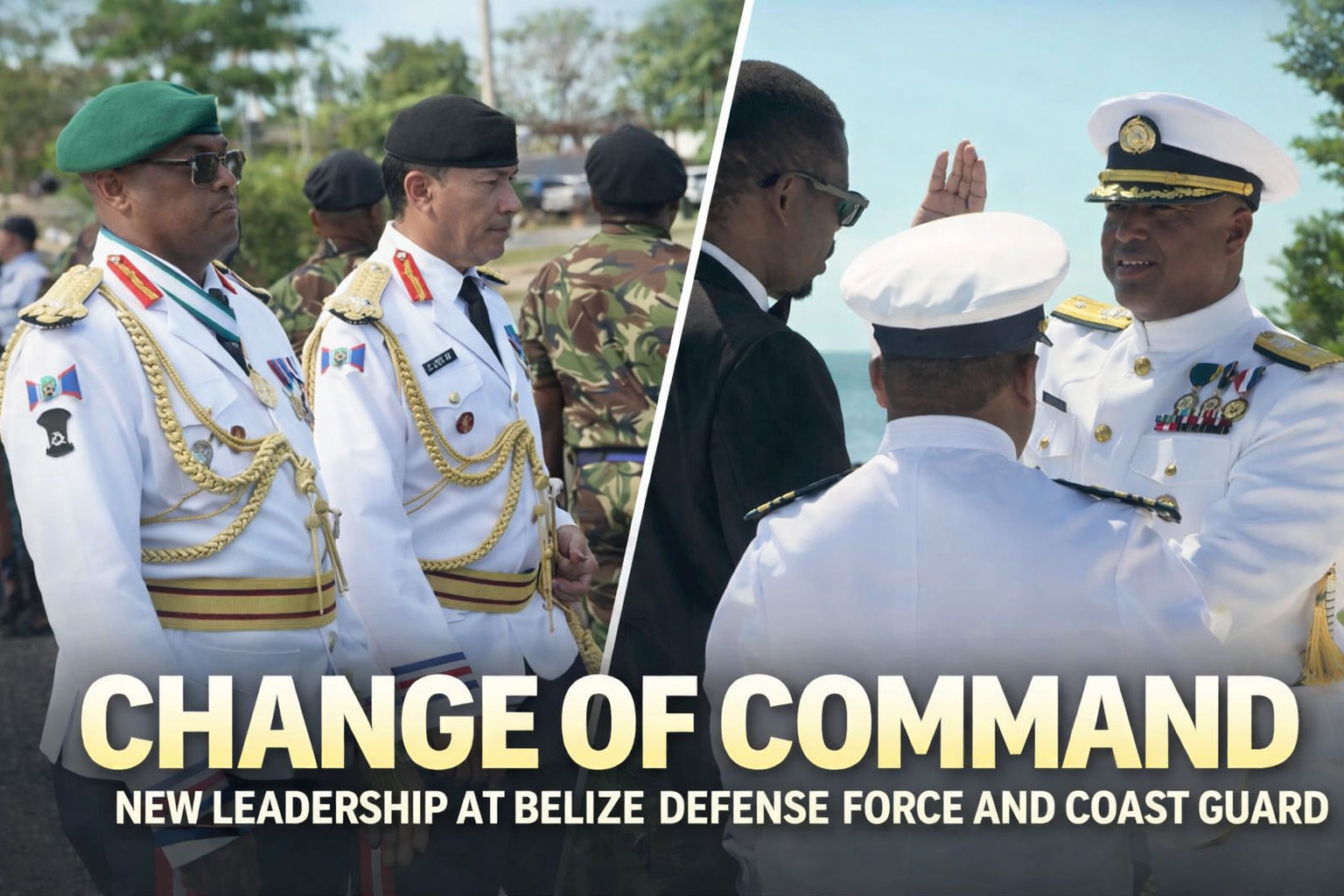
The recent Change of Command ceremonies at the Belize Defense Force (BDF) and the Belize Coast Guard (BCG) were presented with all the grandeur expected of military tradition—precision drills, stirring speeches, and solemn pledges of service.
But beyond the polished optics, Belizeans must ask a harder, more uncomfortable question:
Is this genuine military development aimed at national security and sovereignty—especially in the shadow of a pending ICJ judgment—or is it another episode of political theatre by the Briceño Administration?
Because ceremonies do not defend borders. Capabilities do.
From Promise to Attrition: A Familiar Pattern
When the Briceño Administration took office in 2020, expectations were high. The appointment of Florencio Marin Jr.—a former BDF officer—as Minister of National Defence and Border Security, alongside a seasoned military CEO, Brigadier General Dario Tapia, suggested a rare opportunity for reform driven by insider understanding.
What followed instead was sacrifice without structural reward.
- During COVID, servicemen and women endured extended deployments, restricted movement, and personal hardship.
- Housing was promised; some received empty lots without utilities.
- Education pathways for active servicemembers were announced; never institutionalized.
- Social Security coverage remains unresolved.
- Barracks improvements amounted to token construction—two or three facilities against nationwide need.
- Rations remain poor; officers eat marginally better, rank-and-file largely forgotten.
- Equipment and gear remain outdated, donated, and insufficient.
By the time the PUP entered its second term (2025–2030), the system had not transformed—it had simply normalized stagnation.
New Commanders, Old Constraints
Today, Brigadier General Anthony Velasquez assumes command of the BDF, while Rear Admiral Gregory Soberanis takes the helm of the Coast Guard. Both are career officers. Both are disciplined. Both are respected.
But neither can manufacture capability out of political neglect.
Their speeches—commendable in tone—contained a recurring truth:
“The soldier can do miracles with limited resources.”
Miracles are not a defence policy. They are a warning.
The ICJ Reality Belize Cannot Ignore
Belize is approaching one of the most consequential moments in its modern history: a ruling from the International Court of Justice.
Regardless of the outcome, Belize’s day-to-day sovereignty will still be tested:
- on the Sarstoon River,
- in the adjacency zone,
- across territorial waters,
- and in airspace Belize barely controls.
International law provides legitimacy.
Military readiness provides deterrence.
At present, Belize’s deterrence posture is fragile if not broken:
- Air capability: one operable helicopter; two or three light aircraft—serviceability inconsistent.
- Sea capability: improved Coast Guard presence, but still stretched across a vast maritime domain.
- Land capability: no mechanized artillery unit; limited mobility; overstretched infantry.
- ISR (intelligence, surveillance, reconnaissance): heavily dependent on partners.
- Training: overwhelmingly U.S.-centric, while regional power asymmetries persist.
The Sarstoon Test: Where Rhetoric Dies
If Belize were serious, the Sarstoon would already have:
- a clear operational protocol,
- defined rules of engagement,
- permanent joint BDF–BCG coordination,
- rapid diplomatic escalation mechanisms tied to incidents.
Instead, Belize relies on restraint, goodwill, and after-the-fact diplomacy—while Guatemalan presence remains assertive.
Sovereignty delayed is sovereignty diluted.
Transformation Has a Checklist — Not a Slogan
If this change of command is truly about progression, Belizeans should demand measurable outcomes within 12 months, not speeches.
1. A National Defence Strategy (2026–2030)
Published, costed, and aligned to ICJ realities:
- threat matrix (land, sea, air, hybrid threats),
- force structure and procurement priorities,
- readiness benchmarks.
2. Mobility Before Manpower
Recruiting 150 new soldiers without transport and sustainment only deepens vulnerability.
- Airlift, patrol endurance, maintenance capacity first.
- Mobility is sovereignty.
3. A Sarstoon River Protocol
Not diplomatic ambiguity—operational clarity.
4. End Donation Dependency
Belize must diversify:
- training partners,
- doctrine sources,
- equipment procurement channels.
Token donations of obsolete gear do not equal partnership—especially when regional neighbours receive heavy hardware.
5. Local Military-Industrial Initiatives
Belize can and should:
- manufacture uniforms, boots, and headgear locally,
- establish defence maintenance and engineering units,
- develop short-range organic drones through reverse-engineering programs under strict military control.
This is not militarism—it is self-reliance.
6. A Defence Budget Tied to Outcomes
Not secrecy—but accountability:
- what was procured,
- what improved,
- what remains unfunded and why.
The Real Question Belizeans Must Ask
Is the Briceño Administration preparing Belize for the post-ICJ world?
Or is it once again substituting ceremony for capacity, faith for planning, and rhetoric for readiness?
Because when the cameras are gone, it is not speeches that will stand at the Sarstoon, patrol our seas, or defend our airspace.
It will be the same soldiers—still under-equipped—asked to perform miracles.
- Belize deserves better than miracles.
- Belize deserves a strategy.
- Log in to post comments