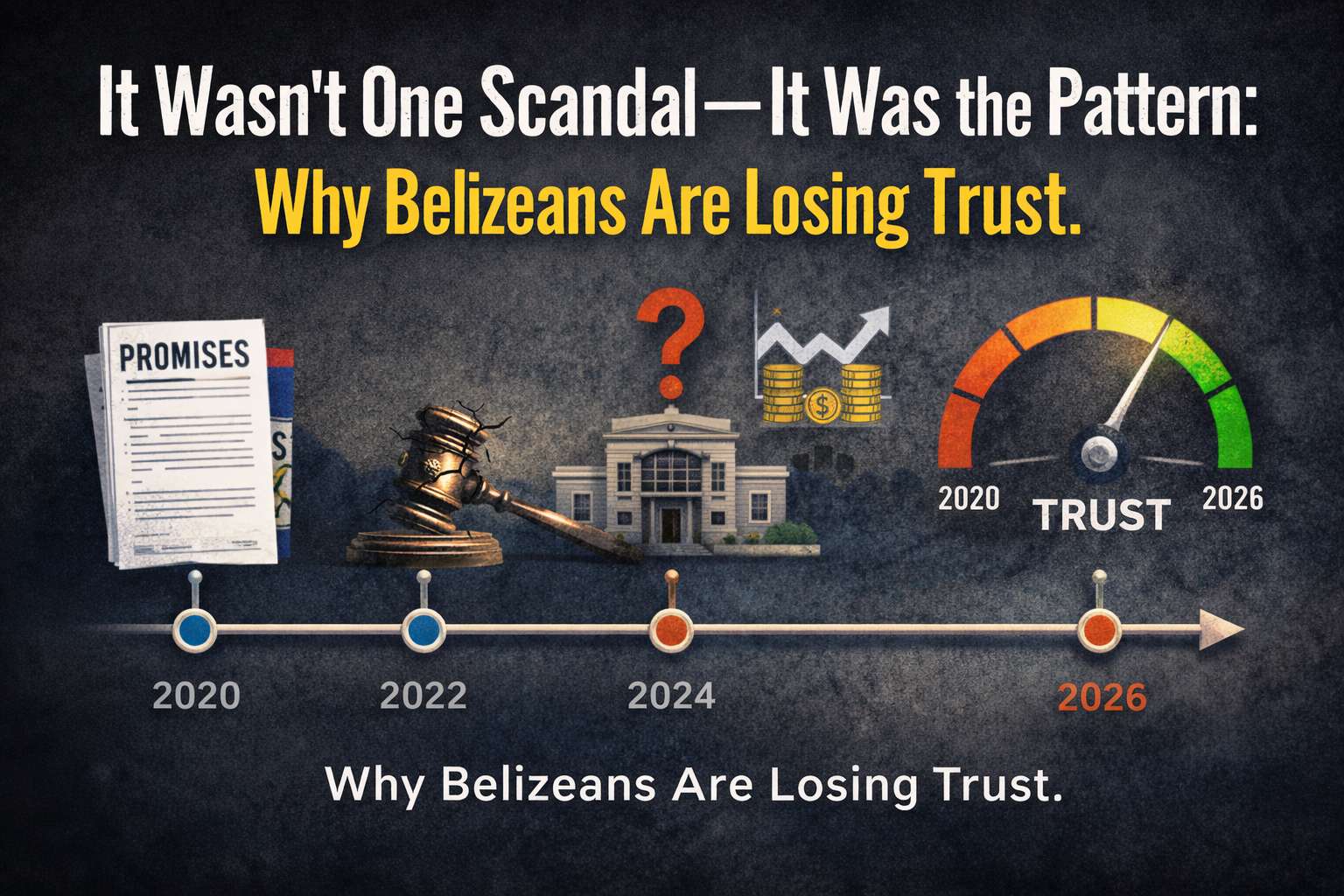
It Wasn’t One Scandal—It Was the Pattern: Why Belizeans Are Losing Trust

By Omar Silva – Editor/Publisher
National Perspective Belize – Digital 2026
Belize City: Thursday 12th February 2026
Trust in government is rarely lost overnight. It erodes gradually—issue by issue, decision by decision, explanation by explanation—until a point is reached where the public begins to question not only policies, but credibility itself.
Belize appears to be approaching that juncture.
Since the beginning of the Briceño Administration’s first mandate in November 2020, a growing accumulation of controversies, perceived contradictions, and governance concerns has steadily weakened public confidence. The recent Dangriga poll, showing a high level of disapproval of the Prime Minister’s performance, is not the cause of that erosion—it is a reflection of it.
The deeper issue is the pattern.
A Mandate Built on Promises of Transparency
When the People’s United Party returned to power in 2020, it did so on a message that resonated strongly with the electorate:
- Transparency
- Accountability
- Consultation with the people
- A break from past practices
These were not minor campaign slogans; they were the central pillars of the administration’s legitimacy.
Many Belizeans voted not simply for a party, but for the promise of a new political culture.
Five years later, critics increasingly argue that those expectations have not been met.
The Growing Perception of Non-Transparency
One of the most persistent concerns raised in public discourse has been the lack of full disclosure surrounding major national decisions.
Across several sectors—telecommunications, land transactions, public contracts, and fiscal decisions—questions have repeatedly surfaced only after decisions were already advanced or finalized.
This sequence has become familiar:
- A decision emerges.
- Public concern grows.
- Explanations follow afterward.
For many citizens, this feels less like consultation and more like notification after the fact.
And consultation delayed is often perceived as consultation denied.
Accountability Deferred Is Accountability Denied
Another recurring concern has been the perception that accountability is slow, selective, or incomplete.
Belizeans have witnessed:
- Allegations of irregularities that remain unresolved for long periods
- Financial controversies explained but seldom fully investigated in the public domain
- Policy missteps acknowledged but rarely accompanied by corrective transparency
In governance, perception matters as much as procedure.
When accountability is not seen, the public assumes it does not exist.
Constitutional and Legal Concerns
Legal observers and civil society groups have also raised alarms over decisions and legislative initiatives perceived as testing or stretching constitutional boundaries.
Whether these concerns ultimately stand in court or not, their political effect is undeniable:
They create the impression of a government willing to act first and justify later.
In a democratic society, that perception is deeply damaging to public trust.
The SPEEDNET/SMART Issue and the Trust Gap
The recent controversy surrounding the proposed acquisition involving telecommunications assets has become a flashpoint—not necessarily because of its technical details, but because of what it symbolizes.
To many Belizeans, the issue is not simply about telecom revenues or market share.
It is about:
- Transparency in public-interest decisions
- Clarity about the role of state-owned enterprises
- The relationship between government authority and corporate actions
When explanations appear to shift or fragment, citizens begin to suspect that the full story has not yet been told.
That suspicion, once formed, is difficult to reverse.
Economic Pressure Intensifies Political Judgment
Public trust is always more fragile during periods of economic strain.
Today, Belizeans face:
- High cost of living
- Rising municipal fees and trade license adjustments
- Persistent import dependency
- Limited relief in utilities despite partial public ownership
Under these conditions, patience declines and scrutiny increases.
Citizens begin to measure government not by speeches, but by results they can feel in their daily lives.
The Danger of Dismissing Public Sentiment
One of the most politically risky responses any leader can give to public dissatisfaction is indifference.
When citizens express frustration and hear that leadership is “not concerned,” many interpret that as detachment from the realities they face.
Even if unintended, the message received is clear:
The government is not listening.
And once people believe they are not being heard, they begin to withdraw not only trust—but respect.
A Narrative That Keeps Changing
Perhaps the most damaging factor of all is the perception that official narratives change over time.
Statements evolve.
Explanations shift.
Positions are revised.
In politics, adjustments are sometimes necessary.
But when changes occur frequently, they begin to resemble contradictions.
And contradictions, repeated often enough, are interpreted by the public as dishonesty.
The Real Risk Ahead
The greatest danger for any administration is not criticism.
It is indifference.
When citizens stop believing that government actions are sincere, engagement declines, cynicism rises, and democratic legitimacy begins to weaken.
Belize is not there yet—but the warning signs are visible.
The Verdict of the People Is Forming
Polls, protests, social media debate, and private conversations are all signals of the same underlying reality:
Public confidence is no longer secure.
And once trust is lost, it is far harder to rebuild than it was to earn.
The Dangriga poll did not create this reality.
It merely revealed it.
Conclusion: A Moment of Reckoning
Governments are not judged only by their intentions.
They are judged by their consistency, their transparency, and their respect for the public’s intelligence.
The Briceño Administration was elected on a promise of transformation and clean governance.
Many Belizeans are now asking a simple question:
What happened to that promise?
And unless clear answers begin to emerge, the pattern—not any single scandal—may ultimately define this era of governance in Belize.
- Log in to post comments