BZ$30 MILLION FOR HEALTH WORKERS — BUT WHERE IS BELIZE'S HEALTHCARE BLUEPRINT?
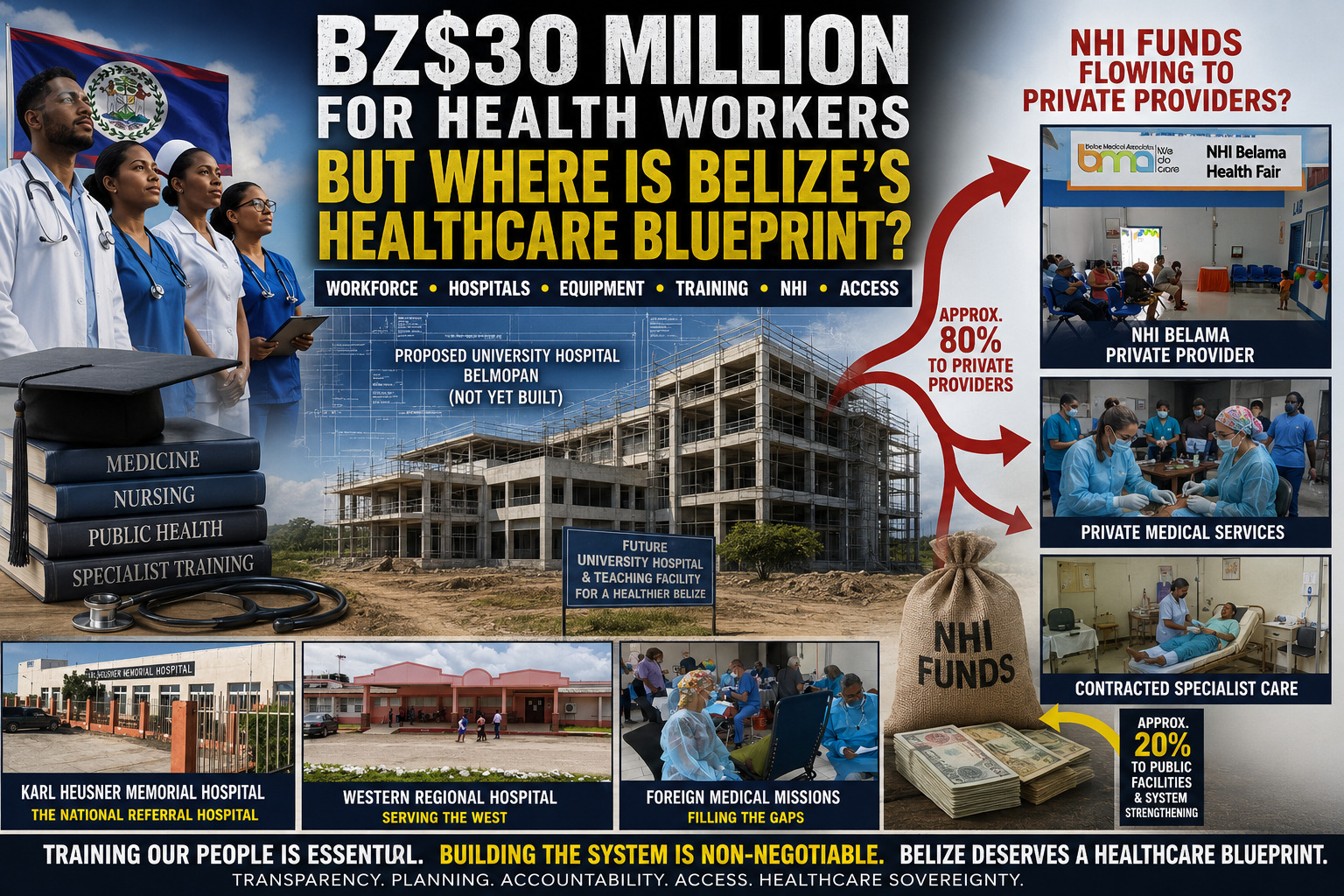
You Cannot Build a Healthcare Workforce in Isolation. Doctors Need Hospitals. Nurses Need Equipment. Specialists Need Diagnostic Capacity. And Belize Needs a System That Connects Them All.
Belize City: Friday 28th August 2026: The announcement sounds encouraging.
The Government of Belize intends to invest approximately BZ$30 million over ten years to train Belizean doctors, nurses, specialists and other healthcare professionals.
Health and Wellness Minister Kevin Bernard say the objective is to confront longstanding vacancies, prepare for an ageing healthcare workforce and gradually reduce Belize's dependence on foreign medical personnel.
On its face, that is difficult to oppose.
Belize unquestionably needs more Belizean doctors.
- We need more nurses.
- We need specialists.
- We need laboratory professionals, pharmacists, radiographers, therapists, public-health professionals and trained personnel willing to serve outside Belize City.
But there is a much larger question that cannot be avoided:
WHAT EXACTLY ARE WE TRAINING THEM FOR — AND WHERE IS THE NATIONAL HEALTHCARE INFRASTRUCTURE PLAN INTO WHICH THEY WILL FIT?
- A healthcare workforce cannot exist independently of a healthcare system.
- A doctor without adequate diagnostic equipment is constrained.
- A surgeon without a properly equipped operating theatre is constrained.
- A specialist without laboratories, imaging, medicines, technical personnel and referral networks is constrained.
- And a government can award scholarships for ten years without necessarily fixing the structural weaknesses that caused Belize's healthcare personnel shortages in the first place.
That is why the BZ$30 million announcement should trigger a larger national discussion.
- Belize does not merely need a Healthcare Workforce Training Plan. Belize needs an integrated National Healthcare Development Blueprint.
Such a blueprint must answer three fundamental questions:
- What healthcare infrastructure will Belize need?
- What personnel will be required to operate it?
- And how will the country sustainably finance both?
THE MISSING PIECE: THE UNIVERSITY HOSPITAL
There is an obvious place to begin.
Whatever happened to the much-promoted University Hospital in Belmopan?
The project was presented as much more than another hospital.
- Government secured approximately US$45 million/BZ$90 million in Saudi financing for what was envisioned as a tertiary-care and teaching hospital.
But the project subsequently became embroiled in controversy over its location.
- The hospital was originally expected to be constructed on land associated with the University of Belize. Government subsequently abandoned that location and purchased approximately 15 acres of private property for roughly BZ$6.9 million, arguing that the original UB location presented accessibility problems.
Two years later, the hospital remains unbuilt.
- Indeed, as recently as August 27, 2026, Minister Bernard acknowledged that the project remains in the procurement/design process and expressed his hope that groundbreaking could occur before the end of this year.
That distinction matters.
- The proposed facility is supposed to be a 150-bed national referral hospital and teaching facility associated with the training of University of Belize medical students.
- Therefore, when Government announces another ten-year programme for developing Belize's medical workforce, Belizeans have every right to connect the two announcements.
Because they should already be connected.
THE UNIVERSITY HOSPITAL SHOULD BE ONE OF THE PHYSICAL ANCHORS OF THE WORKFORCE STRATEGY.
- If Belize intends to produce its own doctors and specialists, where will they receive clinical training?
- Where will residents undertake specialist rotations?
- Where will nurses receive advanced clinical exposure?
- Where will Belize develop cardiology, oncology, nephrology, trauma, intensive care, advanced surgery and other disciplines that presently require foreign assistance or overseas referrals?
***These are not separate policy questions.
They are components of the same national healthcare architecture.
THE NHI QUESTION CANNOT BE SEPARATED FROM THIS DEBATE
Then comes the uncomfortable question of money.
- Belize has progressively expanded the National Health Insurance programme (NHI).
- Government presents NHI as one of its flagship social achievements, designed primarily around access to affordable primary healthcare.
- The NHI's own strategic framework recognizes a mixed provider system involving public, private and NGO healthcare providers.
There is nothing inherently wrong with contracting private providers.
Private healthcare capacity can complement the public system, particularly when government facilities cannot immediately provide a service.
But there is an enormous difference between using private healthcare
to supplement national capacity and allowing public financing to substitute for building that capacity.
That distinction deserves examination.
- During the 2026 parliamentary debate over the NHI Authority legislation, Opposition Leader Tracy Taegar-Panton alleged that approximately 80 percent of NHI services were being procured from private facilities and only 20 percent from public institutions.
That allegation should not simply be repeated as established fact without the Government publishing the complete contracting figures.
Government should therefore disclose them.
- How much NHI money goes annually to private providers?
- How much goes to NGOs?
- How much flows through public facilities?
- Which providers receive those contracts?
- What services are purchased?
- What are the unit costs?
And critically:
HOW MUCH OF THAT PUBLIC HEALTHCARE MONEY IS BUILDING PERMANENT PUBLIC HEALTHCARE CAPACITY?
Because every dollar Belize spends purchasing a service addresses today's patient.
- But strategic investment in laboratories, clinics, diagnostic equipment, hospitals and human capital can potentially address today's patient and tomorrow's patient.
BELIZE MAY BE FINANCING TWO HEALTHCARE SYSTEMS
This is where Government needs to explain its long-term philosophy.
- The State finances the Ministry of Health and Wellness.
- The State finances regional hospitals.
- The State supports KHMH.
- The State finances NHI.
- NHI contracts private providers.
- Government is simultaneously borrowing and obtaining foreign financing to construct or modernize healthcare facilities.
- And now another BZ$30 million is being earmarked over ten years for healthcare-worker development.
Individually, each expenditure can be defended.
- Collectively, however, Belizeans should be able to see one national plan.
- Otherwise, we risk financing programmes instead of building a system.
That is the difference between health expenditure and healthcare development.
AND YET BELIZE IS STILL LOOKING ABROAD
The contradiction becomes even more apparent when Minister Bernard explains the immediate response to Belize's personnel shortages.
- Government is discussing recruiting nurses from the Philippines.
- It is exploring specialised medical personnel from Nicaragua and Mexico.
- The future of the Cuban Medical Brigade remains under discussion.
- And following Prime Minister John Briceño's recent visit to Honduras, Government is now exploring another possibility: medical education, residency opportunities and professional exchanges with Honduras.
Again, none of those initiatives is inherently objectionable.
Small countries routinely participate in medical exchanges.
Belize should cooperate with Cuba, Mexico, Honduras, Nicaragua, the Philippines and any country willing to participate in legitimate mutually beneficial healthcare arrangements.
- But international recruitment should be the bridge while Belize builds capacity — not the permanent substitute for capacity.
THE HONDURAS ANNOUNCEMENT REQUIRES AN IMPORTANT DISTINCTION
Government's presentation of the Honduras discussions also deserves precision.
Minister Bernard himself acknowledged that what presently exists is essentially the beginning of a discussion.
- He referred to an earlier cooperation framework dating back to approximately 1991 involving cultural and educational exchange and said Belize is now interested in developing a medical exchange arrangement.
But he also acknowledged something important:
- Honduras itself faces shortages of healthcare professionals.
Therefore, the emerging proposal is apparently not simply about Belize recruiting Honduran doctors.
- The more potentially valuable component could be access for Belizean doctors to medical education, specialist training and residency programmes within the Honduran system, alongside reciprocal professional exchanges.
That could be worthwhile.
- But it is not yet a completed healthcare agreement.
- The technical teams must negotiate.
- Diplomatic channels must become involved.
- An MOU would have to be finalized.
- And its actual provisions would have to be examined.
Until that occurs, Belize should distinguish carefully between a diplomatic conversation, a proposed framework and an operational bilateral programme.
BZ$30 MILLION OVER TEN YEARS ALSO REQUIRES PERSPECTIVE
Thirty million dollars sounds substantial.
Spread across ten years, however, it averages approximately:
BZ$3 MILLION PER YEAR.
Now consider what that allocation is expected to accomplish.
- Medical degrees.
- Nursing scholarships.
- Specialist residencies.
- Postgraduate training.
- Clinical specialties.
- Continuing professional development.
- Potential overseas training.
- And replacement of professionals reaching retirement.
Suddenly BZ$30 million does not appear enormous.
Which raises another question:
Has Government produced a workforce-needs assessment calculating exactly how many professionals Belize requires by 2030, 2035 and 2040?
- How many general practitioners?
- How many specialist physicians?
- How many registered nurses?
- How many midwives?
- How many pharmacists?
- How many laboratory technologists?
- How many radiologists?
- How many anaesthesiologists?
- How many psychiatrists and mental-health professionals?
- How many physiotherapists?
- And where must those professionals be deployed geographically?
Belize City cannot continue to be treated as though it is the Belizean healthcare system.
- Toledo matters.
- Corozal matters.
- Orange Walk matters.
- Cayo matters.
- Stann Creek matters.
- The Cayes matter.
- Rural Belize matters.
BUILD THE SYSTEM — NOT ANOTHER PROGRAMME
What Belize requires is therefore considerably larger than a scholarship programme.
Imagine instead a National Health Infrastructure and Human Capital Blueprint 2027–2040.
Under one national framework, Government would map:
- PUBLIC HEALTH INFRASTRUCTURE — every hospital, polyclinic, health centre and rural clinic, its physical condition and projected requirements.
- HUMAN RESOURCES — every doctor, nurse, specialist and allied-health position currently filled, vacant or projected to become vacant through retirement.
- MEDICAL EDUCATION — the University of Belize School of Medicine, the proposed University Hospital, nursing education and international residency partnerships integrated into one national training pipeline.
- EQUIPMENT — national inventories and replacement schedules for imaging, laboratories, operating theatres, dialysis, emergency medicine, intensive care and specialist services.
- NHI FINANCING — a transparent accounting showing precisely how much public money goes to public, private and NGO providers and what permanent national capacity is being created.
- REGIONAL DEPLOYMENT — incentives and contractual mechanisms ensuring that publicly financed medical education produces professionals willing to serve underserved communities.
- SPECIALIST DEVELOPMENT — identifying the disciplines Belize repeatedly imports and deliberately training Belizeans to fill them.
- RETENTION — salaries, working conditions, professional development, housing or rural incentives and career pathways capable of keeping the professionals Belize pays to educate.
That would constitute a healthcare strategy.
THE QUESTION IS NOT WHETHER BELIZE SHOULD SPEND THE BZ$30 MILLION
It should.
Perhaps Belize should invest considerably more.
- The question is whether Government will spend BZ$30 million inside a national architecture capable of multiplying its value.
- Because scholarships alone will not produce healthcare sovereignty.
- Foreign doctors alone will not produce healthcare sovereignty.
- Private NHI contracts alone will not produce healthcare sovereignty.
- A new hospital alone will not produce healthcare sovereignty.
- And borrowing millions to construct buildings without developing the people required to operate them will not produce healthcare sovereignty either.
The buildings, equipment, financing, education, workforce and delivery system have to be designed together.
That is what has been missing from too much of Belize's development planning.
FROM DEPENDENCE TO HEALTHCARE SOVEREIGNTY
Belize has depended for decades on foreign doctors and international medical cooperation.
We should remain grateful to those countries and professionals who have helped fill those gaps.
But gratitude cannot become national policy.
- The ultimate objective must be to reach the point where foreign medical cooperation supplements Belizean capacity rather than substitutes for its absence.
- That means producing our own doctors.
- Training our own specialists.
- Building our own teaching institutions.
- Equipping our hospitals.
- Strengthening our regional healthcare facilities.
- Creating competitive conditions that retain Belizean professionals.
- And directing public healthcare financing toward a system capable of becoming progressively more self-sufficient.
So, Minister Kevin Bernard's BZ$30 million announcement should not be dismissed.
- It should be expanded into something much bigger.
- It should become the moment Belize asks Government to put every piece of the healthcare puzzle on the same table.
- The NHI.
- The University Hospital.
- The UB School of Medicine.
- KHMH.
- The regional hospitals.
- The Cuban Medical Brigade.
- The proposed Honduras arrangement.
- Mexican and Nicaraguan specialists.
- Filipino nurses.
- Scholarships.
- Retirement projections.
- Equipment.
- Infrastructure.
- And financing.
Then show Belizeans how all those pieces fit together.
- Because after decades of importing personnel, outsourcing services, borrowing for infrastructure and announcing individual programmes, the country deserves more than another healthcare initiative.
- BELIZE DESERVES A HEALTHCARE BLUEPRINT.
And the ultimate test of that blueprint should be simple:
- HOW MANY OF THE DOCTORS, NURSES AND SPECIALISTS BELIZE NEEDS IN 2036 WILL BE BELIZEANS — TRAINED BY A SYSTEM BELIZE BUILT, WORKING IN FACILITIES BELIZE EQUIPPED, AND PROVIDING QUALITY CARE THAT ORDINARY BELIZEANS CAN ACTUALLY ACCESS?
Until Government can answer that question, BZ$30 million is an investment announcement.
It is not yet a healthcare transformation.
By: Omar Silva: Editorial Director @ www.nationalperspectivebz.com
- Log in to post comments