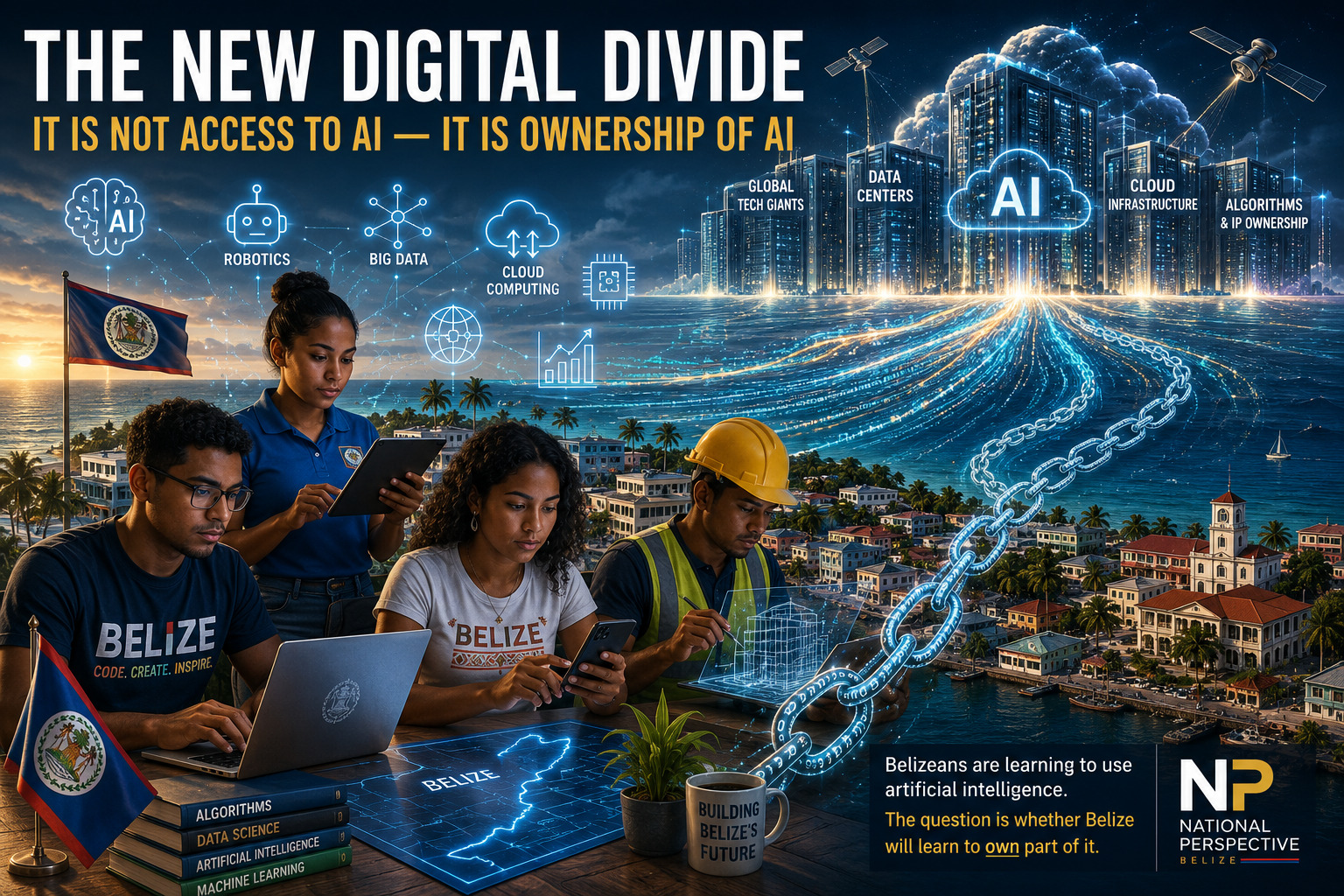
THE NEW DIGITAL DIVIDE IS NOT ACCESS TO AI — IT IS OWNERSHIP OF AI
EDITORIAL
Belize City: Saturday 13th June 2026: For years, the world spoke about the digital divide as a question of access.
- Who had internet?
- Who had computers?
- Who had smartphones?
- Who had connectivity?
Governments, international organizations, and development agencies poured billions of dollars into expanding access to technology. The assumption was simple: if people could get online, opportunity would follow.
Today, much of Latin America and the Caribbean has crossed that threshold.
Internet access is widespread. Smartphones are everywhere. Digital services are becoming part of everyday life. Artificial Intelligence is rapidly entering schools, offices, businesses, and government agencies.
Yet, a new divide is emerging.
And it is far more important than the one that came before.
The new digital divide is not about who can use AI.
It is about who owns AI.
Across the region, institutions are celebrating the rise of AI-related jobs and the growing demand for digital skills. We are told that artificial intelligence will improve productivity, increase efficiency, and create new opportunities.
Those claims may be true.
But they leave out a critical question.
Who will capture the wealth created by this technological revolution?
Will it be the countries that consume AI?
Or the countries that build it?
For small nations like Belize, that distinction may determine whether AI becomes a tool of empowerment or a new form of dependency.
- A country can train thousands of workers to use artificial intelligence and still remain dependent on foreign technology.
- A country can digitize government services and still send millions of dollars abroad every year in software subscriptions, licensing fees, cloud services, and imported expertise.
- A country can become technologically connected while remaining economically disconnected from the value being created.
That is the danger Belize must understand.
Historically, nations accumulated wealth through ownership of productive assets.
- In the agricultural era, those assets were land.
- In the industrial era, they were factories, machinery, and transportation networks.
- In the digital era, the most valuable assets are increasingly data, algorithms, software platforms, computing infrastructure, and intellectual property.
The countries that own these assets will shape the future economy.
The countries that merely consume them will finance the future prosperity of others.
Belize faces this challenge from a position of weakness.
- We remain heavily dependent on imports.
- We manufacture very little.
- We produce limited amounts of technology.
- We consume far more innovation than we create.
Artificial intelligence did not create these realities.
It simply exposes them.
The conversation therefore cannot stop at teaching Belizeans how to use AI.
We must also ask whether Belize intends to participate in creating AI-driven value.
- Where is the national strategy for artificial intelligence?
- Where are the technology parks?
- Where are the innovation centres?
- Where are the incentives for software development?
- Where are the investments in coding, engineering, robotics, and data science?
- Where is the plan to transform Belize from a consumer of digital products into a producer of digital solutions?
These questions matter because the future economy will increasingly reward knowledge, innovation, and intellectual property.
Countries that build capabilities will gain leverage.
Countries that rent capabilities will remain dependent.
This is why the discussion surrounding artificial intelligence must be larger than technology itself.
- It is a discussion about sovereignty.
- It is a discussion about economic independence.
- It is a discussion about whether Belize intends to own part of the future or merely pay for access to it.
The first digital divide separated those who could connect from those who could not.
The next digital divide will separate those who create from those who consume.
- Those who own the technology will shape the future.
- Those who do not will live inside a future designed by others.
The question for Belize is not whether artificial intelligence is coming.
It already has.
The question is whether Belize intends to own a piece of that future—or simply rent it.
By: Omar Silva – Editor/Publisher
National Perspective Belize – Digital
- Log in to post comments