
INTIMIDATION BEFORE AMERICAN WITNESSES? BRICEÑO AND FONSECA MUST EXPLAIN THE SARSTOON ENCOUNTER
BRICEÑO AND FONSECA MUST EXPLAIN THE SARSTOON ENCOUNTER
Accountability Analysis
If Guatemalan military personnel knew that United States Embassy representatives were aboard a Belize Defence Force vessel, why did they reportedly proceed with intimidation?
- That unresolved question deserves an answer from Guatemala, an account from Washington and a substantive response from Belize’s government.
The American presence makes the circumstances more consequential. It does not establish that Guatemala knew who was aboard, that Washington approved the conduct, or that Americans participated in it. Those distinctions must guide the investigation.
The latest reported encounter between the Belize Defence Force and Guatemalan military personnel on the Sarstoon raises a question that cannot be answered merely by praising our soldiers’ professionalism: what protection, resources and diplomatic consequences stand behind the duties Belize assigns them?
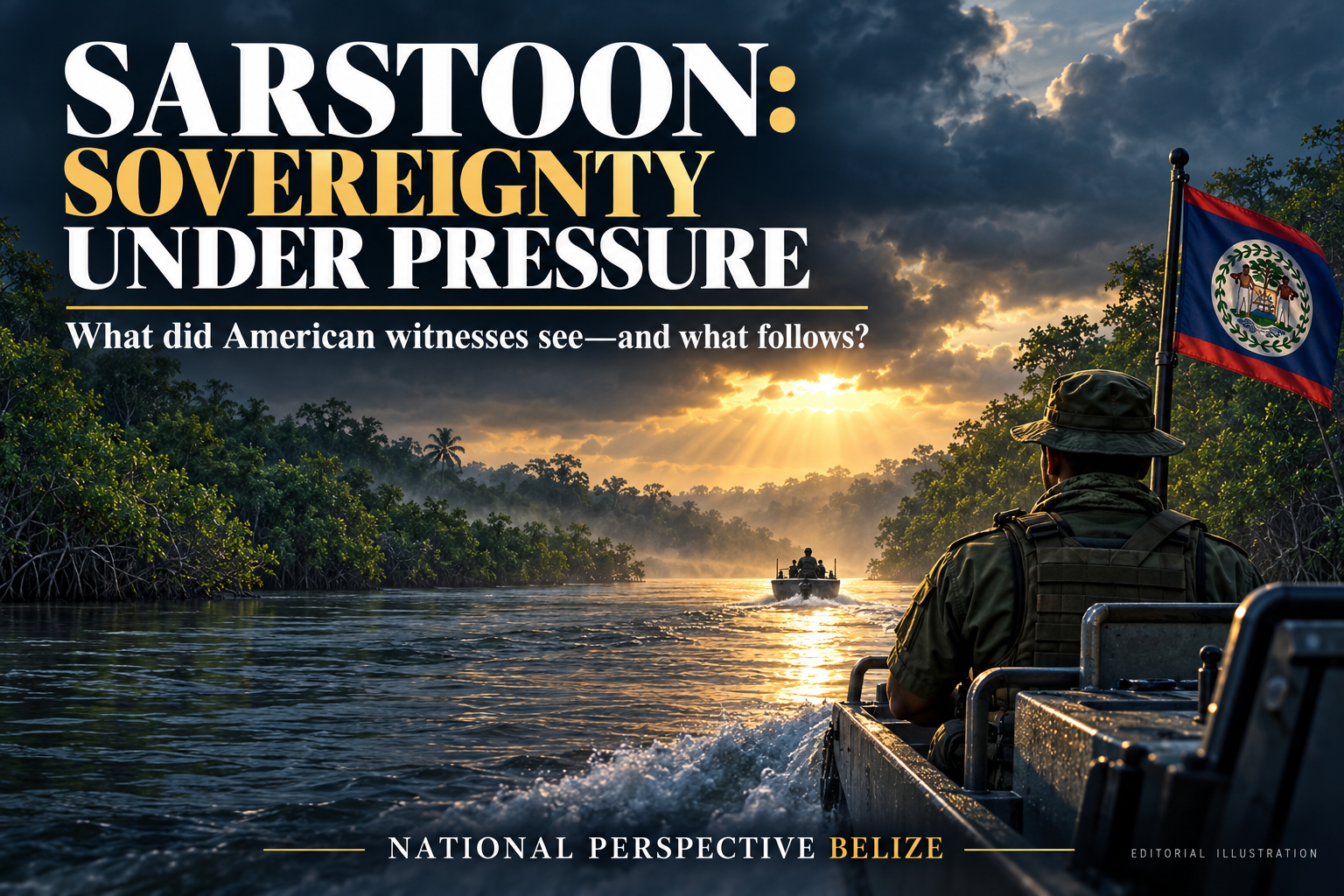
- Reports published on October 27 describe intimidation of a BDF patrol escorting United States Embassy personnel to Cadenas Observation Post for work connected with a communications project. Defence CEO Francis Usher was cited as confirming intimidation and commending the patrol’s handling of the encounter.
That is sufficient reason for a serious public response. It is not sufficient evidence to invent details about weapons, threats, orders or intentions that have not been disclosed.
- There is also an essential distinction concerning the American presence. The reports place U.S. Embassy personnel aboard the Belizean vessel. They do not establish whether those individuals were diplomats, military specialists or contractors. Embassy affiliation alone does not settle their roles.
Did Guatemala know who was aboard?
- Were the Guatemalan personnel informed of the American delegation before the encounter? Did the BDF or Embassy representatives identify the passengers during it? If so, did the conduct change?
- If the Guatemalan personnel did not know, the American presence cannot be treated as something they deliberately disregarded.
- If they did know and continued, that would raise a more serious diplomatic question: were they following standing instructions, deliberately asserting authority before outside witnesses, or acting with an expectation that there would be little consequence?
- These are possible explanations to investigate, not findings about motive. Establishing what the personnel knew would help distinguish among them.
Prime Minister John Briceño and Foreign Minister Francis Fonseca should ensure that this question receives a documented answer.
Why were the Americans there?
- Local News reported that the delegation was scouting possible locations for a communications tower. That provides a general explanation for the visit, but leaves the project’s scope and arrangements unclear.
- Who commissioned and financed it? Which agencies were involved? What functions would the infrastructure perform? Who would own, operate, maintain and access it? What authority and oversight would Belize retain?
- A communications project may serve a legitimate and valuable purpose. Government can explain its purpose, institutional responsibilities and safeguards without disclosing sensitive technical information.
Separate allegations must be established
- A separate allegation—that U.S. military personnel accompanied the Guatemalan side during this encounter—has not been corroborated by the public reporting reviewed for this analysis. It must remain explicitly unverified.
- The published account placing Embassy personnel with the BDF does not logically exclude the possibility of other Americans being elsewhere. Equally, that possibility is not evidence that they were present.
- Belize should ask Washington and Guatemala whether any U.S. military personnel, advisers or contractors were aboard, accompanying or supporting the Guatemalan vessels involved. If so, what were their assignments, what did they witness, and what actions did they take?
Until evidence establishes such a presence, NP cannot attribute participation or complicity to the United States.
What happened—and was Belize’s mission completed?
- The reporting leaves material questions unanswered. Seven News described a blockage and placed the incident on the preceding Saturday; Breaking Belize News described the encounter as occurring on the publication date. An authoritative account should settle the date, explain the nature of the interference and confirm whether the team reached its destination.
Prime Minister John Briceño and Foreign Minister Francis Fonseca should ensure that Belizeans receive those answers.
- Where did the encounter occur? Was passage obstructed, delayed or ultimately allowed to continue without conditions? What evidence has been preserved? What formal representations have been made to Guatemala? Has a response been received?
- The government can answer these questions without publishing patrol schedules, sensitive communications or other information that could endanger personnel.
- Operational confidentiality is compatible with public accountability.
A diplomatic protest must lead somewhere
A formal protest matters because it records Belize’s objection. Its practical value should also be measured against what follows.
- The government should disclose whether it has sought a formal explanation from Guatemala, requested assurances against recurrence, and established a process for reviewing compliance. If previous approaches have failed to prevent further interference, ministers should explain what additional diplomatic measures they are pursuing.
The Commonwealth has already provided a clear basis for engagement. Following the September 10 Sarstoon incident, its Secretary-General called on Guatemala to avoid aggravating the dispute, respect confidence-building measures and refrain from conduct that endangers lives. She also supported establishing a Sarstoon cooperation mechanism with OAS assistance.
- Belize should seek practical follow-through: sustained attention from partners, prompt reporting of incidents, and arrangements that protect safe passage without prejudicing Belize’s territorial position.
A government earns confidence when it can identify the action taken, the answer received and the next step.
Washington should be asked for a clear account
The reported presence of U.S. Embassy personnel gives this encounter additional diplomatic significance.
- The Embassy personnel accompanying Belize may be important witnesses. Their account should help establish what was said, whether passage was obstructed and how the encounter ended.
- Has Belize requested that account? Has the Embassy confirmed its personnel’s roles? Has Washington sought an explanation from Guatemala? What response has Belize received?
Belize should establish what representations Washington is prepared to make in support of safe, lawful access. If Guatemala knowingly intimidated a Belizean patrol carrying American representatives, what message was intended—and what response followed?
- An Embassy visit is not a defence guarantee. Nor should observers assume that American personnel’s presence would automatically prevent interference.
- But a security partnership should permit frank discussion when the partner’s own personnel reportedly witness an encounter affecting Belizean operations. The public deserves to know what engagement has occurred, within appropriate diplomatic limits.
Belize must also define the purpose of such partnerships on its own terms. Cooperation should strengthen national institutions, technical competence and Belizean decision-making.
The ICJ timetable makes preparation urgent
Belizeans should be precise about what is scheduled for early 2027.
The Guatemala–Belize oral hearings are set for February 22–26. The separate Belize–Honduras proceedings concerning the Sapodilla Cayes are scheduled for March 1–5, with Guatemala participating as an intervening non-party. These are hearing dates. They are not announced dates for final judgments. Guatemala’s own official statement confirms that deliberation and decision follow the oral stage.
Belize therefore needs a security policy that covers the period before the hearings, the wait for judgment and implementation afterward.
There is no basis in this reported encounter alone to conclude that invasion is imminent or that Guatemala will refuse a ruling. There is ample reason to prepare responsibly for continued friction and to demand conduct consistent with peaceful adjudication.
A court judgment can determine legal rights. Government remains responsible for the institutions, resources and diplomatic work needed to sustain them.
A small state needs a doctrine designed for its circumstances
- Belize should commission and publicly explain the broad principles of a defence doctrine suited to its geography, population, finances and obligations.
- An asymmetric defensive approach would seek to make better use of limited resources through technical competence, resilience and an ability to remain effective under pressure. Its value would depend on clear missions, lawful authority, disciplined command and capabilities the country can afford to sustain.
- A small engineering and technical cadre deserves serious consideration within that framework.
- Communications engineers, maritime and mechanical specialists, infrastructure professionals and cybersecurity personnel could improve equipment reliability, connectivity, maintenance and institutional resilience. Partnerships with educational institutions and qualified Belizeans abroad could help develop and retain those skills.
These are policy proposals, not claims about capabilities the BDF currently possesses or lacks.
- Engineers would need trained colleagues, appropriate facilities, procurement support and dependable funding. Their work must become part of the force’s everyday capacity rather than an isolated demonstration.
The measure of success would be practical: can Belize sustain its lawful presence, keep personnel connected, maintain essential equipment and respond reliably when difficulties arise?
Assistance must serve a Belizean plan
- Foreign donations can make useful contributions. Every contribution, however, should be assessed against Belize’s own requirements and its full operating cost.
- Who pays for maintenance? Are spare parts available? Can personnel be trained and retained? Is replacement affordable? Does the equipment meet an identified need?
- The age or name of a weapon alone cannot answer those questions. Neither can the ceremony at which equipment is handed over.
- The government should present a costed, multiyear capability programme identifying priorities, recurrent costs, the role of foreign assistance and broad measures of delivery. Parliament should scrutinize it without requiring disclosure of sensitive operational details.
Sovereignty carries continuing financial responsibilities.
The responsibility reaches the Cabinet table
- The BDF’s conduct should be assessed fairly. Maintaining discipline during a tense encounter can protect lives and prevent escalation. It should never become an excuse for leaving personnel to manage recurring risks without adequate support.
The Prime Minister must explain the national strategy. The Foreign Minister must explain the diplomatic action and its results. The minister responsible for defence must explain how readiness priorities are funded and delivered.
- Guatemala’s authorities, in turn, should provide their account of this encounter and ensure that their forces’ conduct supports the peaceful process both countries have chosen.
Belizeans are entitled to a government response proportionate to the seriousness of the report: factual, firm, sustained and backed by resources.
Our soldiers’ professionalism must be matched by the state’s preparedness.
- The immediate questions before Briceño and Fonseca are direct: did Guatemala know American representatives were aboard; what did those representatives witness; and what has Belize demanded from Guatemala and Washington?
Belizeans must also be told what will change after this encounter to make our personnel safer and our lawful operations more secure.
Security partnerships must be assessed by what they deliver when pressure comes.
By Omar Silva – Editorial Director/Publisher @ www.nationalperspectivebz.com
National Perspective Belize | ©
- Log in to post comments
