When Justice Waits, Justice Weakens The Judicial Appointment Debate Must Be About More Than Who Gets the Robe
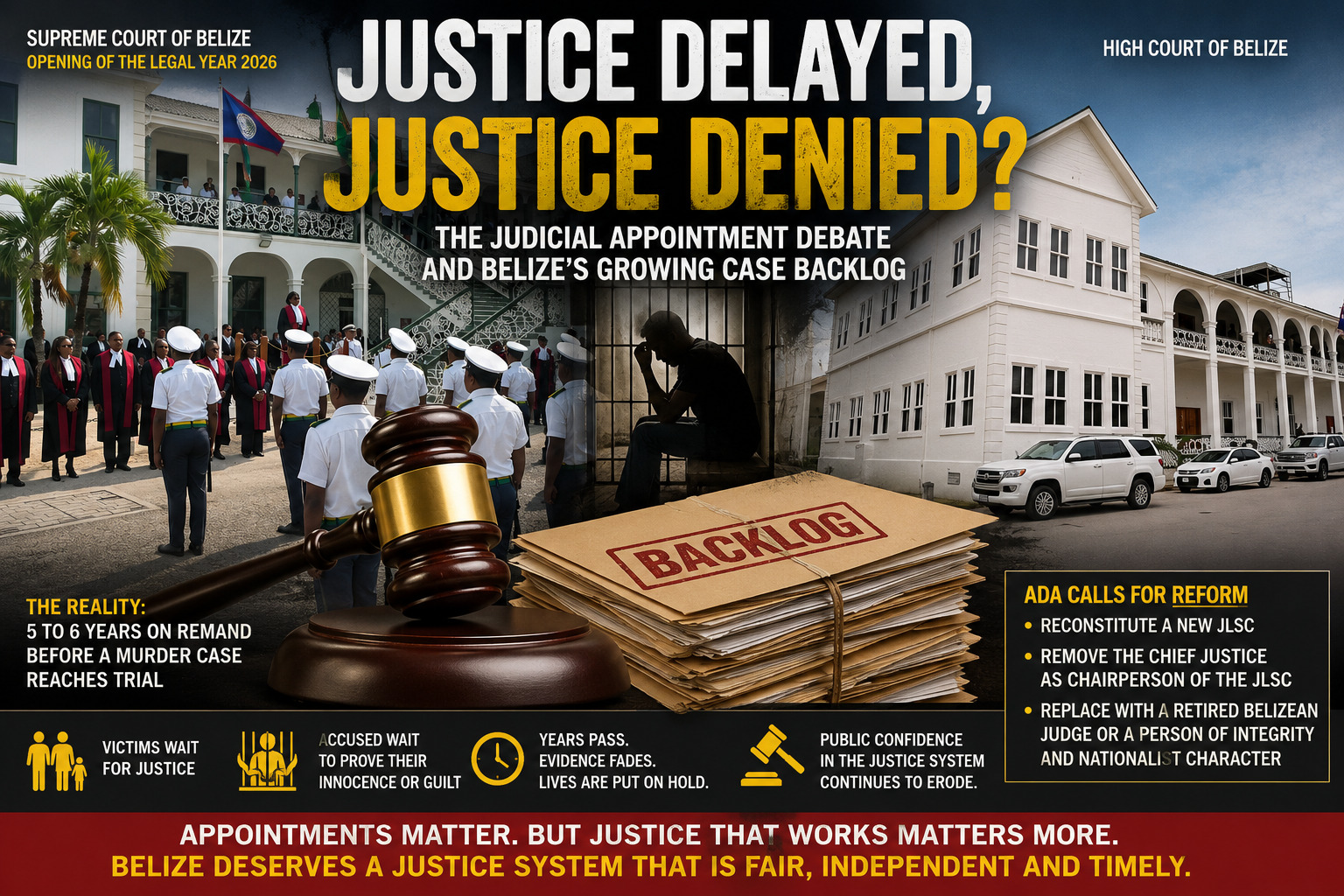
Belize City: Saturday 18th July 2026: The Association of Defence Attorneys (ADA) has ignited a national debate by criticizing the apparent appointment of two additional foreign judges and calling for the removal of the Chief Justice as Chairperson of the Judicial and Legal Services Commission (JLSC). The Attorney General has since clarified that the appointment process is still ongoing and that no final decision has yet been made.
For many Belizeans, however, this debate is not really about nationality.
It is about whether the justice system is delivering justice.
The Question Every Belizean Is Asking
The average citizen is not losing sleep over who sits on the Judicial and Legal Services Commission.
The average Belizean is asking something much simpler:
Why does it take five or six years for a murder case to reach trial?
Imagine the reality.
A young man is charged with murder at age twenty-two. Bail is denied because of the nature of the offence. His family insists he is innocent. The victim's family demands justice.
Years pass.
- One year.
- Two years.
- Three years.
- Five years.
- Sometimes even six years before a jury is empanelled.
If convicted, he has already spent years imprisoned before the verdict.
If acquitted, those years can never be returned.
Meanwhile, the victim's family has waited just as long for justice and closure.
That is the human cost of judicial delay.
The Backlog Is the Real Crisis
The controversy surrounding judicial appointments should prompt a larger national conversation.
Belize's criminal courts continue to carry a significant backlog of serious criminal matters.
Every postponement affects:
- grieving families,
- accused persons,
- witnesses whose memories inevitably fade,
- police investigators,
- prosecutors,
- defence attorneys,
- and public confidence in the courts.
Justice delayed becomes justice diminished for everyone involved.
Is It Only About More Judges?
Not necessarily.
Adding judges may help, but appointments alone cannot solve systemic delays.
A functioning justice system also requires:
- timely police investigations,
- adequate forensic resources,
- sufficient prosecutors,
- experienced defence counsel,
- efficient case management,
- available courtrooms,
- reliable juries,
- and modern administrative support.
If any one part of that chain fails, the entire system slows.
The ADA's Constitutional Concern
The ADA has gone beyond objecting to the apparent appointments.
It is questioning the governance of the Judicial and Legal Services Commission itself, calling for the Chief Justice to be removed as its Chairperson and replaced by an independent Belizean figure of recognized integrity.
Whether one agrees or disagrees with that proposal, it raises an important constitutional question:
Should the head of the Judiciary also chair the body that plays a central role in selecting new judges?
Reasonable people may answer that differently.
What matters most is that the process commands public confidence.
Perception Versus Proven Fact
Another conversation circulating within legal and political circles is the belief held by some that the Chief Justice may be strengthening her professional profile for possible future regional judicial opportunities, including the Caribbean Court of Justice.
There is no public evidence that such considerations are influencing present judicial appointments or administrative decisions.
That distinction is important.
Public discussion should distinguish clearly between perception, opinion, and established fact.
- Confidence in judicial institutions depends upon decisions being seen as impartial as well as being impartial.
The National Question
Belize should perhaps ask itself a different question.
Instead of asking:
"Who should become the next judge?"
Perhaps the country should first ask:
"How do we ensure that every Belizean receives a fair trial within a reasonable time?"
Those objective benefits everyone:
- victims,
- accused persons,
- lawyers,
- police,
- and the wider public.
Conclusion
The opening of the Legal Year is always marked by ceremony, tradition, and declarations of commitment to the rule of law. The robes, the judicial procession, and the formal addresses symbolize the dignity and independence of the courts.
Yet beyond the ceremony lies the daily reality experienced by ordinary Belizeans.
- Families waiting years for murder trials.
- Victims waiting for justice.
- Accused persons waiting to clear their names or answer the charges against them.
The ADA's criticism has therefore touched a deeper national concern. Whether the current appointments proceed or not, the larger challenge remains unchanged.
Belize does not simply need more judges. It needs a justice system capable of delivering justice while it still matters.
By: Omar Silva – Editor/Publisher
National Perspective Belize
- Log in to post comments