$24 Million and a Hungry Country: What Senator Coye’s Declaration Says – and What It Hides
By: Omar Silva I Editor/Publisher
National Perspective Belize
Belize City: Saturday 6th December 2025
When the November 15th, 2025 Gazette quietly carried the Integrity Commission’s backlog of “Prevention of Corruption” declarations for 2018–2020, one line item hit Belize like a slap in the face:
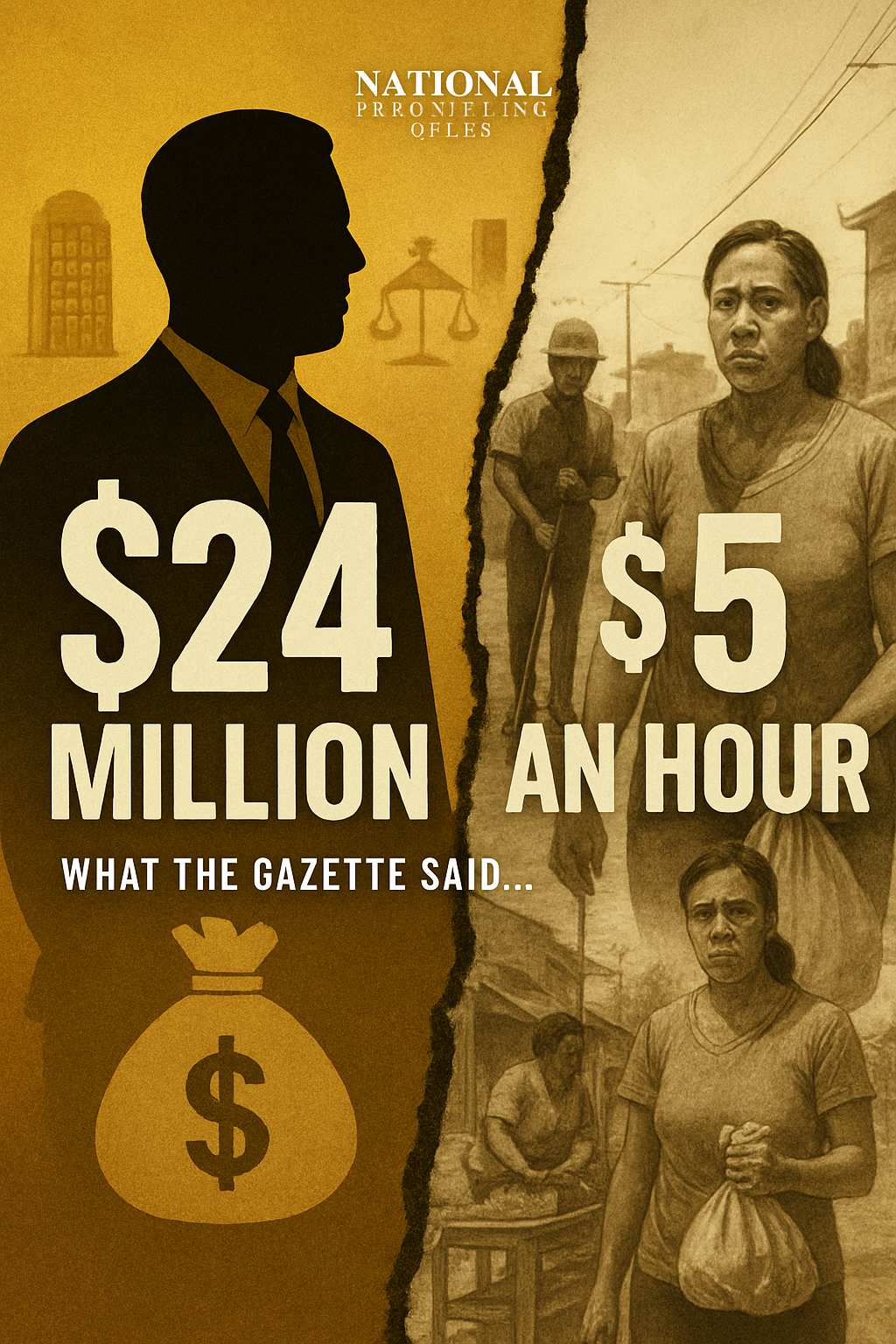
At the end of 2019, then-Senator Chris Coye declared a net worth of just under BZ$24 million, with an annual income of about BZ$1.1 million – roughly BZ$23 million of it in “investments.”
This was before the Briceño administration came into office, when Coye was still an opposition Senator and high-earning private attorney.
Five years later, ordinary Belizeans are lining up at Chinese shops counting coins, living on BZ$5.00 an hour minimum wage, wondering how to stretch one chicken over three days.
So the question writes itself:
How does one Senator walk into power already worth BZ$24 million in a country where more than a third of the population has recently been measured as poor, and why are we only seeing the paper trail now?
What the filings actually reveal
The November 15th Gazette publication of Integrity Commission certificates for 2018–2020 shows a cross-section of declared net worths:
Lee Mark Chang (President of the Senate at the time):
- 2018 net worth: about BZ$4.6M
- 2019: about BZ$5.05M
- 2020: about BZ$4.8M
Business Senator / Now BTL CEO, Mark Lizarraga:
- Around BZ$4.7M net worth in 2018 and 2019.
Senator Stephen Duncan:
- 2019 net worth: about BZ$5.2M.
Fort George Area Rep Henry Charles Usher:
- 2020 net worth: about BZ$356,000.
And then, towering over the list:
Senator Chris Coye
- 2019 net worth: just under BZ$24,000,000
- Annual income for that year: about BZ$1,100,000
- Liabilities: barely over a thousand dollars
- Investments: more than BZ$23M, according to 7News’ breakdown from the certificate.
Of all the filings published, his was by far the highest.
When 7News asked newly elected UDP leader Tracy Panton about that number, she did not mince her words: she wants to know what his net worth is today, and how that wealth was generated – whether it is truly “just from his law practice” and where those “investments” are actually sitting.
Those are not rude questions. They are precisely the questions the law was written to allow the public to ask.
What the law promises: transparency and accountability
Belize’s Prevention of Corruption in Public Life Act was passed in 1994 and later updated to strengthen the Integrity Commission system.
It was supposed to do three simple things:
- Force people in public life to declare their full financial affairs every year:
- Assets
- Income
- Liabilities
- Business interests
- Interests of spouse and dependent children.
- Allow those declarations to be examined and certified by an independent Integrity Commission.
- Provide a mechanism for the public to complain and for the Commission to investigate if something looks wrong or disproportionate.
The law is very clear:
- People in public life (including Members of the House and Senate) must make sworn declarations of their financial affairs, as of 31st December each year, and file them with the Commission.
- The declaration form itself is not just a single figure; it requires detailed listing of:
- Real Estate property,
- Business and company interests,
- Investments and bank accounts,
- Loans and liabilities,
- Government contracts and large private contracts.
- After the Commission reviews a declaration, it issues a certificate and publishes a summary in the Gazette – this is what the public saw in the November 15th issue.
So, the BZ$24M number we saw is not the whole declaration. Behind that one line, the full document at the Integrity Commission should describe:
- Where those BZ$23M in investments are parked
- What type of instruments or companies they are
- What income streams feed the BZ$1.1M annual earnings
- Any relevant contracts or deals that cross the threshold set by law.
That information exists on paper – but the public doesn’t get to see it automatically.
What the system actually delivers: secrecy, delay, zero consequences
On paper, the Integrity Commission is supposed to be the gatekeeper of Belize’s anti-corruption and asset disclosure system. The Commission itself explained in a regional presentation that its mandate is to ensure that persons in public life remain compliant with their duty to file declarations each year.
In reality:
- The Commission has gone years without being properly constituted, or has sat in hibernation, as the Amandala bluntly put it back in 2010.
- Many parliamentarians and public officials simply don’t file at all, or file late, and face no serious penalty.
- International observers have noted that no one has ever been prosecuted under the Prevention of Corruption in Public Life Act, despite it having been in force for decades.
Meanwhile, the Gazette is only now, in November 2025, publishing declarations up to 2020 – already five years out of date for a man who went on to become Minister of State in Finance, sitting as one of the official guardians of the public purse.
So, the people of Belize are being shown:
- A snapshot of his wealth before the PUP took office,
- But no year-by-year picture of whether his wealth grew, shrank, or remained stable while he sat in Cabinet and Senate, with insider access to policy, contracts and information.
This is not a technical delay. It is a political choice to keep the public in the dark for as long as possible.
Two Belize’s: $24M Senators and $5-an-hour workers
Let’s place that BZ$24 million in context.
According to the Statistical Institute of Belize and international partners:
- In 2021, about 35.7% of Belizeans were multidimensionally poor – deprived in several basic areas such as food security, education, employment, and living conditions.
- By 2023, that figure had dropped but was still around 26.4% – more than a quarter of the population, with the intensity of poverty essentially unchanged, meaning poor households are still heavily deprived.
- An IMF assessment in 2023 noted that poverty in Belize remained high, around 35.7% by the 2022 census.
On the labour side:
- The national minimum wage is BZ$5.00 per hour, only recently raised from BZ$3.30 in 2023.
- A worker at minimum wage, working 45 hours per week all year, earns around BZ$11,250 before any deductions.
- At that rate, it would take more than 2,100 years of minimum-wage work – with zero expenses – to accumulate BZ$24 million.
This is the social reality behind the number:
One man’s declared net worth: BZ$24,000,000.
A third of the country: struggling to put food on the table.
The minimum wage: BZ$5.00 an hour.
In a country with that profile, any BZ$24 million declaration by a sitting or recent public official is not a private curiosity. It is a burning public matter.
The questions the filings don’t answer
Because only the certificate was published, Belizeans still do not know:
- When exactly that wealth was built:
- Mostly before 2010?
- Mostly between 2010–2019?
- Did it spike around major transactions or privatizations?
- Where the “investments” sit:
- Belizean companies?
- Offshore accounts?
- Regional funds?
- Real estate at home or abroad?
- How it has changed since:
- Did his net worth grow after he became Minister of State in Finance in 2020–2024?
- By how much?
- From what sources?
These are not malicious questions; they go to the heart of what a Politically Exposed Person (PEP) is in global anti-corruption standards: someone whose position gives them access to decisions, contracts, and insider information that can be abused for private gain.
Tracy Panton’s own response is simply the common-sense view of most Belizeans:
If you sign up for public office, full disclosure and full accountability go with the job.
What the people can do – and what the Integrity Commission must do
The Prevention of Corruption framework – and related reforms – actually gives Belizeans tools, if they choose to use them:
Anyone can report suspected corruption or questionable enrichment to the Integrity Commission under the Act.
The Commission has the power to:
- Call in the full declaration,
- Demand explanations and supporting documents,
- Summon witnesses and request bank or company records,
- Compare declarations across multiple years.
- International review bodies have repeatedly urged Belize to actually enforce the declaration rules, including penalties for non-filing or false declarations.
So the situation is not that “our hands are tied”. The truth is harsher:
The law is there. The Commission exists. The problem is will, not tools.
Belizeans, civil society, unions, the churches, and opposition parties can:
- File formal complaints asking the Integrity Commission to:
- Review and verify Coye’s 2019 declaration.
- Examine his subsequent declarations (if any) as Senator and Minister of State.
- Issue a public statement indicating whether they are satisfied or whether there are red flags.
- Demand annual, timely publication:
- No more five-year delays.
- The country must see before-and-after net worth for everyone who enters and leaves high public office.
- Push for amendments:
- Require publication of year-to-year net-worth changes, not just a static number.
- Require categorization of major investments (local/foreign, real estate/financial, etc.) above a certain threshold.
- Set and enforce real penalties for:
- Non-filing,
- Late filing,
- Proven false declarations.
The real scandal: not the number, but the system that protects it
National Perspective Belize is not saying:
“Chris Coye stole BZ$24 million.”
We are saying something bigger – and more dangerous:
Belize has built a political and legal system where a Senator can declare BZ$24 million, the Integrity Commission can sit on the files for years, secrecy is protected by default, and the majority poor are expected to “mind their business” while the elites multiply theirs.
In that sense, the $24M Senator is not just a man.
He is a symbol of the deeper problem:
- A revolving door between elite law firms and Cabinet,
- A bipartisan culture of UDP–PUP insiders doing well under any colour of government,
- And an anti-corruption law that has never once produced a prosecution in more than twenty years.
In a country where more than a quarter of the people are still poor, and where thousands survive on BZ$5 an hour, that is not just a legal technicality. It is a moral indictment.
The BZ$24 million figure should not paralyze us. It should wake us up.
Because the real question is no longer only:
“How did one Senator get BZ$24 million?”
The real question is:
“How much longer will Belizeans allow a system where such fortunes grow safely in the shadows, while the majority live hand-to-mouth in the blazing sun?”
- Log in to post comments