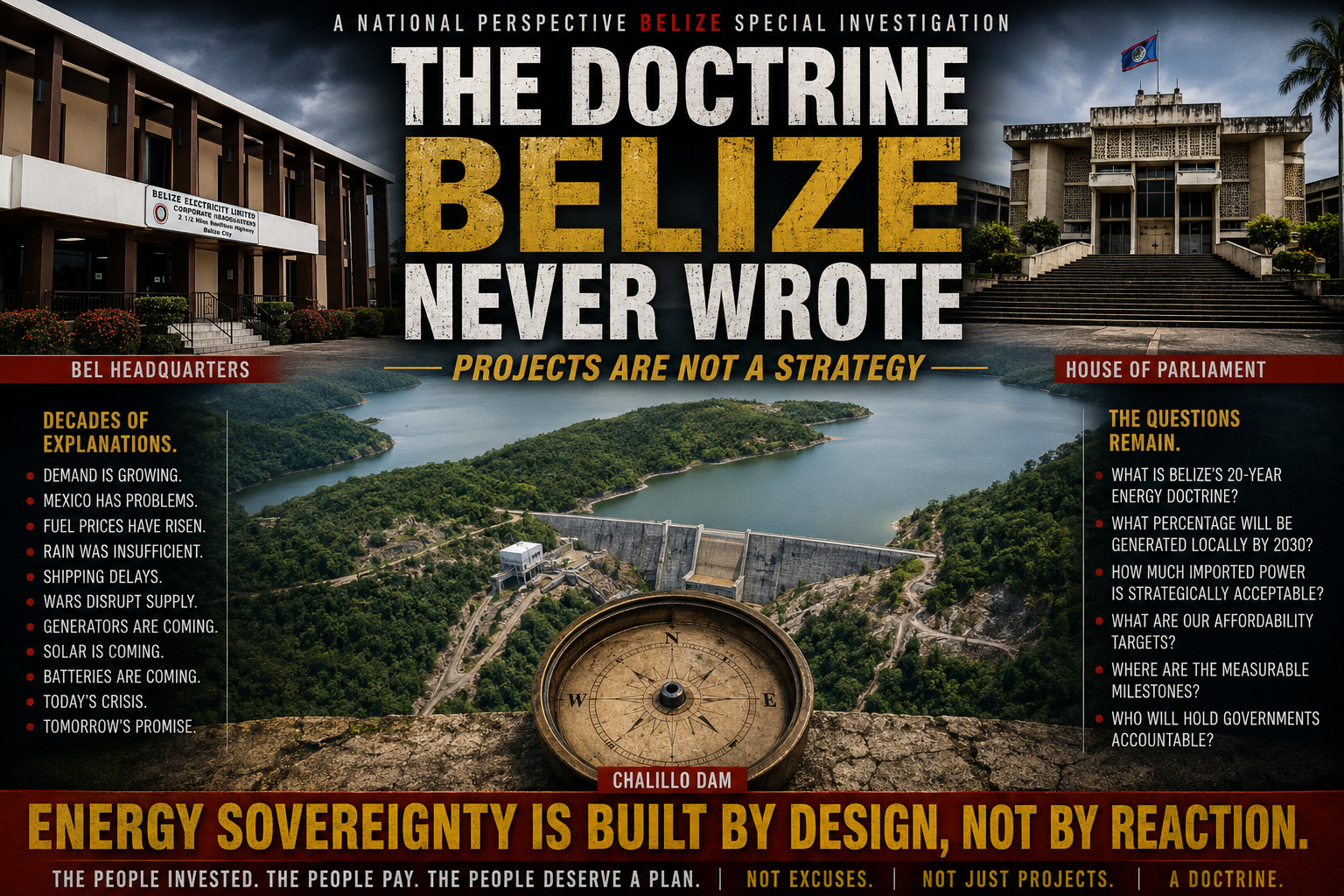
THE DOCTRINE BELIZE NEVER WROTE Why Energy Sovereignty Requires More Than Nationalization, Loans, Investments and Political Promises
By: Omar Silva – Editor/Publisher
National Perspective Belize Special Investigation
Belize City: Thursday 16th July 2026: For more than two decades, Belizeans have been hearing the same assurances.
Every electricity challenge has come with an explanation, demand has increased, and that Mexico has generation problems.
- Fuel prices have risen.
- Rainfall has been insufficient.
- Hydroelectric production has declined.
- Shipping delays have postponed equipment.
- Wars have disrupted global supply chains.
- New generators are coming.
- Solar projects are coming.
- Battery storage is coming.
Every explanation may contain an element of truth but together, they expose a much larger national problem.
- Belize does not appear to suffer from a shortage of explanations.
- Belize suffers from a shortage of doctrine.
The country has spent years responding to one energy challenge after another without presenting Belizeans with a clearly defined National Energy Doctrine that answers the most important question of all:
What is Belize's long-term path toward genuine energy sovereignty?
That is not merely a technical question.
- It is a national security question.
- It is an economic development question.
- It is a constitutional question.
And above all, it is a consumer question because every Belizean household ultimately pays the price when there is no long-term strategy.
Managing Crises Is Not the Same as Building Sovereignty
Successive governments have often presented new projects as solutions.
- Nationalize BEL.
- Expand the transmission network.
- Acquire hydroelectric assets.
- Increase public ownership.
- Import more electricity.
- Purchase standby generators.
- Develop solar farms.
Propose a Cost of Power Adjustment mechanism.
- Each initiative may have merit.
- Each may solve an immediate problem.
- But none of them, standing alone, constitutes a doctrine.
A doctrine does not simply react.
- A doctrine defines where a nation intends to be twenty years from now and establishes measurable milestones to get there.
- Without that roadmap, investments risk becoming disconnected from a clearly defined destination.
The Pattern Belizeans Should Recognize
- The explanations change.
- The dependence remains.
- The projects change.
- The vulnerability remains.
- The investments grow.
- Consumers continue paying.
The headlines change.
The questions remain unanswered.
- Belize still depends heavily on imported electricity.
- Belize still faces load shedding during periods of stress.
- Belize still debates how to finance additional investments.
- Belize still asks consumers to absorb higher costs when international conditions deteriorate.
That is not the definition of energy sovereignty.
That is the management of continuing dependence.
What Should a National Energy Doctrine Look Like?
Every sovereign nation should be able to answer the following questions.
- What percentage of Belize's electricity should be generated domestically by 2030?
- How much imported electricity is strategically acceptable?
- What balance should exist between hydro, solar, biomass, storage and other technologies?
- How much reserve generation should Belize maintain to withstand regional disruptions?
- What affordability target should guide national energy policy?
- What measurable reduction in imported electricity should Belize achieve every five years?
How will Parliament and the public measure progress?
- If these questions cannot be answered through an official national strategy, then Belize does not yet possess a doctrine.
- It possesses a collection of projects.
- Projects are important.
- But projects are not strategy.
- Strategy is not sovereignty.
- And sovereignty cannot be achieved through reaction alone.
The Consumer Has Become the Shock Absorber
Whenever international fuel prices rise, consumers pay.
- When imported electricity becomes more expensive, consumers may pay.
- When additional infrastructure is required, consumers often help finance it directly or indirectly.
- When utilities require additional capital, public resources may again be called upon.
The Belizean consumer has gradually become the financial shock absorber for a system that remains vulnerable to events occurring far beyond Belize's borders.
That is why this discussion is larger than BEL.
- It is larger than Government.
- It is larger than the Opposition.
- It is about whether Belize has defined a national destination or whether it continues navigating from one immediate challenge to the next.
Beyond Politics
This is not a criticism of one administration alone.
- It is an invitation to every administration—past, present and future.
- The People's United Party has governed.
- The United Democratic Party has governed.
Both have overseen major developments within the energy sector.
Yet Belizeans can still reasonably ask:
- Where is the officially adopted National Energy Doctrine?
- Where is the twenty-year roadmap?
- Where are the measurable milestones?
- Where is the annual report that tells Belizeans whether the country is becoming less dependent on imported electricity and more resilient against global energy shocks?
These are not partisan questions.
- They are questions of national planning.
A Call for a National Energy Covenant
- Belize deserves more than annual explanations.
- Belize deserves a National Energy Covenant.
- A covenant that commits every future government to measurable goals rather than changing priorities.
- A covenant that places consumers—not politics—at the centre of national energy policy.
- A covenant that transforms public investment into public benefit.
Because sovereignty is not measured by the number of shares Government owns.
It is measured by the nation's ability to produce affordable, reliable and resilient energy for its people.
Until Belize defines that doctrine, the country will continue debating the next crisis while postponing the larger conversation that should have begun years ago.
The question is no longer whether Belize needs another project.
The question is whether Belize is finally prepared to write the doctrine it never wrote.
- Log in to post comments