A Tobacco Control Bill Built on Sand: Belize Legislates Health While Profiting from Regional Cigarette Smuggling
By: Omar Silva I EDITOR/Publisher
National Perspective Belize – Investigative Feature
Belize City: Friday 5th December 2025
For immediate publication
Belize’s Ministry of Health is proudly celebrating the Tobacco Control Bill 2025 as a historic step for public health. The legislation—praised by Public Health Director Dr. Melissa Díaz Musa as “an excellent and strong bill”—promises to transform how Belize regulates smoking, protects the public from exposure, and aligns with global WHO-FCTC (Framework Convention on Tobacco Control) standards.
But there is one problem. A massive, glaring, and embarrassing problem.
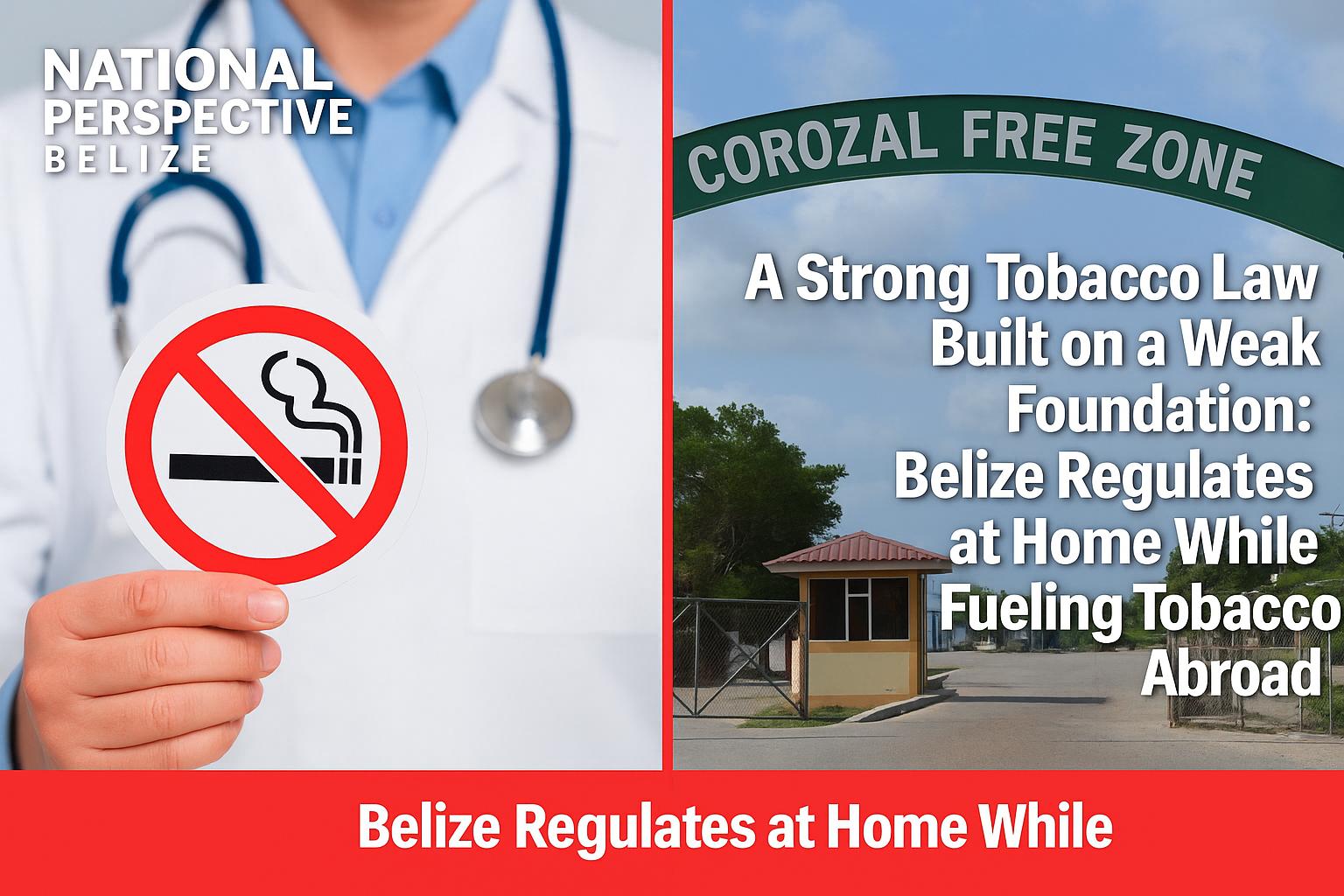
While Belize claims the moral high ground of public-health progress, the Government simultaneously presides over, enables, and profits from the largest tobacco importation and redistribution pipeline in Central America—a pipeline flowing directly through its own state-controlled Free Zones.
This contradiction is not a technicality.
It is a national hypocrisy of the highest order.
The “Strong Tobacco Bill” Meets a Weak National Moral Compass
The Tobacco Control Bill checks every public-health box:
- smoke-free public spaces
- restrictions on sales and advertising
- health warnings
- penalties for violators
- cessation programs
On paper, it reads like a modern, responsible response to Belize’s growing non-communicable disease (NCD) crisis.
But public health is not measured on paper.
It is measured by consistency, coherence, and national integrity.
And this is where Belize fails catastrophically.
Belize: Central America’s Largest Tobacco Importer — But Not a Smoker’s Paradise
Belize is not a heavy-smoking country.
Our domestic consumption is low by regional standards.
cigarettes than any Central American nation.
Why?
Because the Corozal Free Zone and the Western Border Special Economic Zone have quietly evolved into one of the region’s most efficient transshipment corridors for cheap Asian-market cigarettes, feeding:
- Mexico
- Guatemala
- Honduras
via formal crossings — and via notorious puntos ciegos, illegal trails, river routes, and corrupted checkpoints.
This is not speculation.
It is the open secret of the northern districts and a well-known reality among customs officers, police, health officials, and the political class.
And yet, the Ministry of Health now asks Belizeans to celebrate a Tobacco Control Bill while ignoring the very elephant in the room:
the Belizean state’s own complicity in the largest cross-border tobacco diversion operation in the region.
Contradiction #1: Belize Claims WHO-FCTC Compliance While Violating Its Core Spirit
The WHO-FCTC—ratified by more than 180 nations—demands that signatory states:
- reduce the availability of cheap cigarettes
- combat illicit tobacco trade
- strengthen border controls
- eliminate incentives for smuggling
- prevent state structures from being used as trafficking conduits
Belize does the opposite.
Our Free Zones serve as:
- import warehouses for ultra-cheap Asian cigarettes
- redistribution centers for cross-border trafficking
- legal loopholes for powerful operators
- political patronage ecosystems
- no-man’s-lands where enforcement conveniently “does not reach”
This creates a grotesque contradiction:
How can Belize claim adherence to the WHO-FCTC while the state itself licenses, approves, and profits from mass importation of cigarettes for illicit re-export?
The answer is simple:
We cannot.
Contradiction #2: Public-Health Rhetoric vs. Political-Economic Reality
Dr. Díaz Musa compares tobacco control to wearing a seat belt or holding a driver’s license—“regulating legal substances” for the public good.
- A fine metaphor.
- A fine ideal.
But Belizean reality writes a much darker script.
The same government that is lecturing Belizeans on health is enabling Free Zone operators to move hundreds of millions of sticks of cheap cigarettes across borders.
It is regulating the smoke in a bar while ignoring the tobacco pipeline running through its own backyard.
It is criminalizing public smoking while institutionalizing regional smuggling.
This is not public health.
This is political theatre — backed by Free Zone money and border corruption.
Contradiction #3: The Ministry of Health Legislates While Customs, Finance, and Investment Undermine It
What the Tobacco Control Bill does regulate:
✔ secondhand smoke
✔ packaging
✔ marketing
✔ sales to minors
What the Bill deliberately avoids:
❌ Free Zone tobacco importation
❌ transshipment controls
❌ contraband routes
❌ Customs oversight
❌ Trade licensing loopholes
❌ political actors benefitting from the tobacco economy
In other words:
Belize is legislating the symptoms while feeding the disease.
So Why Does This Hypocrisy Persist?
Because the tobacco trade in the Free Zones is lucrative:
- lucrative for investors,
- lucrative for brokers,
- lucrative for political influence,
- lucrative for “unofficial” revenue streams.
And now, as Belize prepares to adopt a progressive Tobacco Control Bill, the Government hopes the public will applaud the performance while ignoring the machinery behind the curtain.
But Belizeans deserve honesty.
Belizeans deserve consistency.
Belizeans deserve a government that does not speak in two tongues.
Public Health Cannot Coexist with State-Sanctioned Smuggling
The core purpose of WHO-FCTC is simple:
to reduce the availability, affordability, and attractiveness of tobacco.
Belize’s Free Zone operations do the exact opposite:
- They flood the region with the cheapest cigarettes available on the global market.
- They undermine the anti-smoking efforts of neighboring countries.
- They create incentives for smuggling and tax evasion.
- They empower organized criminal networks.
- They tarnish Belize’s international legitimacy.
A Tobacco Control Bill cannot succeed when the Government’s economic policy actively contradicts its public-health obligations.
You cannot claim to fight fire while selling gasoline next door.
The National Perspective Belize Position
We at National Perspective Belize support strong public-health legislation.
But we oppose hypocrisy, double standards, and any government policy that uses one hand to preach morality while the other profits from vice.
Belize cannot present itself as a responsible, health-conscious nation while its Free Zones operate as regional tobacco trafficking corridors under official approval and protection.
The Tobacco Control Bill may be progressive — even admirable — but as long as our Free Zones are allowed to function as a cigarette re-export pipeline, Belize cannot claim compliance with WHO-FCTC nor any moral credibility in the fight against tobacco-related harm.
If Belize Wants to Be Taken Seriously, It Must Choose One Path:
Public Health or Tobacco Profiteering.
It cannot have both.
- Log in to post comments