CHINA SANCTIONS BELIZE: 37 YEARS WITH TAIWAN — BUT WHAT HAS BELIZE GAINED?
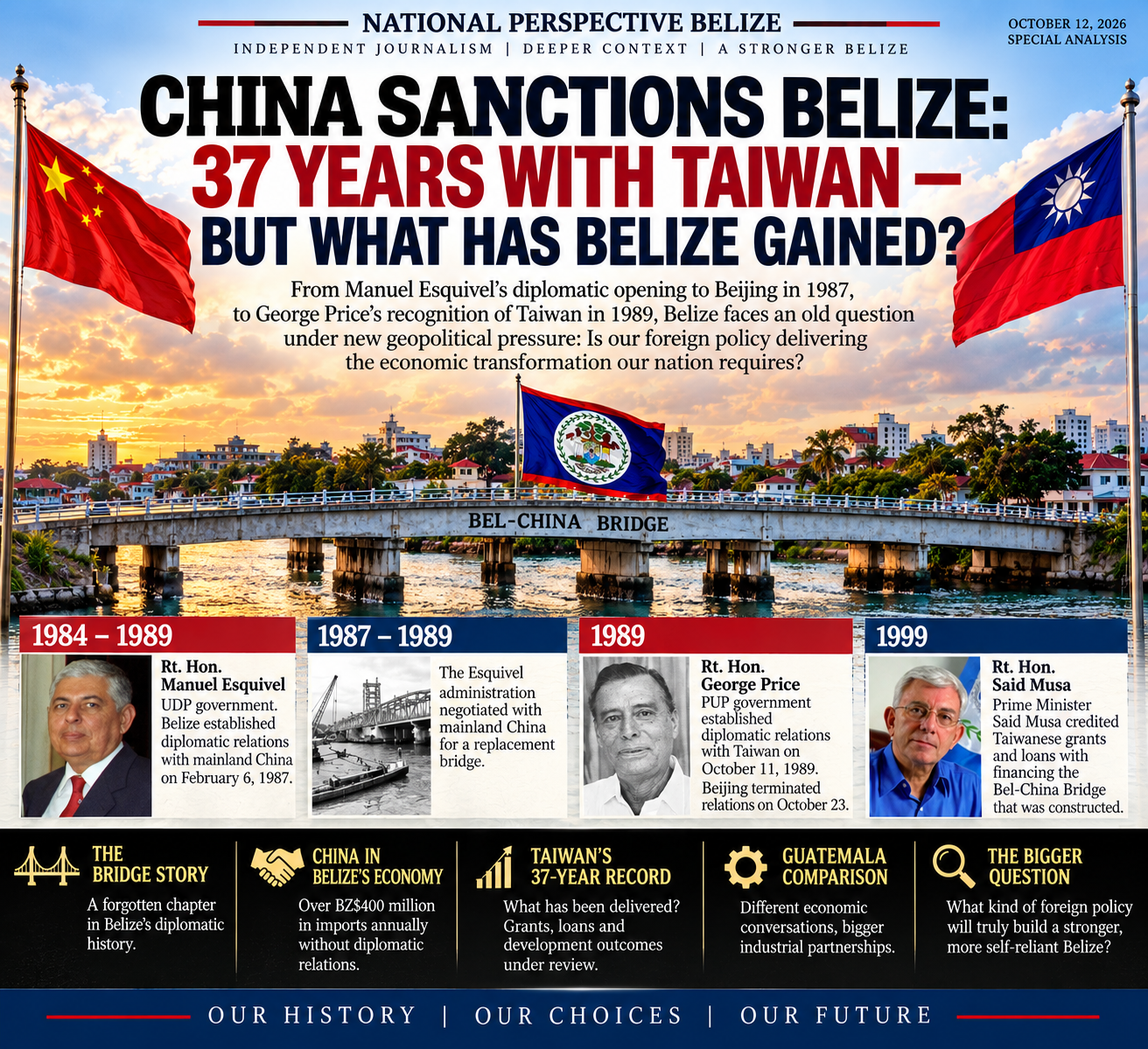
From Manuel Esquivel's diplomatic opening to Beijing in 1987, to George Price's recognition of Taiwan in 1989, Belize faces an old question under new geopolitical pressure: Is our foreign policy delivering the economic transformation our nation requires?
SPECIAL ANALYSIS
Belize City: Monday 12th October 2026: China's decision to impose sanctions against Belize's Minister of Foreign Affairs, Francis Fonseca, has thrust our small Central American nation into an international diplomatic confrontation involving Beijing, Taipei and the future of Taiwan's remaining diplomatic allies.
The announcement, made on October 12, 2026, also targets Paraguay's Communications Minister, Gustavo Villate.
Beijing has imposed restrictions involving entry into China, including Hong Kong and Macau, asset holdings and transactions with Chinese entities.
- These measures are directed at the two officials. They are not a general trade embargo against Belize or Paraguay.
- But while the mainstream headlines concentrate on the sanctions, National Perspective Belize believes the moment demands a more comprehensive examination.
Belize has been here before.
- And to understand the significance of today's confrontation, Belizeans must revisit a chapter of their diplomatic history that has received insufficient public attention.
BEFORE TAIWAN, THERE WAS MAINLAND CHINA
Between 1984 and 1989, Belize was governed by the United Democratic Party administration of the late Prime Minister Rt. Hon. Sir Manuel Esquivel.
- On February 6, 1987, his government established formal diplomatic relations with the People's Republic of China.
That relationship lasted less than three years.
- Following the return of the People's United Party government under the late George Price in 1989, Belize established diplomatic relations with the Republic of China (Taiwan) on October 11 of that year.
On October 23, Beijing terminated diplomatic relations with Belize.
- These were consequential decisions taken by successive Belizean administrations at a time when the country was still establishing its international identity following independence in 1981.
Yet there is a revealing historical footnote.
When Manuel Esquivel returned to office in 1993, his administration did not reverse Belize's diplomatic recognition of Taiwan.
- The relationship therefore became an established feature of Belizean foreign policy across both major political parties.
- Today, 37 years later, Belize remains among the small number of countries maintaining formal diplomatic relations with Taipei.
But diplomatic continuity, however significant, should never be confused with a complete national development strategy.
THE BEL-CHINA BRIDGE: A FORGOTTEN CHAPTER
The history of the Bel-China Bridge in Belize City provides an especially interesting illustration of the country's early diplomatic dealings.
- A historical account published by Amandala in 2019 reported that the Esquivel administration had negotiated with mainland China for a replacement bridge and that a bridge had already arrived before the change of government in 1989.
According to that account, the original bridge was subsequently sent to Jamaica.
- The story requires further documentary investigation, particularly concerning the original agreement, ownership and final disposition of the structure.
What is independently documented is that Prime Minister Said Musa, speaking during a Taiwanese delegation's visit in January 1999, credited a combination of Taiwanese grants and loans with financing the Bel-China Bridge ultimately constructed in Belize City.
These are two distinct historical claims and should not be confused.
- Nevertheless, they illustrate something important.
- Both Beijing and Taipei have figured in Belize's infrastructure-development history.
The bridge is therefore more than a crossing over the Belize River.
- It is a reminder that diplomatic decisions can carry practical economic consequences, including the financing, continuation, cancellation or replacement of national development projects.
The question for Belize is whether we have consistently negotiated those relationships with sufficient regard for our long-term national interests.
CHINA IS ALREADY PART OF BELIZE'S ECONOMY
- There is another reality that cannot be ignored.
Although Belize has no formal diplomatic relations with Beijing, mainland China remains an important source of manufactured goods purchased by Belizean businesses and consumers.
Chinese products are present in Belizean stores, construction projects, households and commercial operations.
- According to China's Ministry of Foreign Affairs, citing Chinese customs statistics, bilateral merchandise trade with Belize amounted to approximately US$206 million in 2025, predominantly Chinese exports.
- That represents approximately BZ$412 million at Belize's conventional two-to-one exchange rate.
- This is China's reported bilateral trade figure, not a Belize-specific import total calculated using Belizean customs statistics. The two sources may differ because of valuation, shipment route and reporting methodologies.
But the underlying economic relationship is undeniable.
- Belize recognizes Taiwan diplomatically while maintaining substantial commercial dealings involving mainland China.
This raises a serious question.
- If China is already an important supplier to Belize without diplomatic relations, what would formal recognition actually change in investment, financing, market access and industrial development?
- Would Belize gain access to infrastructure financing?
- Could it attract manufacturing investment?
- Would it obtain meaningful technology transfer?
- Or would it simply exchange one set of diplomatic dependencies for another?
These questions cannot be answered by political slogans.
- They require detailed economic assessment, including the potential costs of changing recognition and the conditions attached to any proposed financing.
GUATEMALA: SAME ALLY, DIFFERENT ECONOMIC CONVERSATION
Only days before Beijing's sanctions, Taiwan's Foreign Minister Lin Chia-lung led a business delegation to Belize and Guatemala.
The visit provided a revealing comparison.
- In Belize, publicly highlighted cooperation included the construction of the San Pedro General Hospital, a social housing project and the proposed Taiwan-Caribbean Prosperity Academy.
These are worthwhile initiatives with potential social and educational benefits.
In Guatemala, however, official announcements highlighted additional areas of strategic economic cooperation.
- The Guatemalan government reported discussions concerning semiconductors, infrastructure, electric mobility, cybersecurity and investment.
- It also hosted a joint economic meeting involving a delegation of 32 Taiwanese business representatives, during which three economic cooperation instruments were signed.
This does not mean that every proposed investment will materialise.
- Nor does it prove that Guatemala receives ten times more financial assistance than Belize, a comparison that would require verified figures covering the same period and categories.
But the difference in the publicly announced agendas is significant enough to warrant examination.
- Why is Guatemala publicly discussing semiconductors, industrial investment and advanced technology while Belize's most visible cooperation projects continue to emphasise social infrastructure and institutional assistance?
There may be additional Belizean projects not captured in the public announcements.
- If so, the government should disclose them.
The more fundamental issue is whether Belize has placed industrial development, export production and technology acquisition at the center of its diplomatic negotiations.
37 YEARS OF FRIENDSHIP: WHERE IS THE DEVELOPMENT ACCOUNTING?
Taiwan has contributed to Belize through infrastructure, healthcare, education, agriculture, training and technical cooperation.
- Those contributions should be recognized fairly.
- But recognition is not a substitute for evaluation.
After nearly four decades, Belizeans should be able to examine a comprehensive public accounting of the relationship.
- How much assistance has Taiwan committed?
- How much has actually been disbursed?
- What proportion represents grants rather than repayable loans?
- Which projects have created sustainable employment?
- How much investment has expanded Belize's productive capacity?
- And how many initiatives have increased the country's ability to manufacture goods, process agricultural products and export higher-value commodities?
These are not questions designed to diminish Taiwan's contributions.
- They are questions that should apply equally to every international development partner.
- Belize needs hospitals and schools.
- It also needs factories, industrial technology, competitive energy, skilled employment and domestic enterprises capable of participating in international markets.
Social development and economic transformation are complementary objectives.
- But one cannot permanently substitute for the other.
BEIJING'S SANCTIONS: PRESSURE OR DIPLOMATIC WARNING?
China maintains that Taiwan is part of its territory and that official recognition of Taipei violates its position on national sovereignty.
- Taiwan rejects Beijing's claim of authority over its government and maintains its right to international relationships.
- Belize, as a sovereign state, has chosen to recognise Taiwan.
- Beijing's sanctions against Francis Fonseca therefore represent a direct expression of China's opposition to that diplomatic relationship.
But their immediate economic significance should not be exaggerated.
- There is presently no basis to conclude that Belizean imports from China have been prohibited or that ordinary commercial transactions have been generally suspended.
The measures are targeted at named officials.
- Nevertheless, they raise a legitimate concern about whether future diplomatic escalation could affect Belizean commercial interests.
The Briceño administration should clarify whether any assessment has been undertaken of that possibility.
- Belize's response must preserve its sovereign right to make independent diplomatic decisions.
Foreign policy should not be dictated by sanctions. Neither should it be insulated from economic scrutiny.
BELIZE MUST NEGOTIATE FROM A NATIONAL DEVELOPMENT STRATEGY
The central issue is larger than the rivalry between Beijing and Taipei.
- Belize has repeatedly sought international assistance while struggling to build sufficient domestic industrial capacity.
- We export agricultural commodities and import large volumes of manufactured products.
- We possess productive land, an entrepreneurial population and access to Central American and Caribbean markets.
Yet too much of our economic activity remains concentrated in commerce, services and the sale of relatively unprocessed goods.
- A modern foreign policy should be connected to a clearly defined national development programme.
That programme should identify the industries Belize intends to establish, the technology it needs, the financing it can responsibly absorb and the partnerships capable of supporting those objectives.
- Taiwan's technological capabilities offer potential opportunities.
- China's manufacturing scale and commercial networks present different opportunities.
But neither relationship automatically guarantees Belize's development.
- The decisive factor is whether Belize possesses the institutional capacity, negotiating discipline and strategic vision to secure agreements that benefit its people.
THE QUESTIONS THAT MUST NOW BE ANSWERED
China's sanctions have created an opportunity for Belize to engage in a serious national discussion.
- The government should explain the immediate implications for Foreign Minister Francis Fonseca and whether any wider commercial consequences are anticipated.
- It should also publish a transparent assessment of the economic and developmental results of Belize's 37-year relationship with Taiwan.
- And it should clarify whether successive administrations have examined the potential costs and benefits of alternative diplomatic arrangements.
Such an assessment should not begin with a predetermined conclusion.
- It should account for existing commitments, political risks, economic opportunities, financing conditions and Belize's broader international relationships.
Most importantly, it should be conducted in the national interest rather than as a partisan contest.
THE BRIDGE BETWEEN OUR PAST AND OUR FUTURE
There is a certain historical irony in today's confrontation.
- Belize once maintained formal diplomatic relations with mainland China.
- It subsequently established relations with Taiwan.
- It has maintained that relationship through successive governments for 37 years.
- And today, the same unresolved international rivalry has reached directly into Belize's diplomatic establishment.
The Bel-China Bridge offers a fitting symbol of this history.
- But the more important bridge is the one Belize has yet to construct: the connection between its foreign policy and a sustained programme of national economic transformation.
- Belize should not abandon Taiwan because Beijing applies pressure.
- Neither should Belize refuse to examine alternative economic possibilities simply because the existing relationship has endured for decades.
Sovereignty means retaining the right to decide.
- Economic sovereignty requires something more: the ability to make those decisions from a position of knowledge, preparation and national purpose.
After 37 years, the question is not merely who Belize recognises.
It is what Belize has built, what Belize has negotiated, and what Belize intends to become.
That is the discussion National Perspective Belize believes the country must now confront.
NATIONAL PERSPECTIVE BELIZE
Independent Journalism | Historical Perspective | Economic Sovereignty | Public Accountability
By Omar Silva – Editorial Director @ www.nationalperspectivebz.com
National Perspective Belize
- Log in to post comments