TEARING DOWN “THE MCC LEGISLATIVE CRISIS” TO THE LAST NUT AND BOLT, THE $125 MILLION DEADLINE
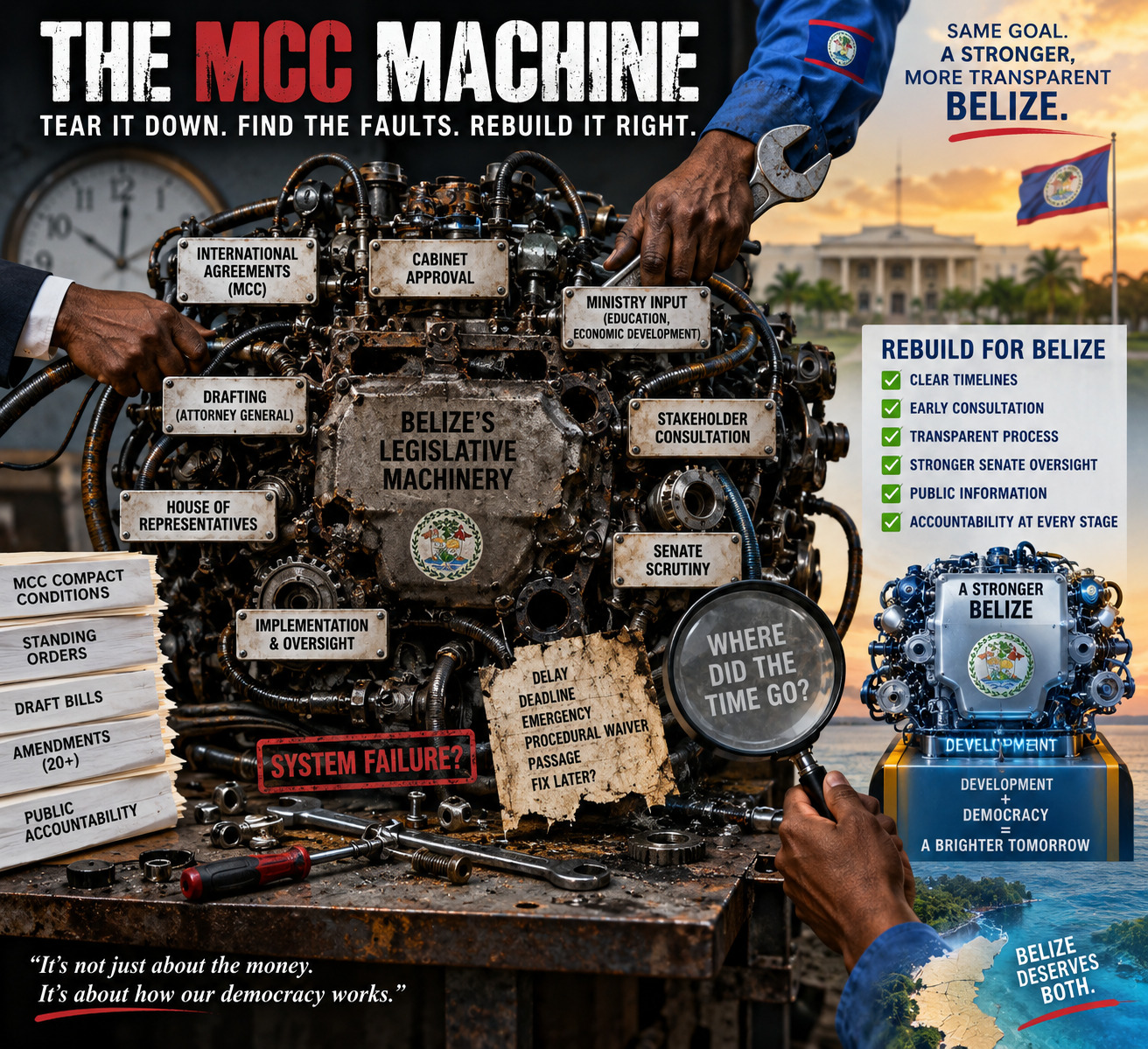
Belize did not suddenly discover the MCC conditions in September 2026. So how did two years of preparation become ten days of parliamentary urgency?
Belize City: Wednesday 9th September 2026: There is a very dangerous temptation in the public discussion surrounding Belize's US$125 million Millennium Challenge Corporation Compact.
It is to reduce everything to one question:
Do we want the US$125 million—or don't we?
That is the wrong question.
- Belize should want the investment.
- Belize needs serious investment in education, technical training, electricity generation and modernization of its national grid.
But accepting development financing does not require Parliament to surrender its responsibility to examine the laws through which that development programme will be implemented.
- And what happened in the Senate on September 8, 2026 exposed something considerably deeper than a disagreement between Government and Opposition.
- It exposed a weakness in the machinery of the Belizean State itself.
- Because the real scandal is not that September 18 arrived.
The real question is:
HOW DID BELIZE ALLOW SEPTEMBER 18 TO BECOME AN EMERGENCY?
THE FIRST NUT: THESE CONDITIONS WERE NOT A SURPRISE
- The MCC Compact was signed on September 4, 2024.
- Its legal architecture was not hidden.
Annex VII of the Compact specifically states that before the agreement enters into force, Belize must enact legislation covering major education and TVET reforms.
Among them are requirements for national student assessments; publication of school-level assessment results; strengthened teacher licensing; mechanisms for secondary teachers to become certified in subjects outside their original degree areas; raising compulsory schooling requirements; expanded access to free secondary education; and a completely restructured framework for technical and vocational education and training.
The TVET conditions are particularly substantial.
Belize undertook to create an autonomous National Training Agency, sectoral skills councils, sustainable financing arrangements, standards governing TVET teachers and staff, and new rules concerning governance, quality, inclusion and apprenticeship-based training.
These are not little housekeeping amendments.
They represent structural changes to the way Belize educates, certifies and trains part of its population.
And Government knew this.
- MCC publicly stated as far back as January 2025 that legislative reforms to Belize's Education Act and TVET framework would be necessary for the project.
- Belize's own Ministry of Economic Development later identified enactment of the National TVET Act as a planned priority.
Therefore the first bolt that must be unscrewed is the notion that Parliament was suddenly confronted with unforeseen American requirements.
It wasn't.
- The requirements had been written into the agreement for approximately two years.
THE SECOND NUT: GOVERNMENT ITSELF EXPECTED AN EARLIER ENTRY INTO FORCE
This may be one of the most revealing pieces of the entire chronology.
In the Government's 2026 Budget Speech, delivered months ago, the administration stated that entry into force of the MCC Education Project was expected in July 2026.
Stop there.
July.
Yet the Senate found itself holding a Special Sitting on September 8 because September 18 had supposedly become the cliff edge.
That creates an unavoidable accountability question.
What happened between the expected July entry into force and the September emergency?
- Was drafting delayed?
- Were consultations incomplete?
- Did Washington request late modifications?
- Did Government fail to resolve objections from stakeholders?
- Were amendments discovered only after the Bills reached Parliament?
- Were ministries unable to reconcile competing positions?
- Was Cabinet late approving the legislation?
- Was parliamentary scheduling mishandled?
- Or did uncertainty created by the change of administration in Washington freeze parts of the process longer than Government has publicly explained?
Some combination may be perfectly legitimate.
- But Belize deserves the chronology.
- Because deadlines do not explain themselves.
THE THIRD NUT: THE SENATE WAS BEING ASKED TO LEGISLATE WITH KNOWN DEFECTS
This is where yesterday's debate crossed from political controversy into a serious institutional problem.
Leader of Government Business Senator Eamon Courtenay acknowledged the uncomfortable position confronting the Senate: legislation was being passed even though senators were not satisfied with it, because the September 18 deadline had to be met.
- He further referred to more than twenty proposed amendments already identified for subsequent action.
- That is an extraordinary situation.
It means Parliament was effectively being told:
- We know the legislation requires correction.
- We know amendments are already contemplated.
- But pass it first because time has run out.
Then repair it later.
- That doctrine should trouble every Belizean regardless of party affiliation.
Because Parliament is not supposed to be the place where defective legislation is knowingly certified merely because an administrative timetable has become inconvenient.
- Parliament exists precisely so legislation can be examined before it acquires the force of law.
THE FOURTH NUT: THE FIVE-DAY RULE EXISTS FOR A REASON
- Senator Patrick Faber raised the Senate Standing Orders.
- He was correct that Standing Order 49 provides that ordinarily at least five days must elapse between the first and second reading of a Bill, unless the Senate specifically agrees to proceed earlier or immediately.
- There is therefore nothing necessarily unlawful about proceeding faster.
- The Senate possesses the power to waive the interval.
But that isn't the real issue.
- The issue is what a procedural exception becomes when it evolves into routine practice.
A rule designed to provide senators time for scrutiny becomes meaningless if governments repeatedly rely upon the exception whenever their legislative timetable demands speed.
The distinction is fundamental:
- The Senate may legally waive scrutiny time.
- That does not mean doing so is institutionally healthy.
Legality is the floor.
- Good governance should be considerably higher.
THE FIFTH NUT: “WE NEED THE MONEY” CANNOT BECOME A PARLIAMENTARY DOCTRINE
Nobody serious should pretend US$125 million is so insignificant.
MCC describes the Compact as a major investment addressing two binding constraints on Belize's economic growth: poor education outcomes and high electricity costs.
- Those are real national weaknesses.
- Indeed, the fact that Belize badly needs the investment reinforces the importance of securing the Compact.
But here lies the constitutional danger.
If the proposition becomes:
“The money is too important for Parliament to delay the legislation,”
- then Parliament becomes weakest precisely when the financial stakes are highest.
That logic is backwards.
The larger the agreement, the more consequential the obligations and the greater the public resources involved, the stronger parliamentary scrutiny ought to become.
Otherwise tomorrow's argument could be:
- There is a World Bank deadline.
- There is an IDB deadline.
- There is a climate-finance deadline.
- There is an infrastructure financing deadline.
- There is a sovereign borrowing deadline.
- There is a foreign-government deadline.
- There is an investor deadline.
And before long Parliament ceases to control the legislative calendar.
8.The calendar controls Parliament.
THE SIXTH NUT: THIS IS NOT REALLY AN MCC FAILURE
This distinction must be made with absolute clarity.
- It would be easy—and intellectually lazy—to portray the United States or MCC as the villain.
- The evidence does not support that conclusion.
- Belize voluntarily negotiated the Compact.
- The conditions were documented.
- The Government participated extensively in designing the programme.
Belize and MCC had been developing the initiative since well before signature. MCC records show that Belize was selected to develop a Compact in December 2021, that the two binding constraints were identified in 2022, and that a US$10 million Compact Development Funding agreement was signed in March 2023 to undertake project preparation.
This was therefore not a project dropped upon Belize in September 2026.
It had been developing for years.
- Which means the central accountability question belongs primarily in Belmopan:
WHAT HAPPENED INSIDE OUR OWN GOVERNMENTAL PIPELINE?
THE SEVENTH NUT: FIND THE BOTTLENECK
That is where Parliament and the press should now go.
Someone should produce a complete MCC legislative timeline showing:
- When drafting instructions were issued.
- When the Attorney General's Ministry received them.
- When the first drafts were completed.
- When MCC reviewed them.
- When the Ministry of Education reviewed them.
- When teachers, unions, managing authorities and other stakeholders were consulted.
- What objections were raised.
- When Cabinet approved the Bills.
- When the final amendments became necessary.
- Why more than twenty amendments were already contemplated when the Senate was being asked to enact the legislation.
- What exactly changed because of Washington's policy uncertainty.
And critically:
12. Which delays were caused externally—and which occurred inside Belize?
Without that chronology, “we had a deadline” is an explanation of the final ten days.
13. It is not an explanation of the preceding two years.
THE EIGHTH NUT: WHO OWNS A BILL?
Here we reach a structural weakness that Belize rarely discusses.
Major legislation passes through a chain:
POLICY IDEA ↓
MINISTRY ↓
TECHNOCRATS ↓
LEGAL DRAFTING ↓
STAKEHOLDER CONSULTATION ↓
CABINET ↓
HOUSE OF REPRESENTATIVES ↓
SENATE ↓
ASSENT ↓
IMPLEMENTATION
When legislation reaches the Senate containing deficiencies already recognized by Government, something earlier in that chain has malfunctioned.
The answer cannot simply be: “The Senate will repair it later.”
- That transfers responsibility downstream.
- Good public administration demands the opposite.
- The defects should be identified as early as possible.
- Policy contradictions should be resolved before drafting.
- Drafting problems should be solved before Cabinet.
- Stakeholder objections should be processed before introduction.
- Cabinet should know exactly what it is approving.
Parliament should then scrutinize a finished government proposal—not participate in emergency debugging.
THE NINTH NUT: THE SENATE'S ROLE HAS BEEN EXPOSED
There is an even larger constitutional lesson.
Belize continually describes its Senate as a chamber of review.
Yesterday demonstrated what happens when that review function encounters executive urgency.
The Senate Standing Orders contemplate time between stages precisely because senators require time to read legislation, obtain advice, hear stakeholders and understand consequences.
But if senators are repeatedly presented with completed political decisions and told:
- There is no time.
- The deadline is approaching.
- The agreement has already been made.
- The money could disappear.
then the Senate's practical function changes.
- It stops being meaningful scrutiny.
- It becomes legislative ratification under pressure.
- And that goes directly to Belize's unresolved constitutional debate about what kind of Senate the country needs.
THE TENTH NUT: DENNISON'S REFUSAL MATTERS MORE THAN PARTY POLITICS
Union Senator Glenfield Dennison put his finger on the principle.
- His position was not that Belize should reject US$125 million.
- He explicitly recognized the value of the money.
- His objection was essentially that financial necessity should not compel senators to approve legislation they already know needs correction.
That distinction is critical.
The debate therefore cannot conveniently be reduced to: Government supports development; critics oppose it.
That is false.
The real division was: Should Belize secure the Compact?
Almost everyone appears to agree.
The disagreement was: Must Parliament compromise scrutiny to secure it?
Those are completely different questions.
THE ELEVENTH NUT: NOW LOOK AT THE ENERGY CONTRADICTION
Then Business Senator Kevin Herrera stood on the adjournment and opened another door.
He argued that Belize's electricity system had been allowed to deteriorate through successive failures of planning and investment and called upon the Senate to investigate.
MCC's own diagnosis had already identified high electricity costs as a binding constraint on Belizean economic growth.
That connection is devastating.
Because the same Senate sitting essentially produced two messages:
- Belize urgently needs foreign development financing to help repair its energy system.
And:
2.Belize has failed for years to properly develop its own energy system.
That tells us something much larger about our development model.
- Belize repeatedly postpones structural investment until a crisis emerges.
- Then when crisis arrives, urgency replaces planning.
THE TWELFTH NUT: SAN PEDRO REQUIRES DATA, NOT RHETORIC
Dennison also raised an uncomfortable question about the concentration of energy investment around San Pedro.
- That question should not be dismissed.
- But neither should speculation substitute for evidence.
MCC says the Energy Project is intended to reduce electricity costs and modernize the national grid, with benefits ultimately extending across connected households and businesses.
Therefore the proper investigation is not: “Is America building infrastructure for Americans living in San Pedro?”
There is presently insufficient evidence for that conclusion.
The proper questions are much stronger:
- Why was this infrastructure configuration selected?
- What engineering study ranked it against competing national needs?
- What is the projected national benefit?
- Who owns the land and assets benefiting directly from the infrastructure?
- What increase in generation and transmission capacity will occur?
- How will mainland consumers benefit?
- What savings are projected?
- Who bears maintenance costs?
- What happens to tariffs?
- Who procures the infrastructure?
- Who supplies it?
- Who ultimately owns it?
Those questions can produce facts.
And facts are far more dangerous to bad governance than speculation.
THE THIRTEENTH NUT: FOLLOW THE MONEY—ALL OF IT
Senator Faber also asked for an accounting of Compact expenditures to date.
- That should absolutely be provided.
- The public discussion should distinguish among several pots of money.
- There was Compact Development Funding before entry into force.
- There is the US$125 million MCC Compact itself.
- There is Belize's own required contribution.
- There are administrative and implementation costs.
- There will be procurement contracts.
- There will be consultants.
- There will be equipment.
- There will be infrastructure.
- There will be institutional operating costs.
For a programme built around MCC's stated principles of good governance and accountability, there should be no difficulty publishing a clear ledger explaining:
- Amount committed.
- Amount disbursed.
- Amount spent.
- Recipient.
- Purpose.
- Procurement mechanism.
- Contract value.
- Remaining balance.
- Implementation milestone.
- That should not be treated as opposition information.
- It is public information.
NOW WE HAVE REACHED THE ENGINE
After stripping away all the personalities, parliamentary sparring and political theatre, the underlying machine becomes visible.
- The real problem is not MCC.
- The real problem is a governmental culture that too often operates like this:
- DELAY → DEADLINE → EMERGENCY → PROCEDURAL WAIVER → PASSAGE → PROMISE TO FIX LATER.
That cycle appears again and again across public administration.
- And every time it happens the emergency becomes the justification for bypassing the mechanisms designed to prevent mistakes.
- Eventually governance itself becomes crisis management.
SO LET US RECONSTRUCT IT
- Criticism without architecture achieves very little.
- If this episode teaches Belize anything, it should produce reform.
1. NATIONAL LEGISLATIVE CALENDAR
Every major government Bill linked to an international agreement, loan, grant or treaty should appear on a publicly accessible legislative implementation calendar.
The public should know:
- Agreement signed.
- Conditions outstanding.
- Drafting deadline.
- Consultation period.
- Cabinet deadline.
- House introduction.
- Senate consideration.
- External deadline.
No more manufactured surprise.
2. MANDATORY PRE-LEGISLATIVE DISCLOSURE
Major structural Bills should be published before introduction together with explanatory memoranda identifying:
- the problem;
- the proposed solution;
- financial implications;
- institutional implications;
- stakeholders consulted;
- international obligations being implemented;
- and outstanding areas of disagreement.
3. PROTECT THE SENATE SCRUTINY PERIOD
Standing Order 49 already establishes the ordinary five-day interval.
Its waiver should become exceptional rather than habitual.
Whenever Government asks for immediate passage, the responsible minister should table a written explanation setting out:
- why urgency exists;
- when Government first knew the deadline;
- why normal scrutiny became impossible;
- and what consequences arise from waiting.
That would transform urgency from a political assertion into an accountable parliamentary decision.
4. CREATE A LEGISLATIVE SCRUTINY UNIT
Senators should have independent technical capacity.
- Economists.
- Legislative lawyers.
- Accountants.
- Policy analysts.
- Energy specialists.
- Education specialists.
- Constitutional advisers.
A senator receiving a complex 80-page Bill should not have to rely entirely upon Government's interpretation of Government's own legislation.
A serious Senate needs its own brain.
5. PUBLIC BILL TRACKING
Belizeans should be able to open one webpage and see every Bill moving through Parliament.
- Original text.
- Committee amendments.
- Government amendments.
- Senate amendments.
- Stakeholder submissions.
- Voting record.
- Final Act.
- No hunting.
- No mystery.
6. INTERNATIONAL AGREEMENT OVERSIGHT
Whenever Belize undertakes international obligations requiring domestic legislation, Parliament should receive a formal implementation statement immediately after signature.
- That statement should list every law requiring amendment and every deadline attached to the agreement.
- That alone could have prevented much of what occurred here.
7. POST-LEGISLATIVE REVIEW
If Government genuinely must pass emergency legislation and repair it later, then the repair obligation should not depend upon political goodwill.
Write the review into the legislation.
- Require Parliament to revisit the statute within a defined period.
- Require a public report.
- Require stakeholder consultation.
- Require publication of proposed amendments.
- Make the promise enforceable through procedure.
AND FINALLY: RECONSTRUCT THE SENATE ITSELF
This episode belongs to a much bigger national conversation.
A Senate cannot provide meaningful sober second thought if Government normally controls the timetable, possesses most of the technical information, arrives with predetermined legislation and can invoke urgency when scrutiny becomes inconvenient.
Yesterday showed Belizeans, in real time, why institutional design matters.
The question is therefore no longer merely:
Did the Senate pass the MCC legislation?
It did.
The more important question is:
DID THE SYSTEM ALLOW THE SENATE TO DO THE JOB BELIZE EXPECTS A SENATE TO DO?
- That question reaches far beyond US$125 million.
- It reaches directly into the architecture of Belizean democracy.
THE VERDICT
The MCC Compact may ultimately produce enormous benefits.
- Its education objectives address genuine weaknesses.
- Its TVET reforms address a longstanding skills deficit.
- Its energy investments could help modernize a sector now demonstrating serious vulnerability.
- Belize should make the Compact succeed.
- But precisely because this programme is important, we should refuse the false choice between development and democracy.
We should demand both.
- Belize had been developing this Compact since 2021.
- The binding constraints were identified in 2022.
- Development funding followed in 2023.
- The Compact was signed in September 2024.
- The legislative conditions were explicitly written into the agreement.
- Government itself expected the Education Project to enter into force by July 2026.
- Yet on September 8, 2026, senators were sitting under the pressure of a September 18 deadline, considering legislation Government itself acknowledged would require further amendments.
Therefore the question Belize should refuse to let disappear is very simple: Who is the leader of government?
WHO TURNED FOUR YEARS OF MCC DEVELOPMENT—AND TWO YEARS SINCE SIGNING—INTO TEN DAYS OF PARLIAMENTARY EMERGENCY?
- Find that answer.
- There lies the failure.
- Fix that failure.
There begins the reconstruction.
By: Omar Silva – Editorial Director @ www.nationalperspectivebz.com
NATIONAL PERSPECTIVE BELIZE
Development money should build institutions—not become the reason institutions are hurried around.
- Log in to post comments