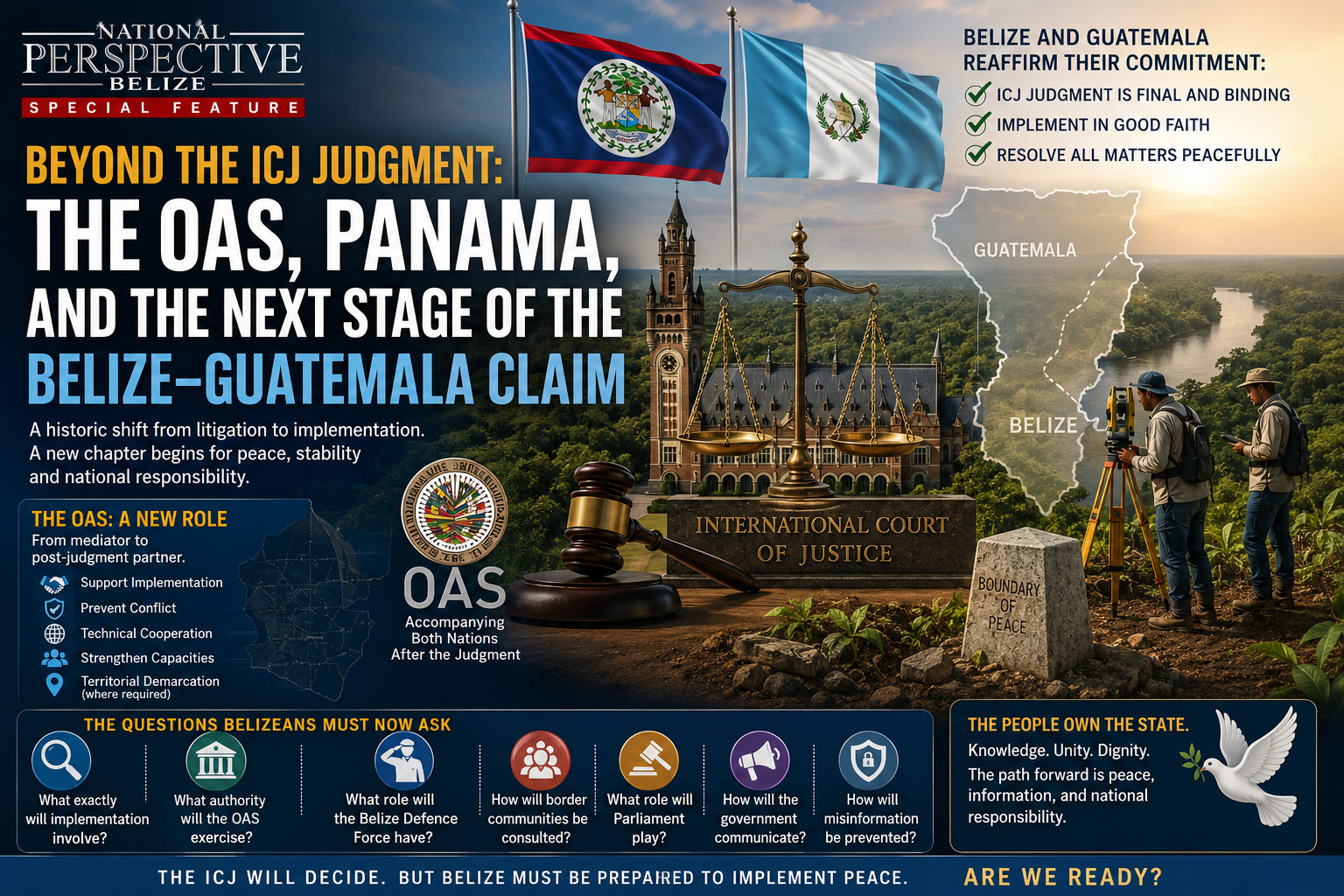
BEYOND THE ICJ JUDGMENT: THE OAS, PANAMA, AND THE NEXT STAGE OF THE BELIZE–GUATEMALA CLAIM
SPECIAL FEATURE
Belize City: 30th June 2026: The Joint Declaration issued by Belize and Guatemala in Panama on June 24, 2026, is not an ordinary diplomatic statement. It is one of the clearest signs yet that both countries are now preparing not only for the judgment of the International Court of Justice, but for the difficult and sensitive process that must follow after the Court speaks.
For years, Belizeans were told that the ICJ would decide the territorial, insular and maritime claim. That remains true. But what Panama now reveals is that the judgment itself will not be the end of the matter. It will open a new phase: implementation, explanation, demarcation where necessary, public reassurance, and peace management.
The Declaration was signed in Panama City during the Fifty-Sixth Regular Session of the OAS General Assembly. Belize and Guatemala reaffirmed their duty to accept the ICJ decision as final and binding, and to comply with and implement it fully and in good faith.
That wording must not pass unnoticed.
It means both governments have publicly committed themselves not only to respect the Court’s decision, but to carry it out.
THE OAS IS MOVING FROM MEDIATOR TO POST-JUDGMENT PARTNER
For more than two decades, the Organization of American States has helped maintain peace and confidence between Belize and Guatemala, especially through its Office in the Adjacency Zone. In Panama, both countries recognized that role and asked the OAS to remain involved.
But the requested role is now broader.
The Declaration asks the OAS to support conflict prevention, verification of incidents, resource mobilization, the Binational Commission, implementation of existing agreements, and the development of national and bilateral capacities for the implementation of the judgment, including territorial demarcation.
This is the heart of the matter.
- The OAS will not decide the case. The ICJ will do that.
- The OAS will not rewrite the judgment. The Court’s ruling will stand.
But the OAS is being positioned as a facilitator and accompanying partner in the sensitive period after judgment.
WHY THE WORD “DEMARCATION” MATTERS
The word demarcation is politically sensitive, but it must be explained honestly.
Demarcation does not automatically mean Belize will lose territory. It does not automatically mean Guatemala will gain territory. It means that if the Court’s judgment requires physical, legal, technical, or cartographic clarification of boundaries, the two countries must have a process to mark, verify, and implement that outcome.
That may involve surveyors, maps, coordinates, border markers, military coordination, local community engagement, and international observation.
This is why Belizeans must be prepared with knowledge, not fear.
The danger is not the word demarcation. The danger is a population left uninformed until the process is already upon them.
THE QUESTIONS BELIZEANS MUST NOW ASK
The most important part of Panama is not simply what the governments signed. It is what the people of Belize must now understand.
First, what exactly will implementation involve?
- The government must explain whether implementation will be purely legal, technical, administrative, territorial, maritime, or a combination of all these. Belizeans must not be left to guess.
Second, what authority will the OAS exercise?
- The people must understand that the OAS is not a court and not a government over Belize. Its role, according to the Declaration, is facilitating and accompanying the parties, based on what Belize and Guatemala agree and require.
Third, what role will the Belize Defence Force have?
- If demarcation, verification, or confidence-building continues near the border, the BDF’s role must be clearly explained. National security cannot be treated as an afterthought.
Fourth, how will border communities be consulted?
- The people living closest to the Adjacency Zone must not be the last to know. They are the citizens most exposed to uncertainty, misinformation, fear, and political manipulation.
Fifth, what role will Parliament play?
- If any laws, budget allocations, institutional mandates, or national security measures are required after the judgment, Parliament must not behave like a rubber stamp. This is a national matter, not a party matter.
Sixth, how will the government communicate with the people?
- There must be a national public education process before the judgment, not panic management after the judgment.
Seventh, how will misinformation be prevented?
- The ICJ decision will be technical. Political actors, social media opportunists, and foreign interests may attempt to twist its meaning. Belize needs a credible national information mechanism that explains the judgment in plain language.
THE PEOPLE MUST OWN THE PEACE
The government governs. Institutions administer. But the people own the State.
That principle must guide Belize in the post-ICJ era.
The Belizean people were asked to vote in a referendum. They were asked to trust a legal process. Now they must be respected enough to receive clear, continuous, and honest explanations of what comes next.
The Panama Declaration tells us that both governments are already planning for the day after the judgment. Therefore, Belize must not wait until that day to educate its citizens.
NATIONAL PERSPECTIVE VIEW
National Perspective Belize believes that this matter must be treated with sobriety, maturity, and national responsibility.
No political party should exploit the ICJ judgment for partisan gain. No government should hide behind diplomatic language. No opposition should inflame public fear for political advantage.
Belizeans deserve the truth.
The ICJ judgment will be final and binding. The implementation process may be delicate. The OAS will likely remain involved. Demarcation may become part of the technical conversation. Border communities must be protected. Parliament must be informed. The people must be educated.
Panama did not end the Belize–Guatemala dispute.
Panama signalled that the next stage has already begun.
And the central question is no longer only: What will the ICJ decide?
The greater question now is:
IS BELIZE PREPARED TO IMPLEMENT PEACE WITH KNOWLEDGE, UNITY, AND NATIONAL DIGNITY?
- Log in to post comments