When Law Becomes Politics: The Dangerous Manipulation of Belize’s Maya Land Rights Debate
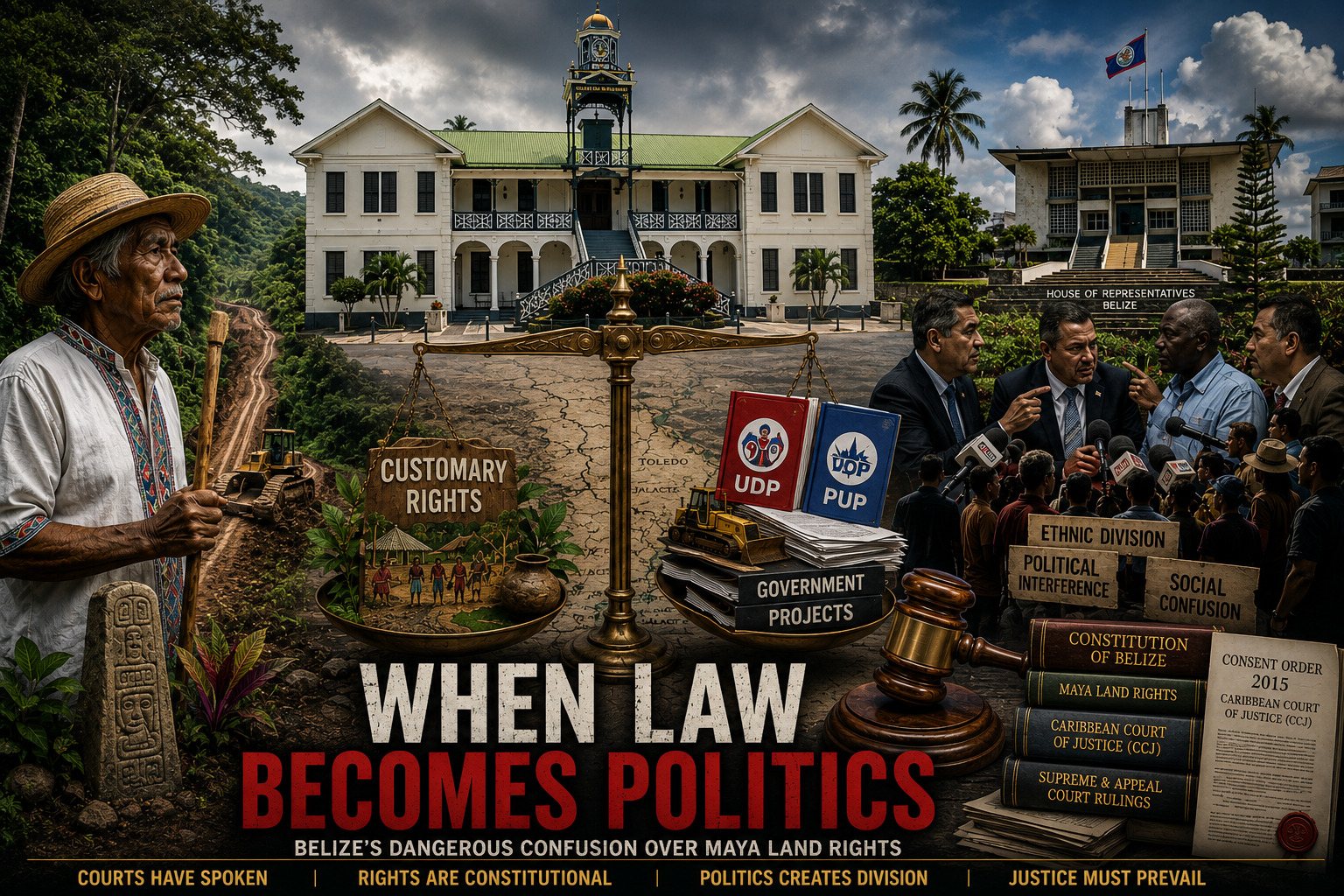
Belize City: Wednesday, 27th May 2026: One of the greatest dangers facing Belize today is not merely political interference itself, but the deliberate mixing of constitutional law, ethnicity, partisan narratives, economic fear, and social division into issues that courts have already repeatedly clarified through due legal process.
The ongoing Maya customary land rights matter is becoming a textbook example of how governments and political actors can muddy a legal issue so thoroughly that the wider population begins to lose sight of what the courts have actually ruled.
And that confusion is dangerous.
Because what should fundamentally remain a constitutional and legal matter is increasingly being dragged into the arena of political tribalism, ethnic suspicion, and manufactured national anxiety.
The Courts Have Already Spoken Repeatedly
The first reality Belizeans must understand is this:
The Maya land rights issue did not emerge yesterday.
Nor was it created through political activism alone.
This matter has moved through years — indeed decades — of litigation through Belize’s judicial system, including:
- The Supreme Court,
- The Court of Appeal,
- and ultimately the Caribbean Court of Justice (CCJ).
At every major stage, courts have consistently recognized that Maya customary land tenure gives rise to constitutionally protected property rights.
This is no longer speculative theory.
It is established jurisprudence.
And yet, despite this repeated judicial clarification, segments of the political establishment continue approaching the issue as though it remains merely a political debate open for manipulation depending on electoral convenience.
That is where the danger begins.
The PUP Government’s Delicate Balancing Act
The current People's United Party administration now finds itself attempting to walk a deeply complicated political tightrope.
On one side lies Belize’s constitutional obligations and international legal commitments regarding indigenous rights.
On the other lies growing anxiety among various ethnic groups, landholders, farmers, developers, political supporters, and communities who fear uncertainty about land ownership, access, or future economic implications.
Instead of confronting these concerns with mature constitutional education and transparent legal explanation, what often emerges is political ambiguity.
And ambiguity creates fear.
Fear then becomes fertile ground for ethnic narratives, misinformation, and social division.
Ethnicity Is Being Used to Distort a Legal Matter
One of the most troubling developments is the gradual reframing of the Maya land rights issue as though it were an “ethnic competition” within Belize.
That framing is profoundly misleading.
The courts are not granting “racial superiority.”
They are recognizing historical customary tenure systems that predate the modern Belizean state and which fall under constitutional property protections.
That distinction matters enormously.
Because once the issue is politically reframed into “one ethnic group receiving special treatment,” public understanding collapses into resentment rather than constitutional reasoning.
This becomes especially dangerous in Belize’s fragile multi-ethnic society, where historical coexistence has generally remained peaceful despite social inequalities and political manipulation.
Now the discourse risks drifting toward:
- “Who owns Belize?”
- “Who has more rights?”
- “Which ethnicity benefits?”
- “Who loses economically?”
Those are politically combustible narratives.
And once governments allow constitutional matters to become ethnicized, the nation itself begins to fracture emotionally and socially.
A Failure of National Leadership
The deeper failure here is not necessarily the existence of disagreement.
Disagreement in a democracy is natural.
The failure lies in the inability — or unwillingness — of leadership to clearly explain the constitutional realities already established by the courts.
Instead of educating the nation on:
- what customary land rights actually mean,
- where they apply,
- what protections exist,
- what limitations exist,
- and how national development can coexist with indigenous rights,
the issue often becomes buried beneath political soundbites and selective narratives.
That vacuum then becomes filled by rumour, fear, and manipulation.
Economic Fear Is Also Being Weaponized
Another layer of confusion involves the economy.
Some sectors now quietly promote fears that recognition of Maya land rights will:
- halt development,
- discourage investment,
- freeze agriculture,
- obstruct infrastructure,
- or create uncertainty over private property.
But those fears are often exaggerated beyond legal reality.
No serious constitutional democracy can sustainably pursue development by ignoring established property rights — whether private, communal, or indigenous.
In fact, long-term investment stability usually improves when land frameworks become legally clear and transparent.
The real threat to investment is not indigenous rights themselves.
The real threat is governmental inconsistency, political interference, weak implementation mechanisms, and prolonged uncertainty.
Investors fear instability more than legality.
And Belize’s inability to consistently implement court decisions creates precisely that instability.
Judicial Authority Must Mean Something
Perhaps the most dangerous aspect of all is what happens when repeated court rulings are treated politically rather than institutionally.
Because if:
- Supreme Court judgments,
- Court of Appeal rulings,
- and CCJ decisions
can all become subject to endless political reinterpretation, delay, or selective implementation, then public confidence in the rule of law begins to erode nationally.
The Maya land rights issue therefore transcends Toledo.
It now touches the credibility of Belize’s entire constitutional order.
A country cannot claim to uphold democracy while simultaneously treating binding constitutional rulings as negotiable political inconveniences.
Belize Needs Calm Constitutional Clarity — Not Ethnic Agitation
Belize stands at a sensitive moment.
The nation does not need inflammatory rhetoric from any side.
Nor does it need political opportunism disguised as patriotism.
What Belize desperately needs is:
- constitutional clarity,
- legal transparency,
- structured implementation,
- social dialogue,
- and mature leadership capable of calming fears rather than exploiting them.
Because once constitutional disputes become racialized and politically weaponized, nations enter dangerous territory from which recovery becomes difficult.
Final Reflection
The Maya land rights issue should never have been allowed to descend into confusion between ethnicity, politics, economics, and constitutional law.
The courts have repeatedly established the legal foundation.
The real challenge now lies in whether Belize’s political leadership possesses the integrity and statesmanship to implement those realities responsibly without turning communities against each other.
History will not judge Belize merely by how it developed land.
History will judge Belize by whether it preserved justice while doing so.
By Omar Silva -Editor/Publisher
National Perspective Belize – Digital
- Log in to post comments