THE BORROWING STATE: WHEN GOVERNMENT MUST BORROW TO GOVERN
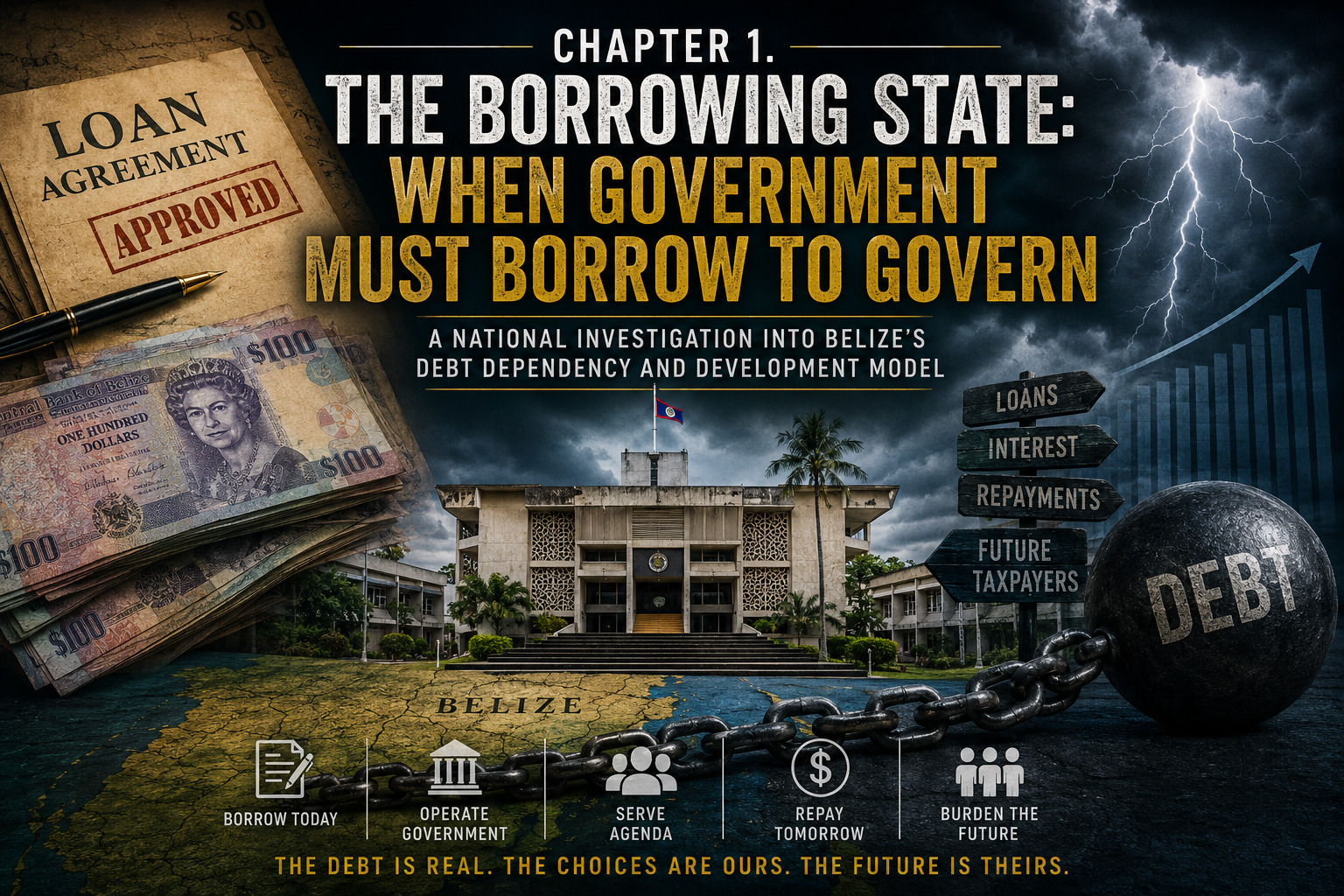
Belize is told that the economy is stronger, the debt burden is falling and fiscal stability has returned. Then why does another loan seem to accompany almost every new Government initiative?
Part: 1
Belize City: Monday 24th August 2026: There comes a point when a country must stop celebrating the announcement of financing and begin asking a much harder question:
WHY ARE WE BORROWING THE MONEY IN THE FIRST PLACE?
Belizeans have become accustomed to the language.
- US$8 million approved.
- US$20 million secured.
- US$40 million mobilized.
- Financing agreement signed.
- Development partner engaged.
- Concessional facility obtained.
Every announcement is presented as progress.
But borrowing is not development.
- Borrowing is financing.
Development is what remains after the money has been spent.
- And those are two entirely different things.
ANOTHER US$8 MILLION — THIS TIME TO IMPROVE GOVERNMENT ITSELF
On June 26, 2026, the Inter-American Development Bank approved an US$8 million sovereign-guaranteed loan for Belize's Support to Civil Service Modernization programme.
Belize will contribute another US$1 million, bringing the programme's total cost to US$9 million — approximately BZ$18 million.
The official objective?
To “improve the efficiency of the central government's wage bill” and strengthen strategic management of public employment.
Read that again.
Belize is not borrowing this US$8 million to construct a bridge.
- Not to establish a manufacturing complex.
- Not to build an agricultural processing plant.
- Not to construct a hydroelectric facility.
- Not to establish an export industry capable of generating foreign exchange.
We are borrowing money to improve the administration of Government's own employment and payroll machinery.
That may be necessary.
The reforms may even prove valuable.
But the existence of the need should make Belize pause.
Because this is not merely another loan.
It is a window into a much larger question about the financial architecture of the Belizean State.
HOW DID GOVERNING ITSELF BECOME SOMETHING BELIZE MUST BORROW MONEY TO IMPROVE?
The IDB says the programme will introduce an integrated Human Resources Management Information System, strengthen payroll controls, improve workforce planning and support compensation reforms.
Those sound like entirely reasonable objectives.
But Belizeans should separate two questions that Government announcements frequently blend together.
Question One: Is the reform useful?
Possibly yes.
Question Two: Why must Belize assume another sovereign financial obligation to carry it out?
That question is considerably more uncomfortable.
Because if every weakness in the machinery of Government requires another externally financed programme to correct it, then we are dealing with something larger than the individual project.
- We are confronting structural dependency on borrowed development capacity.
THE CONTRADICTION BECOMES DIFFICULT TO IGNORE
- Government and international institutions have repeatedly emphasized Belize's improved fiscal position.
The World Bank stated in May 2026 that public debt had fallen from approximately 103% of GDP to around 62%, while highlighting economic recovery and the Government's reform programme.
The IMF likewise recorded a substantial decline in Belize's public-debt ratio and projected continued gradual reductions over the medium term.
That achievement should be acknowledged.
Belize did emerge from an extraordinarily dangerous debt position.
But now comes the question that deserves far more national attention:
IF OUR FISCAL POSITION HAS IMPROVED SO DRAMATICALLY, WHY DOES OUR DEVELOPMENT MODEL STILL APPEAR SO DEPENDENT ON BORROWING?
Those two realities are not necessarily contradictory.
- A country can lower its debt-to-GDP ratio while continuing to contract new debt.
- Economic growth expands the denominator.
- Old liabilities can be restructured.
- Debt can be refinanced.
- Government can produce primary surpluses.
- Concessional financing can replace more expensive financing.
All of that can improve a country's debt indicators.
But none of it automatically answers another question:
- Has Belize increased its capacity to finance its own transformation?
- That is a fundamentally different measurement of national economic strength.
WE MUST STOP CONFUSING ACCESS TO CREDIT WITH WEALTH
A person who qualifies for another bank loan has demonstrated creditworthiness.
- He has not necessarily become wealthy.
The same principle applies to countries.
International institutions being willing to lend Belize money may indicate increased confidence in Belize's ability to repay.
That is important.
But it does not necessarily demonstrate that Belize has developed the productive assets necessary to finance development internally.
And there lies the danger of the narrative.
Every new loan can be announced as evidence that Belize has attracted another development partner.
But from the citizen's side of the ledger, there remains another description:
BELIZE HAS ACQUIRED ANOTHER OBLIGATION?
The quality of that obligation therefore depends entirely upon what Belize receives in return.
NOT ALL DEBT IS BAD DEBT
This distinction is essential.
A serious national examination cannot simply declare:
- “Loans are bad.”
That would be economically childish.
- Countries borrow.
- Businesses borrow.
- Families borrow.
- Some of the world's wealthiest governments maintain enormous sovereign-debt markets.
The proper question is:
WHAT ARE YOU BORROWING TO CREATE?
- Borrow BZ$100 million for an energy project that saves Belize BZ$300 million in imported electricity over its life?
That could be exceptionally intelligent borrowing.
- Borrow to construct irrigation and agro-processing infrastructure that dramatically increases exports?
Potentially transformational.
- Borrow to build productive ports, logistics systems, water infrastructure or resilient infrastructure whose economic benefits exceed their financing cost?
Again, entirely defensible.
Even administrative modernization can be economically justified if it generates measurable savings exceeding its cost.
But then show us the return.
THAT MUST BECOME THE NEW NATIONAL STANDARD
For every significant Government loan, Belizeans should be told:
- How much are we borrowing?
- At what interest rate?
- For how many years?
- What is the grace period?
- What will the total repayment be?
- What precisely will the money purchase?
- What measurable economic or social return is expected?
- What permanent asset will Belize possess when the programme ends?
- How much annual expenditure will it save?
- How much new revenue will it generate?
- How much foreign exchange will it earn or save?
And finally:
WILL OUR CHILDREN INHERIT AN ASSET — OR SIMPLY THE REPAYMENT SCHEDULE?
- That should not be considered anti-government.
- That is elementary stewardship of public money.
THE NUMBERS ALREADY TELL US WHY THE QUESTION MATTERS
World Bank debt statistics show Belize's total external debt at approximately US$1.559 billion in 2024, including roughly US$1.399 billion in public and publicly guaranteed external debt.
- Of that public and publicly guaranteed external debt, approximately US$540 million was owed to multilateral institutions.
This means institutions such as the IDB, World Bank and other multilateral lenders are not peripheral actors in Belize's development architecture.
They are deeply embedded in it.
Again, that is not automatically sinister.
- Multilateral loans can offer better interest rates, longer maturities and stronger technical support than commercial borrowing.
- But dependence can be inexpensive and still be dependence.
- And that is the distinction Belize must begin confronting.
BECAUSE THIS IS NOT EVEN OUR FIRST LOAN TO MODERNIZE GOVERNMENT
This deserves particular attention.
The current US$8 million Civil Service Modernization programme is not Belize's first recent IDB-backed loan involving the machinery of Government.
In September 2021, the IDB approved another US$8 million loan entitled Strengthening Public Expenditure Management in Belize, whose stated objective was to promote Belize's fiscal sustainability.
So now the question becomes even more legitimate.
- One US$8 million programme to strengthen public expenditure management.
- Another US$8 million programme to modernize the Civil Service and improve wage-bill efficiency.
- That is US$16 million in these two IDB lending operations alone associated substantially with improving how the State manages itself.
And therefore:
AT WHAT POINT DOES INSTITUTIONAL REFORM BECOME INSTITUTIONAL CAPACITY?
- How many modernization programmes must be financed before Government becomes modern?
- How many expenditure-management programmes must be undertaken before expenditure is effectively managed?
- How many consultants?
- How many assessments?
- How many digital systems?
- How many implementation units?
- How many technical-assistance programmes?
- And how many loans?
These are not accusations.
They are questions that every country financing reforms through sovereign debt should be prepared to answer.
THE DEBT MAY FALL — WHILE THE DEPENDENCY REMAINS
This is perhaps the most important distinction of this entire discussion.
The Briceño administration can legitimately point to a much lower debt-to-GDP ratio than the one it inherited during the pandemic crisis.
That is one measurement.
But National Perspective Belize is asking another:
- How much of Belize's development agenda can Belize now finance from the productive strength of Belize itself?
- Because true fiscal transformation cannot mean merely becoming a better borrower.
Eventually it must mean becoming a stronger producer.
- A country does not escape dependency simply because creditors regard it as safer.
It escapes dependency when its economy creates sufficient productive wealth to reduce the frequency with which development itself must be financed by creditors.
THE GOVERNMENT WAGE BILL MAKES THIS PARTICULAR LOAN EVEN MORE REVEALING
According to the IDB, Belize's growing government wage bill is constraining resources that could otherwise be directed toward infrastructure, education and health.
That sentence deserves to be translated into ordinary language.
- Money being consumed by the machinery of Government is reducing the money available for national development.
- Government therefore borrows money to improve the efficiency of the machinery consuming that money.
That is the circle Belize must break.
Because the ultimate objective cannot simply be:
Borrow → Reform → Borrow → Modernize → Borrow → Expand → Borrow → Reform Again.
The objective must eventually become:
REFORM → SAVE → PRODUCE → INVEST → GROW → FINANCE MORE OF OUR OWN DEVELOPMENT.
Otherwise, modernization becomes another recurring expenditure financed through another generation of borrowing.
BZ$18 MILLION MUST PRODUCE A RESULT BELIZEANS CAN SEE
When this Civil Service Modernization programme reaches maturity, Government should not be permitted to measure success primarily by saying:
- A new system was implemented.
- Training was completed.
- Consultants were engaged.
- Workshops were held.
- Policies were developed.
- Studies were conducted.
- Reports were submitted.
Those are activities.
They are not outcomes.
For approximately BZ$18 million in total programme expenditure, Belizeans deserve measurable answers.
- How much did the wage bill save?
- How many payroll irregularities disappeared?
- How much overtime expenditure was reduced?
- How much administrative duplication was removed?
- How much faster did government services become?
- How much public money was redirected into infrastructure, health or education because of those savings?
That is the return Belize must demand.
Because eventually the only meaningful measurement of reform is:
WHAT CHANGED?
AND NOW WE ARRIVE AT THE THUNDEROUS QUESTION
- For years Belizeans have watched administrations announce loans as achievements.
Perhaps it is time to reverse the perspective.
Instead of asking only:
- “How much financing did Government secure?”
Belize should begin asking:
- WHY DID BELIZE HAVE TO BORROW IT?
And then:
- WHAT WILL BELIZE OWN WHEN IT IS REPAID?
Because a nation cannot measure its economic transformation by the number of institutions willing to lend it money.
It must measure transformation by what those borrowed dollars enable the country to build, produce, export, save and eventually finance for itself.
That is where our examination now begins.
- Not with condemnation.
- Not with partisan slogans.
- But with a ledger.
- A very large ledger.
On one side:
- WHAT BELIZE BORROWED.
On the other:
- WHAT BELIZE BUILT.
And somewhere between those two columns lies the real economic story of the Briceño administration.
THE BORROWING STATE HAS NOW ENTERED THE AUDIT ROOM.
To be continued: The Briceño Borrowing Ledger — tracing the major loans, lenders, purposes and promised returns from November 2020 to August 2026.
By: Omar Silva: Editorial Director @ www.nationalperspectivebz.com
- Log in to post comments