THE COST OF POWER OR THE COST OF THE SYSTEM? Belizeans Are Being Asked to Pay More. They Deserve to Know Why.
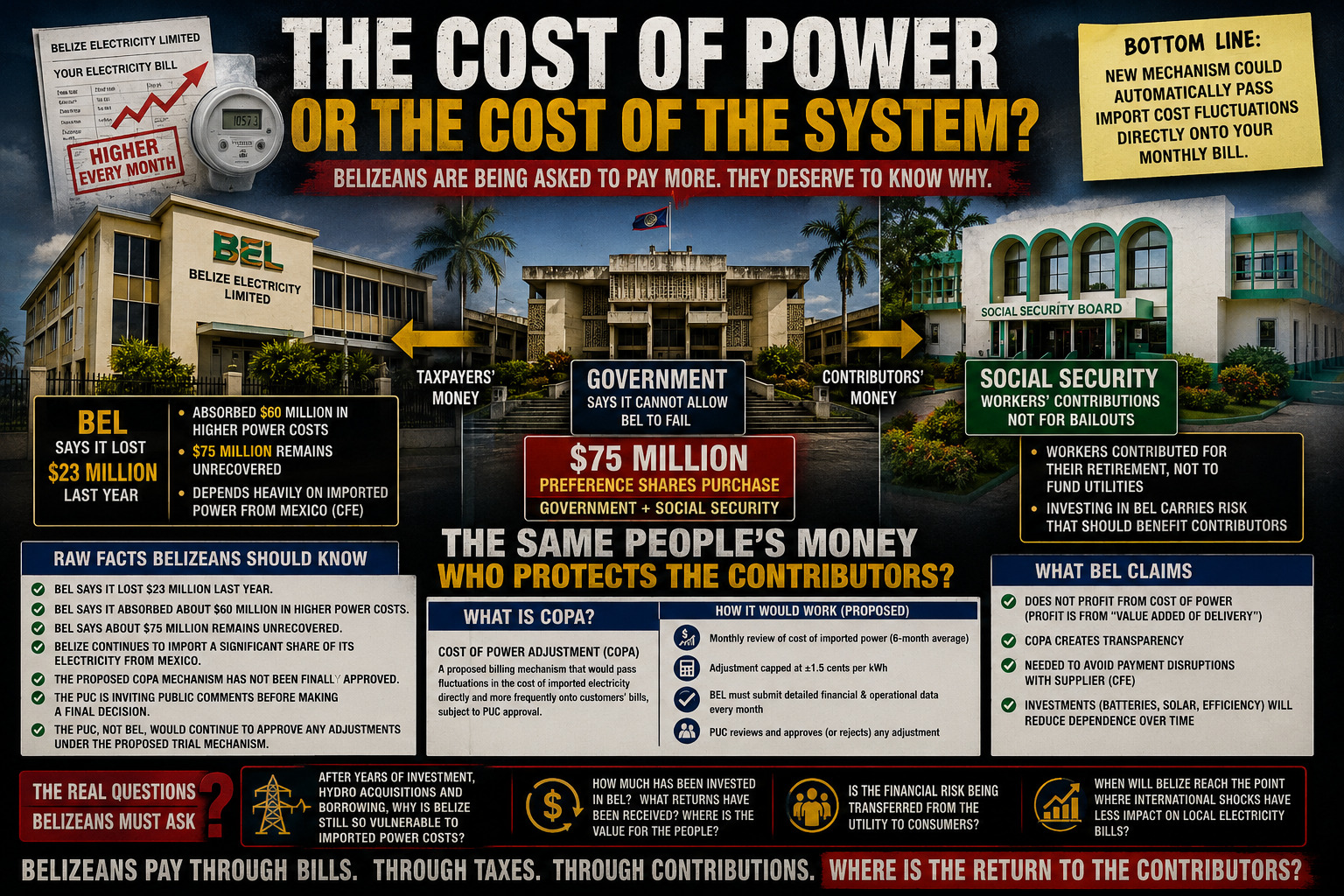
Belize City:Monday 6th July 2026: The latest announcement from the Public Utilities Commission (PUC) and Belize Electricity Limited (BEL) should concern every Belizean household—not because your bill is increasing today, but because it could fundamentally change how electricity costs are passed on in the future.
BEL calls it the Cost of Power Adjustment (COPA).
The PUC calls it a Regulatory Sandbox.
For the average Belizean, however, the question is much simpler:
- Who bears the financial risk when the cost of electricity rises?
Under the proposed mechanism, fluctuations in the cost of imported electricity would be reflected more frequently in consumers' bills, subject to PUC oversight during the trial period.
BEL argues this is about transparency and financial stability.
The PUC insists it is maintaining regulatory control.
Both may be true.
But neither explanation answers the broader questions Belizeans should now be asking.
The Facts
- BEL says it lost approximately $23 million last year.
- BEL says it absorbed approximately $60 million in higher power costs.
- BEL says approximately $75 million remains unrecovered.
- BEL says Mexico's electricity prices fluctuate dramatically.
- BEL says the company faced moments when its supplier warned that power could be disconnected if payments were not made.
These are significant statements.
But they naturally lead to equally significant questions.
The Questions Belizeans Deserve Answered
- If BEL has been partially publicly owned since 2009...
- If Government has invested repeatedly...
- If hydroelectric assets have been acquired...
- If infrastructure has been expanded...
- If millions have been borrowed...
- If another $75 million in public investment is now proposed...
Why does Belize still remain so vulnerable to imported electricity costs?
That is not a political question.
It is a strategic question.
Ownership Is Not the Same as Energy Security
The public has heard for years about:
- National ownership.
- Hydro acquisitions.
- Infrastructure investment.
- System modernization.
Yet BEL itself says Belize continues to depend heavily on imported electricity.
If imported electricity remains the determining factor in consumer prices, then Belizeans have every right to ask:
How much progress has actually been made toward genuine energy sovereignty?
Who Carries the Risk?
When international fuel prices rise...
- Consumers pay.
When imported electricity becomes expensive...
- Consumers may pay.
When exchange costs increase...
- Consumers may pay.
When BEL experiences unrecovered power costs...
- Consumers may eventually pay.
This raises an important public policy question.
- Is the financial risk increasingly being transferred from the utility to the consumer?
That is precisely why the proposed COPA deserves careful public scrutiny before becoming permanent.
Transparency Must Work Both Ways
- BEL says the mechanism creates transparency.
Transparency should not stop with monthly adjustments.
Consumers also deserve transparency about:
- How much power Belize imports.
- How much locally generated power costs.
- The financial performance of hydro assets.
- Returns on public investment.
- Long-term plans to reduce dependence on imported electricity.
- The expected timeline toward greater energy independence.
Without those answers, consumers see only one side of transparency—the side that appears on their monthly bill.
Beyond Monthly Bills
BEL argues that it does not profit from the cost of power itself and that its profits come from delivering electricity efficiently.
That distinction is important.
But for most Belizeans, the monthly bill is what matters.
Consumers judge the system by what they pay.
Businesses judge the system by whether electricity makes them more or less competitive.
Families judge the system by whether they can afford to keep the lights on.
The National Question
- The debate is no longer simply about COPA.
- The debate is about Belize's energy strategy.
After years of public investment, hydro acquisitions, infrastructure borrowing and expanded government ownership, Belizeans deserve to know:
- When will the country reach the point where international energy shocks have less impact on local electricity bills?
Because if every global crisis—from wars to shipping disruptions to fuel prices—continues to flow directly into Belizean households, then the larger question remains unanswered.
Has Belize built an energy system that protects consumers, or one that increasingly passes global risks on to them?
That is the conversation Belize should now be having.
By: Omar Silva - Editor/Publisher
National Perspective Belize
- Log in to post comments