THE DOCTRINE OF INSTITUTIONAL INTERDEPENDENCE: Why a State Is an Organism, Not a Machine of Disconnected Parts
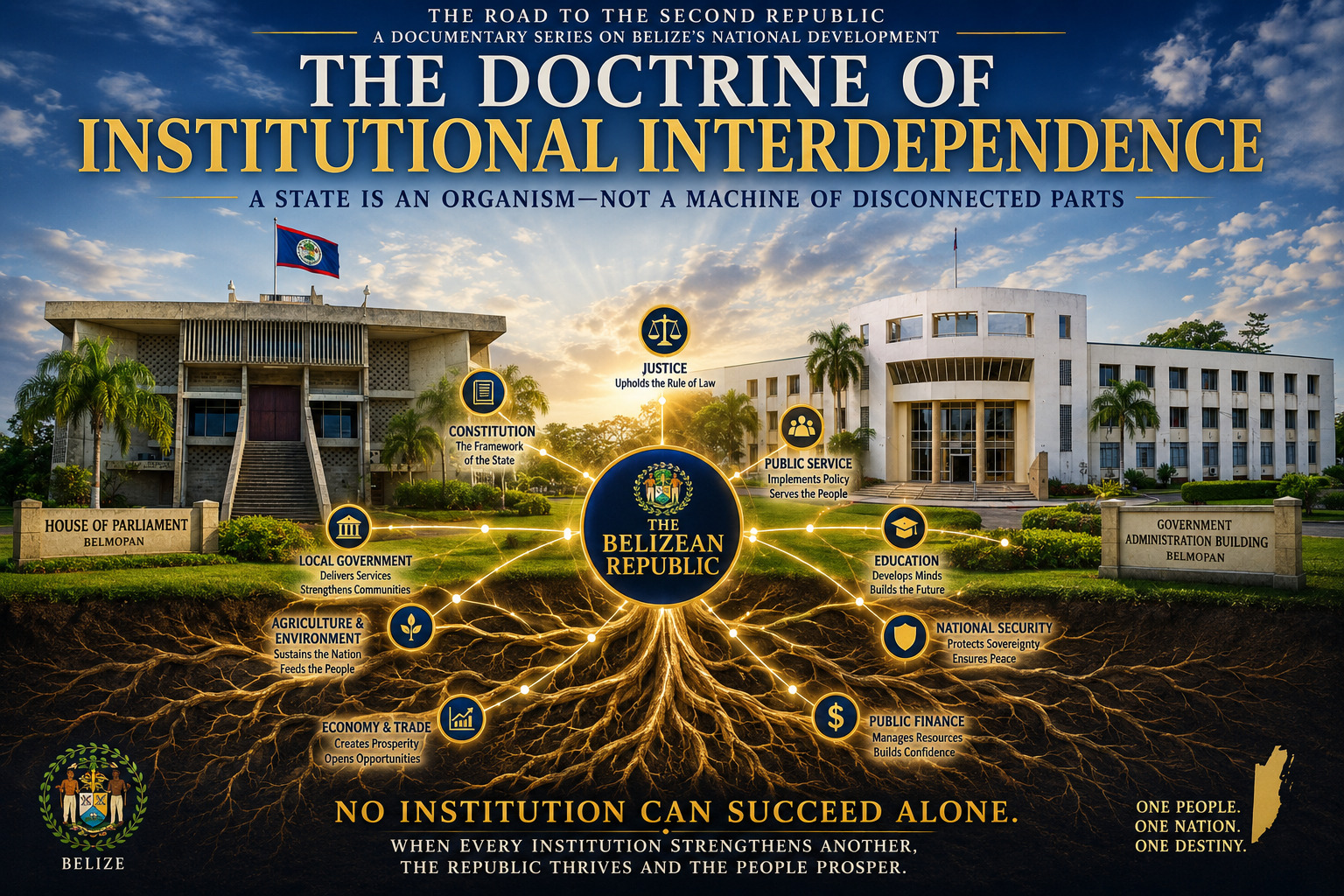
THE ROAD TO THE SECOND REPUBLIC
A Documentary Series on Belize's National Development: Volume IV
By: Omar Silva - Editor/Publisher
National Perspective Belize
Belize City: Tuesday 7th July 2026: For generations, governments have been examined ministry by ministry, department by department, and crisis by crisis.
- When procurement fails, procurement laws are amended.
- When crime rises, policing strategies are revised.
- When the economy weakens, fiscal measures are introduced.
- When education struggles, curricula are rewritten.
- When healthcare comes under pressure, additional resources are allocated.
- Each response seeks to improve one institution.
- Each reform addresses one problem.
- Each solution is developed largely within the boundaries of one ministry or one department.
Yet despite decades of reform, many of the same structural challenges continue to reappear.
This recurring pattern invites a deeper question.
What if the problem is not merely the performance of individual institutions?
What if the challenge lies in the relationship between the institutions themselves?
This volume introduces what National Perspective Belize describes as The Doctrine of Institutional Interdependence.
It begins with a simple proposition.
A State is an interconnected institutional organism—not a machine of disconnected parts.
Like the organs of the human body, every institution of government performs a distinct function while depending upon the health and proper functioning of every other institution.
- The Constitution provides the framework within which government operates.
- The Legislature creates the laws.
- The Executive administers them.
- The Judiciary interprets and safeguards them.
- The Public Service implements public policy.
- The Auditor General verifies accountability.
- Oversight institutions protect integrity.
- Local government delivers services closest to the citizen.Economic policy influences employment.
- Education shapes the future workforce.
- National security protects sovereignty.
None of these institutions exists in isolation.
Each influence—and is influenced by—the others.
A weakness in one eventually creates pressure throughout the whole constitutional body.
That reality explains why isolated reforms often produce only temporary improvement.
- A procurement system may become more efficient while political accountability remains weak.
- Financial controls may become stronger while institutional independence remains fragile.
- Economic reforms may succeed while education fails to produce the skills required for sustained growth.
The result is not lasting renewal.
- It is recurring adjustment.
This doctrine therefore distinguishes between institutional reform and systemic transformation.
Institutional reform seeks to improve the performance of individual components.
Systemic transformation seeks to strengthen the relationships between those components so that the State functions as one coherent constitutional organism.
This distinction is fundamental.
- A nation is not governed ministry by ministry.
It is governed system by system.
- No ministry succeeds entirely on its own.
- No institution fails entirely on its own.
The health of the State depends upon the health of the whole.
That is why every major national challenge—whether corruption, public finance, economic development, healthcare, education, justice, or national security—should be understood not as isolated events but as expressions of an interconnected governance system.
- The future of Belize will therefore depend not only upon improving individual institutions but upon ensuring that those institutions reinforce one another through coherent constitutional design, professional public administration, democratic accountability, transparency, and citizen participation.
The Second Republic, if it is ever to emerge, will not be built by repairing one institution after another.
- It will be built by understanding how every institution contributes to the life of the nation as a single constitutional organism.
That is the Doctrine of Institutional Interdependence.
- Log in to post comments